
The Garden Shed
A Community Newsletter published by the Piedmont Master Gardeners
September 2019-Vol.5, No.9


For comments, questions or suggested topics for future Garden Shed articles contact us at: garden-shed@piedmontmastergardeners.org.
If you have specific gardening questions or need help to solve a gardening problem, our Horticultural Help Desk is a free community resource and can be contacted at 434-872-4583 or by email: albemarlevcehelpdesk@gmail.com.

Who We Are
We are members of the Piedmont Master Gardeners, which simply means we have all been trained to share the scientific expertise of Virginia Tech and the Virginia Cooperative Extension Service. More important, we are your friends and neighbors with a passion for gardening – and learning more about it. MORE
Table of Contents
Lawn
Responsible Lawn Management in the Era of Climate Change
Do we truly need that perfect turfgrass lawn?
Tasks and Tips
The Vegetable Garden in September
Now is the time to tidy up the summer garden and plant hardy leaf and root crops for late fall and early winter harvest
Tasks and Tips
September Tasks & Tips for the Ornamental Garden
Time to plant trees, shrubs, perennials and bulbs!
Upcoming Events
Celebrate PMG's 30th anniversary; enjoy Monticello's annual Heritage Harvest Festival; hike, tour a garden, take a class.
September Tasks & Tips for the Ornamental Garden

Japanese stiltgrass. Photo: NY State IPM Program, Cornell University
Is anybody out there as tired of pulling stiltgrass as I am? At least it’s easy to pull, and that seems to be its only saving grace. If you have some in your beds and it has not yet flowered and dropped seeds, I suggest you rush out and pull it while you still can. Check out the stiltgrass alert that’s currently appearing on the home page of Blue Ridge PRISM (Partnership for Regional Invasive Species Management), https://blueridgeprism.org.
Having spent the second half of August dealing with stiltgrass (the price you pay for a long vacation, apparently), I’m eager to turn to the fun tasks of fall. Fall is one of the best planting seasons, so get ready. It’s especially good for planting shrubs and trees, though if it’s still hot, delay for a week or two until weather is cooler. The ideal time is when the leaves begin to change color. For expert, detailed advice on planting trees, consult “Planting Trees,” Va.Coop.Ext., https://www.pubs.ext.vt.edu/content/dam/pubs_ext_vt_edu/426/426-702/426-702.pdf.
Water newly-planted trees and shrubs regularly throughout the fall. Check the soil near the roots once a week. If the soil near the trunk is dry, the tree needs water, and plenty of it, especially if there’s been no rain. If the soil near the trunk is moist, don’t over-water as that can kill a tree as surely as under-watering.
September is an excellent time to start dividing those perennials that need it, and the ideal time — adjusted somewhat for climate change — appears to be around the 2nd or 3rd week of September. “Dividing Perennials,” www.clemson.edu/extension/flowers
Fall is also the time to divide bulbs and plant new ones. This can be done anytime until the ground freezes.
Fertilize bulbs: Any time after your bulbs have finished blooming is a good time to fertilize them, but they may not need fertilizer if you regularly add organic matter, like compost, to your beds. But if your narcissus and other spring-blooming bulbs look like they’re not getting enough nutrients from the soil, you might consider fertilizing them lightly with a 5-10-10 fertilizer. Avoid high-nitrogen fertilizer (the N element, the first of the three numbers listed on the label).
For more detailed tips, see previous September issues of The Garden Shed: 2018, 2017, 2016 and 2015.
Happy gardening!
SOURCES:
Month-by-Month Gardening in the Mid-Atlantic, (Viette, 2004)
“September Tips: Lawns and Landscaping,” Va.Coop.Ext., https://albemarle.ext.vt.edu/content/dam/albemarle_ext_vt_edu/files/hort-tip-sheets/9-14-lawns-landscaping.pdf
Frost Dates, http://www.ncdc.noaa.gov/climatenormals/clim20supp1/states/VA.pdf
“Dividing Perennials,” http://www.clemson.edu/extension/hgic/plants/landscape/flowers/hgic1150.html
“Perennials: Culture, Maintenance and Propagation,” http://pubs.ext.vt.edu/426/426-203/426-203.html
“The Ornamental Garden in September, 2015,” http://pmgarchives.com/article/the-ornamental-garden-in-september/
“The Ornamental Garden in September, 2016,” http://pmgarchives.com/issue/september-2016/
“The Ornamental Garden in September, 2017,” http://pmgarchives.com/article/the-ornamental-garden-in-september-3/
Tea with Scones and Clotted Cream
Any self-respecting Anglophile would be familiar with ‘tea time’ but along with the tea must be the proper accompaniment. As we explore this tradition, I shall continue typing in the Queen’s English dialect and hope you dastardly, rebellious colonists can follow along. Shall we?

Photo: Charmaine Zoe
As for the accompaniment, you would traditionally have scones. (Leaving those Krispy Creme donuts for either bribing or apologizing at work.) Butter is quite universally accepted as dressing on your scone, refer to “The Lumberjack Song” by Monty Python. However for those who fancy themselves a bit more posh you would use jam, usually made with rrrrrrred frrruit. (Yes, I said that rrrright.)
The final condiment is the uniquely luxurious ‘clotted creme’ which we are making today. You will need an oven, a glass casserole pan, and 2-3 quarts of non-pasteurized heavy cream. (Pasteurized cream has already been heated and thus won’t work.) Simply preheat the oven to 200 degrees Fahrenheit. Place the pan into the oven on a middle rack and after the first hour, turn the power off and leave the pan sit overnight or for about 12 hours. Afterwards, collect the clotted cream from on top, place it into a jar, and save the remaining milk liquid for making your next batch of scones.
Scone recipe:
— Combine dry set into one bowl:
2 cups of flour
1/3 cup of sugar
1/2 tsp of salt
1/4 tsp of baking soda
1/2 cup of dried raisins, currants, or cranberries– Combine wet set in another bowl:
1 egg + 1/2 cup of milk leftover from the clotted cream.Combine everything by hand, pushing the dough into the side of the bowl until dough can hold its form. Form the dough into a circle, about one inch thick, then cut into triangles like a pizza or as desired. Place parchment paper on a cookie sheet, lightly dust with flour, and placing the triangles on the sheet, allow for a for about 3 inches in between each. Bake at 400°F on the low or middle rack for 15-17 minutes.* Note, I purposefully deferred discussing crumpets because I’ve found they have always gone moldy too fast and I prefer just buying English muffins, which are a much better product anyway, because they’re actually Made in ‘Merica!
And thus, I return you to your box set of Downtown Abbey and I shall bugger off for now. Cheers!
T.R. Wilson, Esquire
The Vegetable Garden in September
The arrival of September signals the vegetable gardener’s opportunity to urge surviving summer crops toward their final production while planting cool weather leaf and root crops for a late fall and early winter harvest.
Whether or not you are planting fall crops, it is a good time to perform garden hygiene, removing spent and diseased plants. Diseased material should be burned or bagged and removed, not composted. A thorough cleanup now will reduce pest problems next spring.
It is also a good time to plant cover crops in unused garden space. Cover crops bring several benefits including reduced erosion and soil compaction, weed suppression, adding organic matter, and in the case of legumes, fixing atmospheric nitrogen for plant use. There are a couple of basic choices in terms of types of crops: winter-killed and winter-hardy.
- Winter-killed cover crops die out after a few hard frosts, but their root and surface biomass help hold the soil and they are easy to till under in spring. Oats, field peas, oilseed radishes and rapeseeds are commonly used types.
- Winter-hardy cover crops can either grow through or go dormant in winter but resume growth in spring. They should be cut prior to going to seed, with the roots being tilled under and greens used as compost or mulch. Allow 2 or 3 weeks after tilling for decomposition to start prior to planting. Winter-hardy choices include winter rye, winter wheat, hairy vetch, Austrian winter peas and crimson clover.
More information on cover crops can be found in earlier Garden Shed articles including Cover Crops from September 2015 and Minimum Till Cultivation from the February 2019 issues.
Although we all get a bit worn down by the heat and work involved in keeping the garden going all summer, it is worthwhile to summon one last burst of energy to do some fall planting. With an average first frost date of October 19-29 for the Piedmont region, September provides enough time for many spring cool weather crops to mature before the harsher winter weather arrives. The VA Cooperative Extension Vegetable Planting Guide provides a lot of information. In a nutshell, possibilities for planting in early September include beets, endive, kale, collards, lettuces, mustard, radishes, spinach and turnips. The last six items should be ok if planted up through the end of the month. If you haven’t done much fall gardening, you should give it a try. It is very satisfying to continue the harvest into early winter, and many of the mid-summer pest and disease problems are reduced (weeds excepted of course), especially after the first frost.
Here is some further guidance for a strong finish to the gardening season:
Plant garlic in our area during the month of October. Remember, many retailers quickly exhaust their inventories of the most popular varieties before October. If you haven’t purchased garlic for fall planting, now is the time to do it. A few garden centers in our area sell garlic bulbs for fall planting, but the varieties are somewhat limited. However, there are many varieties and sources available on the web. For additional information, check out the article on growing great garlic in the October 2015 issue of Garden Shed.
Give your tomato plants one last feeding. Compost tea or fish emulsion should give them the extra energy they need to make that final push at the end of the season. Pinching off small green tomatoes and any new flowers will channel the plant’s energy into ripening the remaining full-size fruit.
Collect herbs from your herb garden for freezing and drying. If you don’t have access to a dehydrator, herbs can be dried quickly in a microwave oven. Simply place the herbs between two paper towels and heat for a minute. Remove them from the oven, cool, then test to see if the leaves are crisp. If not, return them to the microwave for a few more seconds. Store in sealed jars in a dark place so they will keep their color and flavor.
Pot up chives, parsley, and other herbs, and bring them into the house to extend the growing season.
If you’ve been lax in your garden documentation this year, tour your own vegetable garden and make notes on this year’s varieties, successes, challenges and chores, so that you can learn for next year. Make a sketch showing the location of this year’s plants to be used next spring for rotating your crops, an important pest and disease management practice.
Continue to weed your garden to prevent the weeds from going to seed and germinating over the winter and spring.
Remove all two-year-old canes from raspberry and blackberry plants to reduce overwintering of disease. Fertilizers containing potassium, phosphorus and magnesium or calcium can be applied but do not cultivate or irrigate at this time of the year.
Keep the strawberry patch weed free. Every weed you pull will help making weeding easier next spring.
Fall weed control around fruit trees is crucial because weeds act as hosts to overwintering insects.
Thanks for joining us in The Garden Shed — hope to see you again next month!
Sources:
“Gardening by Month–September,” Missouri Botanical Garden, http://www.missouribotanicalgarden.org/gardens-gardening/your-garden/help-for-the-home-gardener/advice-tips-resources/gardening-by-month/september.aspx
“Monthly Horticulture Tip Sheets — Herbs, September,” Va. Coop. Ext. Albemarle/Charlottesville, https://albemarle.ext.vt.edu/content/dam/albemarle_ext_vt_edu/files/hort-tip-sheets/9-14-herbs.pdf
“Monthly Horticulture Tip Sheets — Fruit and Nuts, September,” Va. Coop. Ext. Albemarle/Charlottesville, https://albemarle.ext.vt.edu/content/dam/albemarle_ext_vt_edu/files/hort-tip-sheets/9-14-fruits-nuts.pdf
Camassias
In September, we gardeners tend to think about planting spring-blooming bulbs. But before you plant another daffodil, there’s a native bulb that you should consider: camassia.
Haven’t heard of it? Well, it’s a stunner. From its tuft of grass-like foliage, it sends up a single tall raceme whose multiple blooms open from the bottom to the top of the raceme. And it blooms during the quiet time after the narcissus are fading, but before the summer flowers begin their show. Despite its dreamy colors — most are azure blue like mine — you rarely see it in local gardens.

Camas Prairie Centennial Park, Hill City, Idaho.
Photo: Charles Knowles
It is said that when Meriwether Lewis and William Clark first saw meadows of common camas (Camassia quamash) in the West, Lewis wrote, “The color of its bloom resembles lakes of clear water.” Meriwether Lewis was certainly not the last to remark on the glories of this spring bloomer. Here’s what a member of the Virginia Native Plant Society had to say about her first encounter with the Virginia native, Camassia scilloides:
Wild hyacinth (Camassia scilloides) is absolutely breathtaking, yet very few of us will ever see it growing naturally in Virginia due to its rarity. It is categorized by the Natural Heritage Program as an S1 (critically imperiled)—which is defined as a species at very high risk of extirpation from the state due to extreme rarity (often 5 or fewer populations), very steep declines, or other factors. Luckily for us, at least one population grows on protected property! Some VNPS members who attended the Cedars Appreciation Week were lucky enough to be at the right place at the right time to see wild hyacinth in flower.
https://www.facebook.com/VirginiaNativePlantSociety/posts/wild-hyacinth-camassia- scilloides-is-absolutely-breathtaking-yet-very-few-of-us-/1887510421280090/ . If you’d like to see this native camassia at the Cedars Natural Preserve in southwestern Virginia, check out https://www.dcr.virginia.gov/natural-heritage/natural-area-preserves/thecedars.
 The Camassia genus is a native of North America, but as noted above, only one species — Camassia scilloides — is native to Virginia. As indicated above, most of the camassia species are found in the western part of North America, especially the Northwest. Only one species — Camassia scilloides — is native to the eastern part of North America. Sadly, this species is found in only a few counties in the western part of Virginia and is considered to be “critically imperiled” in our state. http://explorer.natureserve.org/servlet/NatureServe?searchName=Camassia+scilloides. The name camassia comes from the Native American term for the plant: kamas or quamash. The genus Camassia was traditionally classified in the Liliaceae family, but has been moved to the asparagus family.
There are six recognized species of the Camassia genus in North America:
- Camassia quamash (common camas, quamash, Indian camas, small camas) – western Canada, western USA (CA OR WA NV ID MT WY UT); blooms are sky blue to deep blue
- Camassia leichtlinii (large camas, great camas), found in British Columbia, Washington, Oregon, northern California, and Nevada; blooms are white, cream, blue or purple with yellow anthers
- Camassia angusta (prairie camas), found in the southern Great Plains and mid-Mississippi Valley (TX OK LA AR MO KS IA IL IN); blooms are lavender to pale purple.
- Camassia scilloides (Atlantic camas, wild hyacinth, bear grass), found in eastern and central North America from Maryland to Georgia, westward to Texas and north into Ontario. Blooms are pale blue to white.
- Camassia cusickii (Cusick’s camas), found in Oregon and Idaho.
- Camassia howellii (Howell’s camas), found in southwestern Oregon.

Camassia leichtlinii ‘Blue Danube’ (large camas lily), Bonsai Museum exterior (BON-YAM-9, acc nr 63110-J), US National Arboretum
It’s worth noting that there seems to be some confusion about species and names in the nursery trade. For example, a number of bulb producers refer to Camassia quamash as Camassia esculenta. The flower bulb industry has developed and marketed a number of hybrids and selections, mostly in shades of blue, pink and white. For example, Camassia quamash `Orion’ has deep blue flowers. In the UK, the Avon Company has developed a mixed strain called the “Avon Stellar hybrids.” Gardeners’ World Magazine. Speaking of confusion, I must confess that I still haven’t figured out which species is growing happily in my beds!
The bulbs of several species of Camassia were a major element of the diet of the indigenous people of North America, even engendering trading among tribes. To learn more about this fascinating history, see “Common Camas,” USDA/Natural Resources Conservation Service, Plant Guide. But I’m not suggesting you add it to your diet! First of all, the plant is easily confused with a plant called death camas (Zigadenus venenosus), which is toxic enough to kill. Not only that, but the camassia bulbs can cause flatulence, as the explorers with Lewis and Clark discovered. In 1825, plant explorer David Douglas reported that:
Captain Lewis observes that when eaten in a large quantity they occasion bowel complaints. This I am not aware of, but assuredly they produce flatulence: when in the Indian hut I was almost blown out by strength of the wind.
So I’m not recommending camassias for edible landscaping!

Photo: Cathy Caldwell
I’ve found camassia to be remarkably easy to grow. It likes either full sun or partial shade. It prefers slightly acid humus-y soil, but will adapt to clay. And though it needs water while it’s actively growing in spring, nature generally supplies it at that time of year. My camassias bloom in late April. Subsequent periods of drought in summer — after it goes dormant — don’t seem to affect it at all. Camassia is generally not bothered by any pests or diseases. And I’m happy to say that deer and rodents leave it alone in my garden.
That all sounds good, but camassias have a couple features that you need to have in mind before you start digging holes. First, its grass-like leaves go dormant in the summer, so you’ll want other plants nearby that will fill in the gaps it leaves behind. The middle of the bed or border may be best, since plants in front and behind can fill in the empty spaces. Second, it is reportedly not fond of disturbance, though I’ve transplanted it successfully in my garden. And sadly, it blooms for a very short period of time. But its ephemeral nature seems to make me treasure it all the more.
Plant bulbs 4-6” deep and 6” apart in fall. Camassia can also be grown from seed, though the first blooms will not appear for 3 or 4 years after sowing.
Camassia bulbs multiply slowly, so you won’t find yourself needing to divide it often. Eventually, however, you may have such a big clump that you will want to divide it, which should be done in summer or fall when the bulbs are dormant. You can plant the little offset bulbs elsewhere in your garden; they’ll reach blooming size within 2 to 3 years.

Camassia leichtlinii ‘Blue Danube’ at Longwood Gardens. Photo: David J. Stang
I’m still working on companion plants for my camassias. They definitely should have a background so their blues can really sing. Since golden or chartreuse foliage provides a wonderful contrast to the blues of camassias, I’ve been trying to get them to nestle close to my Tradescantia ‘Sweet Kate’ but they don’t seem to like the same level of sun, so I’m going to try placing multiple bulbs in front of Spiraea thunbergii ‘Ogon’. Longwood Gardens in Pennsylvania has combined two species of Camassias with a number of plants in their beds, and I highly recommend their article — which contains inspiring photos, Longwood Gardens/blog/Fresh Spring Mix.
You’re probably wondering about the availability of camassia bulbs in the nursery trade. While it may be rare in garden centers, you’ll find it’s readily available among online purveyors of bulbs. So don’t hesitate to give this native bulb a try!
SOURCES:
“Camassia quamash,” Plant Database, https://www.wildflower.org/plants/result.php?id_plant=CAQU2
Ontario Rock Garden & Hardy Plant Society
“Common Camas,” USDA/Natural Resources Conservation Service, Plant Guide
“Camassia scilloides,” Missouri Botanical Garden, Plant Finder
“Camassia leichtlinii,” Missouri Botanical Garden, Plant Finder
“Camassia cusickii,” Missouri Botanical Garden, Plant Finder
“Camassia angusta,” Missouri Botanical Garden, Plant Finder
Upcoming Events
Celebrate the Piedmont Master Gardeners’ 30th Anniversary Event
“The Future of Our Landscapes in a Changing Environment”
Sunday, September 8
Paramount Theater, Charlottesville
3:00 p.m., Exhibitor tables, poster contest, and concessions
4:00 – 6:30 p.m., Program and Q/A Panel
The Piedmont Master Gardeners and Virginia Cooperative Extension celebrate a milestone — 30 years of volunteering, educating and working within the community. How can this work continue in a meaningful way? One way is to explore how local individuals and groups can mitigate climate change. Learn about global environmental trends and wide-ranging impacts in a narrated National Geographic photojourney. Adult tickets $10; ages 18 and under FREE. Purchase tickets at www.theparamount.net or 434-979-1333, M-F 10:00 a.m. – 2:00 p.m.
Tree Basics Class: Restoring the American Chestnut
Hosted by Charlottesville Area Tree Stewards
Tuesday, September 10, 2019
2:00 – 4:00 p.m.
Northside Library, 705 West Rio Road, Charlottesville
Tom Wild of the Charlottesville Area Tree Stewards presents a fascinating look at the rise and decline of the American Chestnut. Once dominant in the Appalachian region and vital for wildlife and humans alike, in the early 1900s it was struck with a blight and the species is now considered functionally extinct in the wild. Over the years numerous groups have made efforts to restore the tree to the wild. We will review the current techniques and progress being made. No advance registration is required for this free event.
The Nature Foundation at Wintergreen
Saturday Morning Guided Hikes
3421 Wintergreen Drive, Roseland, VA 22967
Check the September schedule for dates and start times; note that start times vary.
Join a Foundation Naturalist for an interpretive hike and explore Wintergreen’s natural environment! These hikes are rated moderate. Bring water and wear sturdy shoes. Hikes are free for members; $8 for nonmembers. Space is limited; registration is required. Phone: 434-325-8169 Email: info@twnf.org
The Rockfish Gap Hawk Watch
Saturday, September 14
Join The Nature Foundation staff and Dr. Ashley Peele for a trip to Rockfish Gap, famed location for thousands of migrating hawks. Dr. Peele will discuss the identification of hawks in flight during the hawk migration season in the Blue Ridge Mountains. Registration is required; $8 for members, $10 nonmembers.
Through the Garden Gate – Amy Lewis’s Garden
Hosted by Rivanna Garden Club
Saturday, September 14
9:00 a.m. – 12:00 p.m.
7195 Free Union Rd., Free Union
Amy and her husband, Reid Humphries, bought their 11½ acre parcel in 2008. In March 2010, they moved into their “empty nester” house and began to develop the property. Hitting rock denied them a basement but provided a vast amount of stone that was used to build several stone walls.
Above the 82’ long stone wall is a small orchard, vegetable garden, chicken house and barn, all built by Reid. Below the house, large existing boulders were incorporated into another stone wall that provides the perfect backdrop for a mixed perennial and shrub border.
Further down is a dry stream bed where ferns, bulbs, Virginia bluebells and woodland phlox have naturalized. Above the stream bed is a steep hillside garden stabilized using native shrubs, grasses and perennials. Meander on hillside paths that lead to a 3 ½ acre meadow, now in its sixth season. A challenge to establish, the meadow has been the most fulfilling garden on the property. Paths mowed through the meadow make for a magical place to wander while enjoying the diversity of birds, butterflies, bees and the extraordinary mountain views. Admission is $5 at the door. Download a pdf of the 2019_TTGG_brochure
“Bees, Trees & Clean Water”
Chesapeake Bay Foundation
Saturday, September 14
8:00 a.m. – 2:00 p.m.
Rockfish Valley Community Center
190 Rockfish School Lane
Afton, VA 22920
This program will feature speakers on topics from how to attract native bees (not all sting!), tree and shrub selection, cost-share funding for your landscape choices, and promoting soil building. After the speakers, there will be a brief afternoon guided tour of turf-to-native meadow conversion.
Register now by visiting cbf.org/Bees. The $10 registration fee includes lunch and a copy of Piedmont Native Plants Guide.
Field Trip to Preddy Creek Park
Jefferson Chapter, Virginia Native Plant Society
Saturday, September 14
10:00 a.m. – 12:00 p.m.
143690Burnley Station Road, Charlottesville, VA 22911
Join us field trip led by Tim Williams to explore the meadow at Preddy Creek Park. Mid-September is a prime time for late summer and fall sun-loving wildflowers. With luck we will find Maryland golden asters (Chrysopsis mariana), tall tickseed (Coreopsis tripteris), several types of goldenrod including showy goldenrod (Solidago speciosa), several bonesets and thoroughworts(Eupatorium spp.), and much more. Open to the public. Meet at the main parking lot.
Directions: Route 29 North, 4 miles beyond Airport Road turn right on Burnley Station Road, travel 2.6 miles and park entrance is on the left. (Note, the sign is not easy to see coming from Rt. 29 until you are at the entrance.)
Piedmont Master Gardeners Garden Basics Workshops – “Shrubs for the Home Landscape”
Saturday, September 21
Trinity Episcopal Church, 1118 Preston Avenue
Charlottesville, 22903 + Google Map
Find out how to beautify your home, solve common landscape problems and provide habitat for birds and pollinators by selecting the appropriate shrubs. Free; preregistration is encouraged. To register, send your name to info@pmgarchives.com
Annual Heritage Harvest Festival
Saturday, September 21
10:00 a.m. – 4:00 p.m.
Thomas Jefferson’s Monticello
931 Thomas Jefferson Pkwy
Charlottesville, VA 22902
At the heart of the Heritage Harvest Festival are educational programs on seed-saving, botanical medicine, heirloom varieties, sustainable agriculture, organic gardening, edible landscaping, regional cookery, and other aspects of sustainable living. Interpretive tours of the restored Monticello garden, plus specialty tours on natural history and native plants, will take place every hour. Monticello will come alive with cooking programs highlighting the little mountain’s cross-cultural legacy.
Adults $26.95, Children (5-11) $10, Under 5 Free
http://www.heritageharvestfestival.com
Native Plant Walk
Co-sponsored by Jefferson Chapter, Virginia Native Plant Society and Ivy Creek Foundation
Saturday, September 21
9:00-11:00 a.m.
Ivy Creek Natural Area
1780 Earlysville Road
Charlottesville, VA 22901
Join Phil Stokes to see the fall blooming goldenrods and asters as well as the showy fruits of spicebush and Jack-in-the pulpit. We may also see chinquapin and hazelnut fruits. Meet by the kiosk near the parking lot. Free and open to the public.
Virginia Native Plant Society 2019 Annual Meeting
“Celebrate the Diversity of the Piedmont”
September 27-29
Holiday Inn & Suites Blue Ridge Shadows
11 Hospitality Drive
Front Royal, VA 22630
Experts passionate about understanding our natural world will guide the walks. They will also lead art classes and photography workshops and give presentations on such topics as edible plants, nectar plants, and propagation.
Learn more about and register for the 2019 Annual Meeting in Front Royal September 27-29.
Responsible Lawn Management in the Era of Climate Change
The perfect turfgrass lawn represents the desired, and in some cases required, external appearance for many of our personal and commercial properties. In fact, it appears that lawns are the largest irrigated crop in the country, covering an area of over 63,000 square miles. But around the country, and perhaps especially for us in the transition zone, where neither cool nor warm weather turf grasses thrive without extensive, expensive and potentially polluting assistance, it makes sense to rethink our approach to lawn management.
For those who, for whatever reason, are committed to turfgrass lawns, this article reviews best grass choices and practices for cultivating lawns in the Virginia Piedmont. The second part presents environmentally friendlier alternatives to turfgrass monocultures that can save time and money, reduce chemical use and carbon footprint while maintaining an attractive landscape with many offsetting benefits.
Best options for a turfgrass lawn
Turfgrass lawns are appreciated for their color, appearance, soil stabilization and resilience. Their downsides are many, however, especially in our region where all varieties struggle at some point in the year with our environmental conditions. Cool weather varieties need help to stay green and healthy during our hot dry summers. Warm weather grasses have 3-5 month dormant periods during our relatively cold winters. Nevertheless, if we narrow grass choices to a few ‘best performers” we can optimize chances of success while minimizing the negatives.
Cool Weather Turfgrass Options
Cool weather grasses prefer temperatures in the 60-75° range. They are active early spring through early summer and late summer through early winter. Growth slows in the summer heat. They can be planted in spring, but fall planting provides a longer period to become established before summer heat arrives. Recommended choices are:
- Tall Fescue
- Germinates in 10-14 days
- Full sun to moderate shade
- 2-3” cut height
- Develops deep roots, yielding low- to- moderate maintenance requirements
- Requires 2-4 lbs of nitrogen/1000 square feet per year
- Kentucky Bluegrass
- Germinates in 14-21 days. Slow to establish, best to plant in fall.
- Likes full sun
- 1.5-2.5” cut height
- May go dormant during extended heat or drought (turns brown, but will come back)
- Has an aggressive creeping growth via rhizome, can build thatch
- Requires 3-4 lbs of nitrogen per 1000 square feet per year
- Fine leaf fescue
- Germinates in 10-14 days, establishes slowly, preferring fall planting
- Shade tolerant. Handles dry, poor soils. No wet soils. Best in low traffic situations.
- Fine leaf texture objectionable to some
- 1.5-2.5” cut height
- Low fertilization needs, 1-2 lbs nitrogen per 1000 square feet per year
- Perennial Ryegrass
- Germinates 7-10 days, establishes quickly
- Full sun to moderate shade. Good wear resistance, poor heat and drought tolerance. In our area, successful in cooler areas above 1500 feet elevation
- Often mixed with 10-20% Kentucky bluegrass to get quick establishment with the longer term creeping spread of the bluegrass
- Low mowing heights, 1-2.5”
- Likes 2-4 lbs nitrogen per 1000 square feet per year.
A Tall Fescue and Kentucky Bluegrass blend is attractive for the greater Piedmont area, offering the benefits of diversity and complementary characteristics, even though the look is less uniform than a single variety would be.
Warm weather grasses for the VA Piedmont
Warm weather grasses thrive in temperatures in the 80-95° range. They go dormant for 3-5 months during the winter, depending on location and temperature. They typically have fewer pest problems, lower water requirements and are less sensitive to summer extremes than the cool weather types. Best time to establish them is from mid-May through June.

Bermudagrass sod: Photo: Bermudaattractions.com
- Bermudagrass
- Fast growing via stolons and rhizomes; can invade beds; may require thatch management
- Resilient when damaged
- Full sun; poor shade tolerance
- .5-2.5” cut height. When cutting below an inch, use a reel mower.
- Likes 2-4 lbs nitrogen per 1000 square feet per year
- Zoysiagrass
- Slower grower than bermudagrass, more cold tolerant with a shorter dormant period
- Grows via stolons and rhizomes, dense habit helps choke out weeds
- Low maintenance, less mowing
- 1-2.5” cut height, requires a sharp mower blade
- 1-2 lbs nitrogen per 1000 square feet per year.
Best Practices
To minimize the negatives of lawn management, follow these principles:
- Test soil every 3 years. Follow pH and nutrient recommendations. Too much nitrogen fertilization, a common tendency, increases the chance of leaching and pollution and focuses plants on leaf rather than root growth.
- For new lawns, till soil 4-6 inches deep. If adding lime, add prior to tilling and mix it into the soil.
- For patching or interseeding, loosen soil with a core aerator or vertical mower (dethatcher) prior to planting. Don’t pulverize, small clumps are ok.
- Starter fertilizers should be high in phosphorus, rather than nitrogen. NPK (Nitrogen, Phosphorus, Potassium) ratios of 1:2:1 or 1:2:2 are appropriate.
- When choosing seed, look for endophyte enhanced products. Endophytes are a beneficial fungus that can be found in tall fescue and ryegrass seeds and increase disease and pest resistance.
- Water lightly but frequently until germination, more thoroughly as root systems develop.
- Pay attention to the grass’s preferred cut height range. Keep the mower blade sharp and balanced. Don’t remove more than 1/3 of the grass blade length per cut.
- Choose fertilizers with a mix of fast and slow release nitrogen. They provide N for immediate use while continuing to release nutrients throughout the season. Slow release (water insoluble nitrogen or WIN) may be chemically or microbially intitiated and is less likely to leach than water soluble chemical products. Microbial decomposition brings the benefit of feeding the soil and building a healthier soil organism population.
- Plug aeration reduces compaction while aerating lawns. Do it after germination in the spring but before summer heat or preferably in the fall when surface disruption is less objectionable.
- Thatch, which builds when dead plant material builds faster than it decomposes, is an issue when it is a ½” or more thick. It is most common in grasses that grow via rhizome and stolon. Kentucky Bluegrass and Bermudagrass are prone to thatch build, especially if heavily fertilized. Vertical mowing does a good job of removing it.
Fertilization Tips
Leaching of fertilizers and lawn chemicals is a significant environmental problem linked to turfgrass lawns. To get the benefit of the use of these products while minimizing negative impacts:
- Follow soil test guidance carefully.
- Select slow release nitrogen fertilizers which are less likely to leach and less likely to provide too much nitrogen at one time.
- If following a chemical manufacturer’s multi-step lawn management program, be aware that they tend toward heavy nitrogen additions. Manage quantities carefully.
- Calibrate your spreaders so that you know how much chemical you are adding.
- Return clippings to the lawn. This is best done with a mulching mower which reduces clipping size and gets them to ground level where they decompose and reduce fertilization needs by up to 1/3 of the annual requirement.
Weed Management
Weeds are a perpetual issue for turfgrass lawns. No matter how well controlled, they will continue to reappear year after year. Nevertheless, there are best management practices for weed management:
- Identify the weed(s). Select herbicides targeted to the type and variety of weeds in question. Apply them when they will be absorbed by the plant.
- Winter broadleaf weeds including henbit, dead nettle, chickweed, sebara, bittercress and geranium germinate in late fall, flower in the spring and are best controlled in fall or warm winter periods before flowering and seed set.
- Perrenial broadleafs like dandelion, clover and plantains should be treated in spring during their rapid growth period where absorption is high.
- Be sure your selected herbicide is appropriate for the type of grass in the lawn. Read the complete label and follow directions.
- If using a weed and feed product, select one with a high proportion of slow release nitrogen.
- If using a pre-emergent herbicide to treat crabgrass and summer annual weeds, apply between the forsythia/daffodil bloom and dogwood bloom periods. If using corn gluten meal, an organic pre-emergent, note that it adds about 1 pound of nitrogen per 1000 sq. ft. Other N applications should be reduced accordingly. Note also that in trials at VA Tech, corn gluten meal, while environmentally friendlier than chemicals, is about 60% as effective in weed control. Don’t aerate after pre-emergent application or the weed barrier will be damaged.
The Mixed Lawn Alternative
Best turfgrass management practices aside, the impacts of climate change, pollution, monocultures and pollinator decline are changing the way we look at lawn management. The legitimate goals of reducing chemical use, providing a more receptive pollinator environment, and adding diversity to our home ecosystems are spawning a movement away from the perfect turfgrass lawn.
The strength of turfgrass is that it handles traffic better than alternative lawns. Its future looks secure for sports fields and high traffic areas. Beyond these havens however, there is a definite trend to augment turfgrass with a varied plant mix. Many native weeds are more deeply rooted which helps them stay greener during hot, dry periods. In addition, their low height habits significantly reduce mowing requirements over the course of the growing season. Weeds like white clover were included in seed mixes prior to the 1950s. They fix nitrogen in soils, feeding turf grasses, reducing fertilization requirements, and their flowers provide pollen and nectar for pollinators. What mixed lawns give up in uniformity, they make up for in diversity and environmental friendliness.
Reducing Lawn Area

Wildflower meadow: Photo: Kristine Paulus
A growing trend to make properties more climate friendly is to reduce lawn area, replacing it with vegetable beds, shrubs, native perennial gardens, rain gardens, wildflower meadows and habitat gardens. It makes sense to maintain turfgrass in high traffic areas while partially replacing it to create climate-friendly features. Even in neighborhoods where uniform lawns are valued property elements, there are ways to reduce the monoculture and its associated negatives. For more about meadow gardens, check out this 2017 Garden Shed article: “Meadow Gardening,” https://pmgarchives.com/article/meadow-gardening/. Looking for ideas on lawn alternatives? Take a look at “Alternative Lawns, https://pmgarchives.com/article/alternative-lawns/.
Grass removal is probably the hardest part of any conversion to a smaller lawn. Common techniques include:
- Physical removal: Using hand tools to dig or scrape up sod is practical for smaller spaces. Sod can be composted for later use. Roto-tillers are a good option that can work the grass into the soil for decomposition. Loosening the top 4-6 inches of soil will help new plants get a root system established.
- Solarizing: Covering the area with sheet plastic, held down around the edges by boards, rocks, bricks or anything heavy, for about 6 weeks in summer will kill grasses and enable easier cultivation for the planned changes. Adding some compost after plastic removal will help rebuild soil organisms killed by the solarization process.
- Non-selective herbicides, like glyphosate are a last resort where there is no practical alternative. If this is your choice, follow directions carefully for your and the environment’s protection.
Our Mower Brakes for Pollinators

Author’s mixed plant, reduced area lawn in August
A few years ago, after moving to a house where the prior owner had valiantly but vainly tried to maintain a turfgrass lawn, we decided to promote mixed lawn plantings while reducing lawn area a little bit each year. We’re happy with the appearance and actually enjoy seeing the pollinators frequenting everything from winter weeds to the clover we’ve added to the lawn. We’ve reduced lawn area, replacing it with low maintenance plantings of various types and added non-lawn planting features every year. We use no lawn chemicals, water only the vegetable beds and containers (with most water coming from rain barrels), and mow only when it’s needed. Future plans are to continue reducing lawn, focusing more on native plants. The photo shows the lawn in August during a hot dry summer, still looking pretty presentable.
Honestly, this article started out to describe chemical-free turfgrass lawn care. But it quickly became apparent that for turfgrass lawns, chemical-free isn’t going to work. Thus, I’ve explained how to minimize the negatives for those committed to that. With all due respect to turfgrassers, the world is moving on. Like so many things, the perfect lawn is becoming more a relic of the past than a staple of the future.
As individuals, it sometimes seems like our impact on climate change is inconsequential, but there is strength in numbers. As more of us move in a climate-responsible direction, we will affect everything from neighborhood values to the lawn care products available, and ultimately, public policy. Why not be part of a climate-responsible future. After all, beauty is in the eye of the beholder.
Sources:
“More Lawns than Irrigated Corn,” NASA Earth Observatory, (2005) https://earthobservatory.nasa.gov/features/Lawn/lawn2.php
“The Lawn Is the Largest Irrigated Crop in the USA,” https://geog.ucsb.edu/the-lawn-is-the-largest-irrigated-crop-in-the-usa/, University of California at Santa Barbara Dept. of Geography
“What Grass Should I Grow for My Lawn,” Dr Mike Goatley, Extension Turfgrass Specialist, VA Tech, https://www.sites.ext.vt.edu/newsletter-archive/cses/2008-03/WhatGrass.html
“Fall Lawn Care,” Va.Cooperative Extension https://www.pubs.ext.vt.edu/content/dam/pubs_ext_vt_edu/430/430-520/430-520-pdf.pdf
“Spring and Summer Lawn Management for Cool Season Turgrasses,” Va. Cooperative Extension,
https://www.pubs.ext.vt.edu/content/dam/pubs_ext_vt_edu/430/430-532/430-532_pdf.pdf
“Reducing Pesticide Use in the Home Lawn and Garden,” Va. Cooperative Extension, https://www.pubs.ext.vt.edu/content/dam/pubs_ext_vt_edu/450/450-725/450-725.pdf
Weedalert.com (weed identification), https://www.weedalert.com/search-by-region-results.php?region=4
“Lawn Alternatives,” Home and Garden Information Center, U of MD Extension, https://extension.umd.edu/hgic/topics/lawn-alternatives
“Turfgrass Frustration in Central Virginia,” by Cathy Caldwell, The Garden Shed, September 2018, https://pmgarchives.com/article/turfgrass-frustration-in-central-virginia/
“Weeds, Glorious Weeds”
Weeds are like the pop-up ads on my computer screen. They are the price of gardening. That said, nothing is as satisfying as looking back on a row or bed cleared of weeds. That hard work pays off in better veggies, flowers, shrubs and lawns. Susan Martin’s rule in this year’s June issue is never more true than with weeds: “Success is the sum of small efforts, repeated day in and day out.”
Manually yanking those suckers or mechanically hoeing and raking them on a daily routine remain the most effective assault on unwanted plants without damaging the prizes we’re nurturing. Mulching before weeds appear will help, of course. If we are starting a bed from scratch and can plan a year or more before planting, we might turn over the soil and cover it with black plastic to smother all vegetation. This last technique helps; but if you keep reading you’ll see that some seeds can stay dormant for 80 years; and almost all weeds find a way to spread from one area to another. Weeds are nothing if not persistent, which is another strike against attacking them exclusively with chemicals and risking the health of all biological organisms including yourself.
My gardening battle with weeds was revolutionized when my wife and I found that weeding comes easier with two people. Whether it’s our conversation that keeps us going or the competition to be the last one to give up, the garden looks better after working together. Whatever motivates you in the dirt, this article is an attempt to understand the enemy so all our efforts can be more effective; because weeds have to be controlled or eradicated.
By definition, weeds are plants growing where they are not wanted. In the garden, they may crowd out desired specimens, stealing nutrients, light and water as well as disrupting the appearance of your artistry. We can classify them by their life cycle as annuals, biennials, or perennials; and this may help us to formulate a long-term strategy by knowing when to expect them. Weeds can also be classified as broadleaf or grass-like to help with identification. Most of the time we just want to get rid of them so we can get back to nurturing the plants we really love. Here we’ll address some of the weeds often found in and around the Virginia Piedmont, although I confess these are mostly the ones I deal with year after year.

Broadleaf plantain
Photo: Rasbak
Broadleaf plantain (Plantago major L.) is a perennial weed with low, basal rosettes forming leaves up to 6 inches long and 4 inches wide. Leaves are often dark green with prominent veins curving from base to tip. There is a fibrous taproot which means that, as with dandelions, merely chopping the leaves is a temporary albeit worthwhile fix. Next year you can expect to see the remaining root sprout again. This plantain sports a skinny spike bearing green seed capsules that turn brown. It appears in poor, compact soil, whether in lawns, gardens or any untended places, such as my paths or neglected rows. The leaves die in winter only to come back the following spring.
Narrowleaf plantain (Plantago lanceolate), cousin of the broadleaf, is also a perennial, growing mostly in lawns. Its rosette of narrow leaves produces a naked stalk a foot or so tall with a bullet-sized seedhead. I recall many unhappy hours in childhood swinging a blade against these stalks.
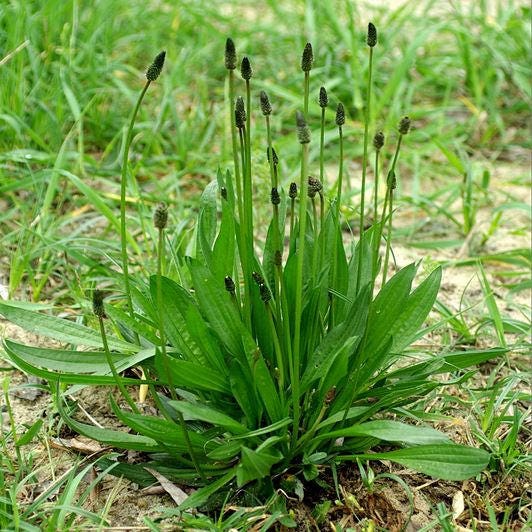
Narrow leaf plantain
Common Ragweed. Could there exist a more exotic name than Ambrosia artemisiifolia, the scientific name for this bane of allergy sufferers? Also known as hay-fever weed, bitterweed, or wild tansy, it’s a summer annual preferring full sun and dry conditions. The small green and yellow flowers produce excessive pollen, the cause of much sneezing and stuffiness. Apart from the symptoms of its pollen, it can be identified by its pale, green leaves up to 4 inches long which are egg shaped, arranged slightly like a triangle and somewhat resembling a small oak leaf. Near the base of the plant beneath the leaf-like cotyledons, it shows a purple color. Although it grows in disturbed areas such as fields or roadsides, it can sprout in our gardens since seeds can survive in the soil for as much as 80 years. Dig it up before it can produce pollen or seeds.

The Common Dandelion (Taraxacum officinale) seems oblivious to its habitat, springing up in pampered lawns and gardens as well as ditches. A recent visit in Michigan showed me how hardy dandelions can serve as a welcome substitute for spring flowers in the cold Northwoods; but Virginians are less tolerant. Readers scarcely need a picture of the happy, yellow blossom, an inch across, to make an identification. It has a taproot that can penetrate 6 inches into our hard clay, which means chopping off the leaves is only temporary. Before you curse its arrival, stop to consider that the early leaves have been used as a salad by more discerning gourmets and the flowers will make a passable wine. Having taken this history into account, dig deeply and discard the deep taproot and the entire debris. Also note that simply mowing the yellow flowers before they turn into puff balls will insure that seeds never develop even though the plant will return.

Photo by Greg Hume – Own work, CC BY-SA 3.0, https://commons.wikimedia.org/w/index.php?curid=17890515
English ivy (Hedera helix) is a shade-tolerant, woody perennial vine. When established, it creates a dense ground cover with attractive dark green foliage. But, left unchecked, this introduced plant invades woodlands, climbs (and kills) trees and is considered an invasive species. Perusing the internet, you can find several “recommendations” for controlling English ivy. Some good, some are questionable, all depend on persistence. This fact sheet summarizes some of the non-chemical and chemical control options. Read more at: https://weeds.ces.ncsu.edu/2019/03/english-ivy-its-time-to-think-about-control-options/

English ivy. Photo: Whiteghost.ink – Own work, CC BY-SA 4.0, https://commons.wikimedia.org/w/index.php?curid=37335932
Yellow nutsedge (Cyperus esculentus) is a perennial that invades lawns and landscape beds as well as gardens, especially those with moist to wet soils. Its narrow leaves are yellow-green up to 8 inches long with a prominent midrib. They taper to a point, unlike the similar purple nutsedge leaves, which do not taper. The triangular stem is more yellow than lawn grass (more purple in purple nutsdge). Underground structures, small and round, called nutlets make it very difficult to control with cultivation.
Tubers and rhizomes, which reproduce the plant, may remain dormant in the ground for 10 years while it lurks in wait of more favorable conditions. The good news is that cutting the leaves at mowing height in the lawn prevents seeding, which is okay if you can tolerate the weed in your yard. It is green after all.
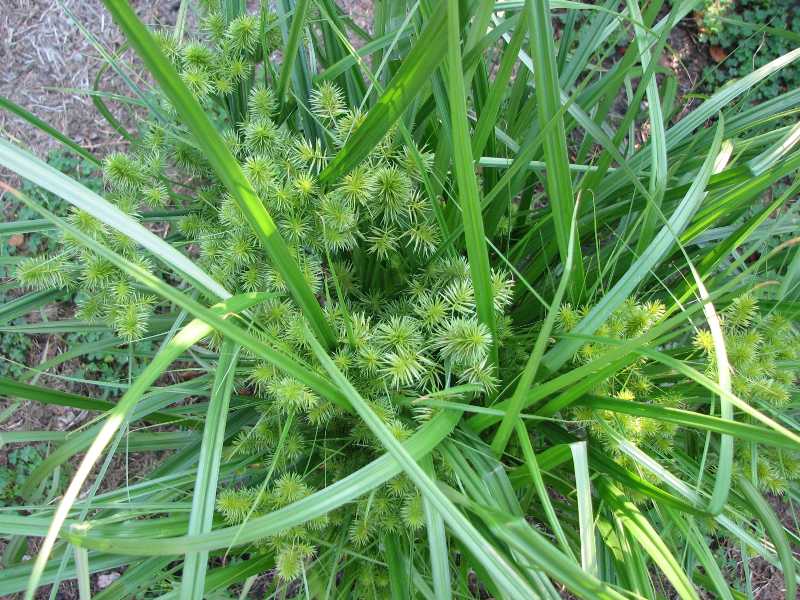 Yellow nutsedge. Photo courtesy of Missouri Botanical Garden
Poison Ivy (Toxicodendron radicans) is a toxic perennial as the botanical name suggests and may grow as a seedling 2-3 inches high or as a thick vine on trees or structures. The ovate leaves come in 3 distinct leaflets, irregularly toothed, green and shiny above, paler below. Leaf shape may alter, but the three leaflets give it away. The color changes to attractive red and orange in the fall before disappearing. However, toxicity does not disappear. Seeds are in a yellowish-green cluster in spring, turning toward white in summer and winter. It reproduces either from creeping roots or seeds. Its relative, eastern poison oak (T. pubescens), grows only as a shrub, but looks similar and is equally poisonous. I include it because no one wants either in their yard or garden.
I’m always surprised at people who work outdoors but cannot identify these irritating plants. Brushing the leaves releases toxin which produces spreading red bumps that itch for days. Always remember “Leaves of three, let it be.” Box elder and Virginia creeper may seem similar; but the former has opposite leaves (and grows into a tree) while poison ivy leaves alternate on the stem, and Virginia creeper has five leaflets.
When working around poison ivy, wash skin with soap and cold water within 30 minutes to reduce or eliminate the ill effects. Clothing should be washed since the toxic urushiol can be transferred to furniture and be carried on tools, pets or the soot of burning brush. The blisters which accompany itching are themselves non-allergenic and won’t themselves cause more harm. Several products are available which may reduce the reaction or help the rash. The AMA estimates that poison ivy and poison oak cause more contact dermatitis in the USA than all other plants, household chemicals, and industrial chemicals combined.
Control: Cutting poison ivy near the ground will eventually eliminate it. Digging or grubbing it out should be done with waterproof gloves. Glyphosate applied on a warm, sunny day when plants are growing will kill it; other herbicides are available. Read labels carefully.

In Vermont Garden Journal, By CHARLIE NARDOZZI • JUL 10, 2015
Ground Ivy (Glechoma hederacea) goes by many names, including ground ivy, but I like ‘creeping charlie’ because it creeps up anywhere in my yard and in the edge of the woods. Like true ivy it’s a perennial that stays green year-round, preferring moist shade but managing sunny areas all too well. The rounded leaves (1-2 inches) have large rounded teeth and stems about the same length as their diameter, growing from a square stalk along the ground. It spreads prolifically from stolons or seed.

Control of Creeping Charlie depends on its location. In the lawn, improving the health of your turf in those shady or moist areas and mowing closely will help to crowd it out. Applying a postemergence broadleaf herbicide such as triclopyr combined with another herbicide eliminates this weed with a couple of treatments in the early fall. In the garden, however these herbicides will kill most desirable vegetables and ornamentals since they are broadleaf. Of course, hand pulling Creeping Charlie and getting absolutely every one of its roots and stolons works anywhere.
Finally, although trees may not come to mind as weeds, I think of four that drop seeds and grow virulently around my house. Maple, Mimosa, Hackberry and Wild Cherry seedlings can be pulled easily when 4-5 inches. Cedar seedlings may have to be slightly taller; but all of these usually come up by the roots with a firm tug. The list of weeds and their characteristics seems endless in the guide listed below. Piedmont gardeners can be grateful for the offer of Virginia Tech agents to help with identification; just take a photo and email it to the Help Desk, albemarlevcehelpdesk@gmail.com
As in all things gardening, daily attention pays dividends. Like those apps for our computers that block pop-up ads, knowledge about weeds will help, but nothing works like deleting them on a regular basis.
SOURCES:
- Two general articles: http://weeds.cropsci.illinois.edu/weedid.htm and https://www.turffiles.ncsu.edu/weeds-in-turf/
- Specific to our area: (https://ext.vt.edu/agriculture/weed-management.html
- Virginia Tech’s guide to weed identification: https://weedid.cals.vt.edu
- Wisconsin’s Extension article on Creeping Charlie: https://hort.extension.wisc.edu/articles/creeping-charlie/