
The Garden Shed
A Community Newsletter published by the Piedmont Master Gardeners
March 2020-Vol.6 No.3


For comments, questions or suggested topics for future Garden Shed articles contact us at: garden-shed@piedmontmastergardeners.org.
If you have specific gardening questions or need help to solve a gardening problem, our Horticultural Help Desk is a free community resource and can be contacted at 434-872-4583 or by email: albemarlevcehelpdesk@gmail.com.

Who We Are
We are members of the Piedmont Master Gardeners, which simply means we have all been trained to share the scientific expertise of Virginia Tech and the Virginia Cooperative Extension Service. More important, we are your friends and neighbors with a passion for gardening – and learning more about it. MORE
Table of Contents
Upcoming Events
Time for the Spring Lecture Series! Plus programs on vegetable gardening, climate change, trees, snakes, and more.
In the Edible Garden
Elderberry: An Attractive Native Shrub That Heals
A native shrub whose medicinal properties have been recognized since ancient times and whose wines and jellies are much loved as well.
In the Ornamental Garden
Streptocarpella: The Houseplant That Flowers All Year
And puts on a summer show on your deck or patio
Tasks and Tips
Climate change has moved our final frost date to mid-late April, so now March is the time to get our cool weather crops in the ground.
Tasks and Tips
Landscapers and homeowners can become targets for abuse when they fail to hew the line on the 'proper' way to prune Lagerstroemia indica.
Upcoming Events
Piedmont Master Gardeners
Spring Lecture Series
Thursdays: March 5, 12, 19, 26
7:00 p.m.
Albemarle County Office Building, 5th Street Extended, just off I-64*
March 5, Tim McCoy, “Pesticides and Pollinators: What Gardeners Should Know”
March 12, Doug Tallamy, “Nature’s Best Hope: Creating a Vibrant Ecosystem in the Home Landscape”
(*Please note the different location for this lecture which will be Lane Auditorium in the Albemarle County Office Building at 401 McIntire Road.)
March 19, Keith Nevison, “Year-round Vegetable Gardening”
March 26, Robyn Puffenbarger, “Robins to Raptors: Observing Birds in Our Backyards”
Admission is $8 for each lecture and may be paid at the door or online in advance at pmgarchives.com/events (when online payment is set up for this event). For more information, visit pmgarchives.com/events or call (434) 872-4581.
Blue Ridge PRISM (Partnership for Regional Invasive Species Management)
Invasive Plant Workshops
Friday, March 6
1:00 – 5:00 p.m.
Blandy Experimental Farm
400 Blandy Farm Ln, Boyce, VA 22620
Thursday, March 19
1:00 – 5:00 p.m.
Rockfish Valley Community Center
190 Rockfish School Ln, Afton, VA 22920
Wednesday, March 25
1:00 – 5:00 p.m.
Ivy Creek Natural Area
1780 Earlysville Rd, Charlottesville, VA 22903
These seasonal workshops will enable you to learn how to confidently identify and manage invasive plants, using best seasonal practices for each invasive. Treatments include herbicides plus manual and mechanical control methods. There will also be an opportunity to identify plants, so bring samples of your mystery plants for identification. Each session includes classroom and outdoor instruction (weather permitting) and discussion. The Blue Ridge PRISM is a project of the Shenandoah National Park Trust, which is a 501c3 nonprofit and the fiscal sponsor of the Blue Ridge PRISM. The $25 workshop fee covers the cost of materials and space rental. For more information and to register go to PRISM.
McIntire Botanical Garden’s 3rd Annual Ian Robertson Legacy Lectureship
“Reclaiming the City: A Focus on Human Centered Design,” Mikyoung Kim
Sunday, March 8
Farmington Country Club
1625 Country Club Cir, Charlottesville, VA 22901
Shop at a market of local vendors and hear from MBG’s lead designer, Mikyoung Kim, whose work around the world focuses on the healing properties of public landscapes. Kim and her team, including Waterstreet Studio, have recently won the prestigious American Society of Landscape Architects’ Honor Award for our Garden design!
Lecture fee is $55. Proceeds support the design of the Garden. Seating is limited, so we encourage you to reserve your place now. See link for full schedule of events and to register.
Virginia Native Plant Society Jefferson Chapter Meeting and Presentation
“Native American Plant Use” with Steve Pullinger
Wednesday, March 11
7:30 – 9:00 p.m.
Ivy Creek Natural Area
1780 Earlysville Rd., Charlottesville 22903
Steve Pullinger brings his experience as a Master Naturalist, avid organic gardener, beekeeper, and homesteader for over 20 years producing roughly 80% of their food. He will discuss how Native Americans used plants in their daily living and how we could similarly use them today. He will discuss local flora and the role each plays, edible plants, and medicinal plants. In addition, he will briefly touch on basic survival needs and supplies. Attendance is free. For more information please see this link.
Virginia Master Naturalists and Montpelier
Montpelier’s Nature Exploration: Magnificent Trees of Montpelier
Saturday, March 14
10:00 a.m. – 12:00 p.m.
11350 Constitution Highway
Montpelier Station, VA 22957
This walking tour is led by Virginia Master Naturalists in cooperation with Montpelier. We will visit many old giant trees around the property and learn how to determine the height and width of these specimens. $10/person. Please register here.
Virginia Native Plant Society State Workshop
“Earth’s Climate: Present, Past, & Future”
Saturday, March 14
Earl Dickinson Building, Piedmont Virginia Community College
444 College Drive, Charlottesville Virginia 22902
For a schedule of events and to register: https://vnps.org/events/vnps-annual-workshop-2020/
Sierra Club Program
“The Serpent in the Garden: Friend or Foe?” with Larry Mendoza
Sunday, March 15
2:00 – 3:30 p.m.
McIntire Room, Jefferson-Madison Regional Library
201 E. Market St., Charlottesville VA 22902
How do I tell the difference between a venomous snake and a non-venomous snake? What do I do if I get bit? Do black snakes keep venomous snakes at bay? Can we co-exist with our slithery friends? Larry Mendoza with the Virginia Herpetological Society will be answering these and other questions about these fascinating creatures and their connection to people. This talk will cover the natural history, identification, distribution, physiology/anatomy, and other interesting facts about these fascinating and highly evolved animals that have been around since the days of the dinosaurs. In addition, Larry will be bringing some of his slithery friends for the audience to meet and interact with. For more information, please see this link.
Shenandoah Valley Plant Symposium
“A Gardener’s Palette”
Friday, March 20
8:00 a.m. – 4:15 p.m.
Best Western Inn and Conference Center
109 Apple Tree Lane, Waynesboro, VA 22980
Go to this link for a full listing of conference speakers and topics, and to register.
Piedmont Master Gardeners Garden Basics Class
“Grow Your Own Vegetables”
Saturday, March 21
2:00 – 4:00 pm
Trinity Episcopal Church
1118 Preston Avenue, Charlottesville, VA 22903
Growing vegetables is easy! Learn how to prepare, plant and tend your vegetable garden. COST: FREE, BUT REGISTRATION IS REQUIRED. HOW TO REGISTER: Send your name and name of class to info@pmgarchives.com
Virginia Native Plant Society Jefferson Chapter
Monthly Plant Walk
Saturday, March 21
9:00-11:00 a.m.
Ivy Creek Natural Area
1780 Earlysville Rd., Charlottesville VA 22903
Led by VNPS members, these walks are offered jointly with Ivy Creek the third Saturday of the month from March-November. Meet at Ivy Creek Natural Area Kiosk. The walks are free and all are welcome. For more information, please see this link.
UPCOMING EVENTS IN APRIL
Virginia Native Plant Society Jefferson Chapter Meeting and Presentation
“Shale Barrens” with Tim Williams
Wednesday, April 8
7:30 – 9:00 p.m.
Education Building at Ivy Creek Natural Area
1780 Earlysville Road, Charlottesville 22903
Much of Virginia west of the Shenandoah Valley is composed of Devonian age shale. Where the shale slopes face south, the daytime temperatures can exceed 120˚F and moisture is exceedingly rare. These slopes are mostly barren of plant life and are given the name of Shale Barrens. Even so, about 30 species of plants occur mainly or exclusively on these barren slopes. Their closest relatives live in the deserts of Utah and the American Southwest.
Well-known local botanist Tim Williams will discuss the plants that live in the shale barrens. They range from asters to clementis, pinks, umbels, mints, clover, wall flowers, evening primrose, and even ferns and club moss. There is no fee; for more information please see this link.
Piedmont Master Gardeners Garden Basics Class
“Gardening with Annuals”
Saturday, April 18
2:00 pm – 4:00 p.m.
Trinity Episcopal Church
1118 Preston Avenue, Charlottesville, VA 22903
Learn how to plant and maintain popular and unusual annual flowers to add color and variety to your garden. COST: FREE, BUT REGISTRATION IS REQUIRED.
HOW TO REGISTER: Send your name and name of class to info@pmgarchives.com
Pharsalia Farm and Event Space
Workshops starting April 16
233 Pharsalia Road, Tyro, VA 22976
An historical farm built in 1814 at the foot of dePriest Mountain in Nelson County, Pharsalia offers one-day plant growing workshops. Starting in mid April and continuing through the summer, workshops offer a variety of topics:
- Growing and Using Culinary Herbs
- Dahlias and Heirloom Mums for a Colorful Fall
- Early Spring Flowers at Their Best
- A Passion for Peonies
- An Extravagant Profusion of Peonies
- The Bounty of Spring Flowers
- Gloriously Captivating Hydrangeas for Cutting
Registration ranges from $85-175, and includes a catered lunch. For more information and registration, go to https://www.pharsaliaevents.
Blue Ridge PRISM (Partnership for Regional Invasive Species Managment)
“Encouraging and Planting Natives Following Removal of Invasives”
Wednesday, April 22
12:30 – 5:00 p.m.
Northside Library
705 Rio Road West, Charlottesville, 22901
You have worked hard (and are still at it) to remove invasives and you want to encourage native plants to return. How do you do this? Will they come back on their own? If you need to plant natives, which ones should you choose? Experts will help you with all these questions and more. This workshop is FREE, but registration is required. Please register here.
Virginia Native Plant Society Jefferson Chapter
Annual Plant Sale
Sunday, April 26
All day
Ivy Creek Natural Area – Barn
1780 Earlysville Rd., Charlottesville, 22903
For more information, visit this link
UPCOMING EVENTS IN MAY
 Piedmont Master Gardeners and Charlottesville Area Tree Stewards
2020 Annual Plant Sale
Saturday, May 2
10:00 a.m. – 2:00 p.m.
On the lawn at the Shops at Stonefield
The Piedmont Master Gardeners Association and the Charlottesville Area Tree Stewards will again host their annual plant and tree sale on the lawn at the Shops at Stonefield. To be held rain or shine, the sale will offer more than 5,000 plants, including annuals, perennials, herbs, vegetables, houseplants, shrubs and trees. Among them will be a large selection of native plants and other plants that support pollinators. In addition, a variety of “green elephants” will be available, including pots, garden décor, tools and more. During the sale, Master Gardeners will staff a Horticulture Help Desk and will provide ten-minute tutorials on “Planting and Caring for Tomatoes” (10:30 a.m.), “Why Plant Natives?” (11:30 a.m.) and “Deer-Resistant Plants” (noon). Please join us on May 2nd from 10 am to 2 pm out on the lawn at the Shops at Stonefield.
40th Spring Wildflower Symposium at the Nature Foundation at Wintergreen
Friday-Sunday, May 15 – 17
For more information as the event draws closer, check https://www.twnf.org/nature-events/
Elderberry: An Attractive Native Shrub That Heals
Our native elderberry, American elder, Sambucus canadensis, is an attractive, relatively large shrub, whose flowers and berries can be made into an array of medicinal, food, and beverage products. Along with its relative, European Elder, Sambucus nigra, elderberry is enjoying a revival of sorts as a medicinal herb although its healing properties were noted by Hippocrates as early as 400 BC.
My first encounter with elderberries was with wild bushes growing on the shoreline of the pond where I fished growing up. On late summer mornings, after fishing since sunup, we would pick a few handfuls of the purple berries for mid-morning replenishment before returning to the task of catching our dinner. The berries’ somewhat bitter taste and astringency was no deterrent to hungry boys. There were many days when we were more successful picking elderberries than catching fish.

Flowering elderberry
Characteristics
While there are a few cultivars worth considering, the native Sambucus canadensis is a shrub with a cane habit that can grow to be anywhere from 4 to 15 feet tall and of equal width. It is native to eastern North America from Nova Scotia to Manitoba and Florida to Texas.
Leaves are pinnately compound, with 5 to 11 leaflets per stem, each averaging about 5 inches long. Edges are finely serrated. Clusters of small white flowers, called cymes, are typically 3 to 10 inches in diameter.
Elderberries prefer well-drained soil with a pH of 5.5 to 6.5. Roots tend to be fibrous and shallow. The shrub reaches full berry production in the third or fourth year, and canes become productive in their second year. They prefer sun but will adapt to part shade and are hardy in zones 3-10.

Elderberry clusters
Elderberries are cross pollinators so at least two varieties within 50 or 60 feet of each other are required for pollination. Flowering and fruiting typically occurs in late August to early September, with exact timing varying a couple of weeks in each direction for different cultivars.
Care
It is a good idea to add a nitrogen-based fertilizer to the root perimeter yearly to support growth.
Two-year-old canes are the most productive. Flower clusters form on terminal ends of current season growth. Careful pruning will increase production and help reduce pest threats. Remove dead, broken and weak canes as noticed. Canes lose vigor after 3 years and should be removed at ground level during dormancy. Leave a roughly equal number of 1-, 2-, and 3-year-old canes intact.

On the patio
To harvest, cut berry clusters from the plant, then strip berries. Use quickly or freeze to preserve.

Red Elderberry
Note that the Red Elderberry, Sambucus racemosa has bright red fruits that are poisonous to humans.
Most Common Disease and Pest Issues
Elderberries’ two most common disease issues are:
- Cankers: caused by various fungi, they form on twigs and branches. Treatment is to prune and burn affected wood.
- Leaf Spot: shrubs are susceptible to 4 forms of powdery mildew, which can be controlled using traditional techniques.
They also have minor susceptibility to thread blight, root rot, and verticillium wilt, but problems are typically manageable.
There are three insect pests that commonly attack elderberries. There are few registered insecticides for elderberries, so most control is cultural:
- Elder shoot borer: the larval stage of Achatodes zeae bores into stems and shoots. The moth lays eggs in July/August on 1-year-old canes for hatch the next April/May. The larva feed initially on leaves, and then bore into shoots. By mid-June, they tunnel into dead canes to pupate, as evidenced by sawdust (frass) on the ground beneath the bore hole. Best practice is to prune out dead wood, preferably before larval entry, and then destroy all prunings.
- Cecropia Moth (Hyalophora cecropia) caterpillars eat foliage. Hand remove them.
- Aphid infestations may cause leaf distortion but damage is usually manageable.
Medicinal Properties
Elderberries have been used for a variety of medicinal purposes for centuries. While science-based proof of medicinal claims is not extensive, there is some evidence that elderberry syrups and lozenges are effective at shortening the duration of flu symptoms and severity of cold symptoms for air travelers. There is less proof but considerable belief that elderberry products reduce sinus and nerve pain, constipation, and other afflictions. The fruits are high in vitamin C and do appear to have a stimulating effect on human immune systems. Persons taking immune suppressants should probably avoid elderberry products.

“Elderberry cordial”
Food Uses
Flowers, picked soon after opening, can be boiled, strained, and sweetened to make syrups, wine, and cordials. They can also be dried and used to make a tea.
Berries are used to make medicinal syrups as well as jellies, wines, and cordials.
While there are longstanding claims of health benefits from partaking of elderberry products, there is also a risk of diarrhea, vomiting and similar symptoms from overconsumption. Leaves, stems and roots can be poisonous to humans.
Where They Fit
Elderberry shrubs are attractive and versatile natives for borders and larger spaces, especially if the gardener enjoys processing grown produce into home remedies, food and drink. They are also a nice addition to properties working to add diversity for pollinators and birds where late summer/early fall flower and fruit availability is desirable. For those who are interested in adding elderberry but not sure, try some commercial syrup to ward off your next cold or strengthen your immune system. Your personal experience may help you decide.
Sources:
https://extension.umd.edu/hgic/topics/gooseberries-currants-elderberries
https://extension.psu.edu/home-fruit-plantings-elderberries
https://extension.psu.edu/home-fruit-plantings-elderberry-variety-selection
https://extension.psu.edu/home-fruit-plantings-elderberry-disease-descriptions
https://extension.psu.edu/insect-pests-in-elderberries-in-home-fruit-plantings
https://www.webmd.com/diet/elderberry-health-benefits
https://www.webmd.com/vitamins/ai/ingredientmono-434/elderberry
https://morningchores.com/growing-elderberries/
https://www.bbcgoodfood.com/howto/guide/berry-bonanza
https://www.gardeningknowhow.com/edible/fruits/elderberry/pruning-an-elderberry.htm
https://www.ncbi.nlm.nih.gov/pmc/articles/PMC4859762/
https://www.ncbi.nlm.nih.gov/pmc/articles/PMC4848651/
Photo credits:
Cover photo: Fruiting elderberry: Photo: Penn State Extension
Flowering elderberry: Photo: Penn State ExtensionCC BY-NC-SA 2.0
Elderberry clusters: “Elderberry and Blackberry Jam” by isapisa is licensed under CC BY-SA 2.0
On the patio: “Foto 241” by siavogel is licensed under CC BY-NC-SA 2.0
Red elderberry: “Alaska, zomer 2010” by Martha de Jong-Lantink is licensed under CC BY-NC-ND 2.0
Elderberry cordial: eam31 is licensed under CC BY-NC-SA 2.0
Tasks & Tips for March in the Ornamental Garden
Lives there a gardener who doesn’t thrill to the arrival of March? Even though I’m concerned that March arrived too early — in February, to be exact — I can’t help feeling bursts of joy at the sight of green shoots emerging from the earth. There’s plenty to do, of course, though our longstanding calendar of monthly tasks is probably going to need some realigning in view of our changing weather patterns. That said, here’s the To-Do List:
Clean up ornamental beds

Edging tool
Clean up flower beds and borders. Remove twigs and other debris. Cut back dead stems and foliage from perennials that were left standing over the winter. Pull the weeds. Redefine flower bed edges, using a flat-edged spade or an edging tool such as the one shown at left.
Top dress flower beds with one inch of compost. The compost improves the soil structure and adds nutrients and moisture-holding capacity.
Assess your emerging plantings and identify perennials that need to be divided. Many perennials benefit from being divided about every three to five years. As a general rule, divide spring–flowering plants after they bloom; divide summer–flowering plants in late summer or fall; and divide fall–blooming plants in the spring. And here’s another tip: Hostas may be divided just as they emerge in early spring. This minimizes damage to the leaves.
Test your soil. If it’s been a while since you’ve had your garden soil tested or if you’ve never had a soil test done before, consider having one done now to determine the pH and to see what nutrients, if any, are deficient. For information on soil testing, check out the Virginia Cooperative Extension’s (VCE) website, and look at Publication No. 452-129, “Soil Sampling for the Home Gardener,” Ext.VT.Pub. No. 452-129.
Finish any pruning chores that you didn’t complete in January or February. This task should be completed before plants break dormancy. For an expert guide to the general principles of pruning, review our feature article from last month, A Pruning Primer: Tools, Techniques and Timing, The Garden Shed.
Cut back to green wood any tree or shrub twigs that were affected by winter kill. On smaller twigs, scratch the bark with your fingernail to determine whether it is alive.

Well-pruned crape myrtle
Photo: Karen Russ, Clemson Univ.Ext.
Prune crape myrtles. For detailed guidance on how to do this, review this month’s article, “Pruning Crape Myrtles” before you start.
Prune shrubs. If you’re wondering if this is the right time to prune a particular shrub, take a look at the helpful Shrub Pruning Calendar published by the Va. Cooperative Extension, Va.Coop.Ext. Pub.No. 430-462, It will tell you, for example, that March is a good time to prune beautyberry, boxwood, clethra, and roses, among others. And for detailed instructions on how to prune shrubs, review Va.Coop.Ext. Pub. No. 430-459.

Blisters on under side of leaves caused by boxwood leafminers
Photo: J.R. Baker, NC.State University

Boxwood leafminer damage.
Photo: Rebecca Finneran, Mich.St.University
I’m pruning some of my boxwoods this month for two reasons: (1) to remove branches with damage caused by boxwood leafminers, and (2) to provide additional light and air to the inner portions of my older boxwoods, which may help them resist the dreaded boxwood blight. Keep an eye out for the tiny boxwood leafminer fly, which has usually been seen buzzing around boxwoods in April, but I’m going to start watching for it this month. For more about the boxwood leafminer and other insect pests of boxwoods, look at Va.Coop.Ext.Insect & Mite Pests of Boxwood.
Be sure to keep an eye out for signs of boxwood blight. The Boxwood Image Gallery can help you to identify it, Va.Coop.Ext. Boxwood Image Gallery. Often it’s difficult to tell what’s wrong with a boxwood. Here’s a really helpful photo guide: Comparison of Boxwood Blight to Other Boxwood Problems, Va.Coop.Ext.. The Va. Cooperative Extension has created many helpful videos about boxwood blight, including What Is Boxwood Blight? Video and Boxwood Blight Symptoms Video.
Prune roses to improve the health and structure of the plant. Make sure your pruners are sharp and clean. Prune canes to an outward-pointing bud and make each cut at a 45° angle just slightly above the bud. Remove any weak or unattractive canes. Cut any damaged wood back about one inch into healthy wood. Cut any dead canes down to the ground level. If any branches rub together, choose the healthier of the two and remove the other one. If you are pruning a grafted rose, check for suckers below the graft union and remove them. Proper pruning facilitates better air circulation, also allows more sun into the middle of the plant, and results in a healthier, more attractive plant.
When performing late winter or early spring pruning tasks, don’t forget to cut back subshrubs. These perennial, generally low-growing, shrubs have woody stems except for the new growth’s terminal part, which dies back annually. Examples of subshrubs include:
- Butterfly bush (Buddleia) — Prune back all stems to about 1 to 2 ft. from the ground.
- Blue mist shrub (Caryopteris) — To neaten the shrub or encourage new growth, cut back by about a third. To rejuvenate the shrub, cut back to about 6 in. from the ground.
- Russian sage (Perovskia atriplicifolia) – Russian sage foliage is generally best left standing in the fall to provide winter interest and to help protect the crown. In early spring, cut back the old foliage to within 6 in. of the crown.
- Lavender cotton (Santolina chamaecyparissus) – Cut back to within 6 in. of the crown every 2 to 3 years.
- Heather (Calluna vulgaris) – Prune flower stems back to the base of old flowers. Snip the green part only. Don’t cut down to the brown woody portion.
Now is a good time to plant bare root, dormant roses. Soak the bare-root rose in a bucket of water for at least eight or more hours to rehydrate the roots. Choose a sunny, well-drained location, dig the planting hole wide enough and deep enough to easily accommodate the roots and set the plant so that the graft union is at soil level. Space roses far enough apart to allow good air circulation. For more detailed how-to instructions, review “The Ornamental Garden in March,” Garden Shed 2016.
Cut back ornamental grasses and liriope before new growth starts.
Tackle weeds

Common chickweed.
Photo: Va.Tech Weed ID
Your beds may have winter annuals — broadleaf weeds like hairy bittercress and chickweed — which reproduce by seed that usually germinates in fall, grows during the winter, and then produces flowers and seed in the spring. NOW — before those seeds drop — is the time to root them out; otherwise, you’ll be seeing lots more of these weeds next year.

Hairy Bittercress
Photo: Va. Tech Weed ID
Right now I’m seeing hairy bittercress in some of my beds. This is the annoying little weed whose tiny white flowers form seed capsules that explode in your face when you’ve waited too long to pull them. In fact the seed from those exploding seed capsules can fly up to 10 feet away! For photos and helpful identification tips for these weeds, check out the Virginia Tech Weed ID site, VaTech/Weed ID/ hairy bittercress and VaTech/WeedID/chickweed.
Don’t Forget the Deer Repellent
Deer tend to browse on broad-leaf evergreens as well as twigs and buds during the winter and early spring, so keep spraying your vulnerable plants with deer repellent. Keep monitoring for deer damage and change repellents regularly. And once that lush spring growth appears, start spraying it immediately. Or perhaps you’re using deer netting around your shrubs. If you have comments or questions about either method, please write them in the comments section below. We’d love to hear from you.
Check out the Monthly Gardening Tips section now located under Gardening Resources on the main page of the PMG website: pmgarchives.com/Gardening Resources/Monthly Gardening Tips/#March. For additional detail, consult our previous March issues of The Garden Shed:
Tasks&Tips/Ornamentals/March 2017
Tasks&Tips/Ornamentals/March2018
If your lawn needs attention, you’ll find a detailed discussion of March lawn tasks and tips in our March 2015 issue, March Lawn Care/TheGardenShed/March2015.
SOURCES:
“Boxwood Blight Alert,” The Garden Shed/Boxwood Blight Alert
PennStateExt/white-tailed-deer-in-home-fruit-plantings
Streptocarpella: The Houseplant That Flowers All Year

Streptocarpella in a hanging basket, courtesy of Wellington Botanic Gardens, New Zealand.
Because it is easy to grow and flowers most of the year, the Streptocarpella makes an ideal gift, and that is how this plant entered my life. Its fuzzy, chubby stems and leaves were not particularly impressive, but its flowers are a heart-stopping lavender blue that will enliven any winter day. But there’s more — as I discovered when I moved my streptocarpella out onto the deck for the summer. Its stems cascaded over the sides of the pot and it bloomed profusely all summer long. And though there are recommended cultural practices, basically this plant will perform beautifully even if you don’t provide ideal conditions. The only problem I’ve had is figuring out its proper name. My friend gave me only one name — streptocarpella — and she explained that to remember it, just think of strep throat. Ugh. The official pronunciation is “strep-toe-CAR-pell-uh” — but there’s nothing about this plant that will remind you of strep throat; it’s easy to grow, adaptable, and is simply gorgeous all year.
Names and Confusions

A one-leaf wonder: Streptocarpus eylesii ssp. eylesii.
Photo: Ron Myhr
Streptocarpella is a tropical perennial found in moist, warm, and humid forests of Africa and is part of the large Gesneriaceae family, known as the Gesneriads (pronounced either “guess-NARE-ee-ad” or “jez-NARE-ee-ad”), which includes African violets and the well-known Cape primroses. After a bit of research, I discovered that my plant is part of the large Streptocarpus genus of evergreen perennials, monocarps and annuals which can be grouped into three very different growth forms:
–stemless clump-forming rosettes (the “rosulates”), including Cape primroses
–unifoliates (plants with a single leaf)
–soft, shrubby-stemmed plants
Streptocarpella is in the third group; it has stems (“caulescent”) and a more typical plant structure. It’s probably no surprise that streptocarpella is often confused with its relatives in the first group, which are usually referred to as Streptocarpus, even though these two “strepts” are markedly different in form. Because these two groups of plants are closely related, they are each classified as a subgenus of the genus Streptocarpus. So those one-leaf wonders and the Cape primroses are properly called — get ready, it’s a mouthful — Streptocarpus subgenus streptocarpus, while my gorgeous houseplant is properly identified as Streptocarpus subgenus Streptocarpella. There’s probably no need to master this mouthful, as many reliable authorities will refer to this plant as Streptocarpella saxorum, or Streptocarpus streptocarpella or simply as streptocarpella, which seems to function as a sort of common name. The plant does have a few common names. I have seen it referred to as nodding violet, false violet, Cape violet and even, oddly enough, “Cape primrose.”
It’s worth noting — especially for those with an interest in plant classifications — that in recent years taxonomists have re-classified the Streptocarpus genus and placed African violets in the Streptocarpella subgenus. If you’d like to know more about the taxonomy and reclassification, especially as it affected African violets, you’ll want to read articles on the rather extensive Gesneriad Reference Web, including, gesneriads.genera/streptocarpella and gesneriads.genera/Streptocarpus Saintpaulia.
And if you’d like to see photos of the many unusual plants in the Gesneriad family, you’ll enjoy the page entitled “Gesneriad Genera,” at Gesneriad Reference Web/Genera. It was a real eye-opener to me, and it helped me understand why this family of plants is so popular with plant hobbyists and is the focus of conventions and shows. www.gesneriadsociety.org.
Species and Hybrids

Streptocarpella ‘Concord Blue’ at Jardin Botanique, Paris, France; Photo: Salix, Wikimedia Commons
Most of the species in the subgenus Streptocarpella are not in cultivation, though a few are widely available in Africa, Europe, and North America as house plants and tender garden plants, including S. caulescens, S. kirkii, S. saxorum, S. glandulosissimus and S. hilsenbergii. There are a few hybrids, but the best-known and most commonly available one is S. ‘Concord Blue’ — pictured at right.
Now that I’ve warned you of all the possible name confusions, let me set your mind to rest with these wise words from plant guru Allan Armitage:
“Species that are useful for summer baskets and containers are similar in appearance, with small ovate leaves and 1-1½” long lavender tubular flowers. They may be Streptocarpus glandulosissimus, S. orientalis, or S. saxorum, but it is difficult to know just what is being sold out there. Quite truthfully, this really doesn’t matter: given low light and consistent moisture, plants are full of flowers throughout the summer into the fall. . . . Whatever is bought under the name Streptocarpus or Streptocarpella will enjoy filtered light and moist, but not wet, soils.”
— Armitage’s Manual of Annuals, Biennials, and Half-Hardy Perennials (p.456)
Growing Streptocarpella

Streptocarpella in winter. Photo: Cathy Caldwell
Streptocarpella is hardy in Zones 9 and 10, and it’s usually grown as a house plant in North America. Plant it in well-drained organic potting mix in a container that allows room below for the cascading stems — a plant stand is ideal. Place it in an area of bright light, but not direct sun. Windows that face either south or east are recommended. My plant is very happy in a south-facing window which is somewhat sheltered from direct sun. Water it regularly, and avoid getting water on the leaves because it causes browning. You’ll notice that the blooms appear on wiry “scapes” that are produced at the stem nodes. I’ve never pruned these after blooming, and my research suggests that no pruning is necessary. I DO need to repot my plant, which is getting potbound, but that’s an exciting prospect since by dividing it, I’ll gain a new one.
In late spring — after all danger of frost is past — I move my streptocarpella onto my deck into a position where it gets a bit of protection from hot afternoon sun. Sometimes I place it on a table, where its stems will cascade almost to the floor, but you could try putting it in a hanging basket, a very popular alternative.
For a photo of a lovely container garden featuring streptocarpella along with a number of other plants, see AggieHorticulture/Container Gardens/Tex.A&Am.

Made for each other: Streptocarpella and hanging baskets.
Photo: West Coast Gardens, British Columbia.
Propagation
Streptocarpella is reportedly easy to propagate, especially from stem cuttings. Cuttings of about 2 to 4 inches can be taken beneath a leaf node. When the cutting is placed in clean water, it will sprout roots. Keep the cuttings in bright, indirect light at about 65-68°F. Once the roots are about 2 inches long, you can pot up the cutting. For a photo showing a cutting in a small water glass, check out womanswork.com/2013/03/22/my-favorite-houseplant-streptocarpella-saxorum. Directions for growing from seed are available at PlantZAfrica/Streptocarpus saxorum.
If you are enamored with the idea of a houseplant that’s an unfussy non-stop bloomer, you’ll want to try streptocarpella. My local nursery just recently assured me that they’ll be arriving soon.
SOURCES:
Armitage’s Manual of Annuals, Biennials, and Half-Hardy Perennials (2001), p. 456.
“Streptocarpus subgenus Streptocarpella,” The Gesneriad Reference Web/genera/streptocarpella/
“Global Plants” database at https://plants.jstor.org/compilation/streptocarpus.glandulosissimus (Note: Global Plants is the world’s largest database of digitized plant specimens; its search page is at https://plants.jstor.org.
“Plant of the Week: Streptocarpella,” Univ.Ark. Ext. Resource Library
“Streptocarpus saxorum,” PlantZAfrica, South African National Biodiversity Institute
Gesneriad Reference Web: Growth Forms
Feature photo courtesy of Fairview Gardens, Raleigh, North Carolina
A Big Thank You to Garden Shed Survey Respondents
Sincere thanks to all readers who completed The Garden Shed survey. The response rate was excellent, and your expressed preferences and suggestions are informative and insightful. Our team of writers and editors met to discuss the feedback and consider how we might incorporate your helpful ideas and recommendations into future issues of the newsletter. We have updated our plans for regular features and forthcoming articles to reflect the topics you suggested. Also, to support readers looking for specific topics, a brief overview of how to search for and access archived articles and topics of interest published in earlier issues of The Garden Shed is coming soon. Thank you for helping us keep our community newsletter valuable and relevant to your needs, interests, and concerns.
From all of us at The Garden Shed
Biopesticides: A Safer Approach to Pest Control
What are Biopesticides?
Let’s begin with the legal definition of “pesticide.” Under U.S. law, a pesticide is defined as any agent that will “prevent, destroy, repel or mitigate any pest.” Anyone wishing to sell a product which makes a pesticidal claim must have that product approved by the EPA and each state in which s/he wishes to sell the product (with a few exceptions). But thirty-one substances are considered so innocuous that they have been declared exempt from the pesticide approval process. Most of them are naturally-occurring constituents of foods, such as cinnamon, garlic, mint, peppermint, sesame, thyme, and their oils, corn and cottonseed oil, citric acid, and eugenol. These substances are referred to under the EPA as the “Section 25b Chemicals.”
Biopesticides are a subset of pesticides derived from natural materials such as animals, plants, bacteria, viruses and certain minerals. In general, products containing biopesticides as active ingredients are considered more environmentally-benign than are conventional chemical pesticides, but they often possess a narrower scope of efficacy. Biopesticides fall into three major categories:
—Biochemicals
—Microbials, and
—Plant-incorporated Protectants (PiPs).
About 400 biochemical and microbial active ingredients are or have been approved for use in the U.S., but only about 25 PiPs.
What are Biochemical pesticides?

Codling moth: “ I want to make babies, but I’m so frustrated!”
Photo: Simon Winkley & Ken Walker, Museum Victoria, CC BY 3.0 AU
Biochemical pesticides control pests by mechanisms that, generally, do not directly cause death to, or inactivation of, a pest. Some are insect sex pheromones, which interfere with mating.
Some biochemical pesticides are scented plant extracts that attract insects and other pests to traps, or repel insects, birds, dogs, cats and other vertebrates. Others are plant or insect growth regulators. Some have pesticidal activities against bacteria, fungi, nematodes, mites and insects.
Like the 31 regulation-exempt substances noted above, many of the biochemicals also are constituents of foods. In this case, however, they are subject to registration for which some information is required concerning their proposed uses and potential impact on human health and the environment. When you see a list of these, it may cause you to wonder why they are “in” while the 31 are “out.” A very good question for which there is not a clear-cut answer.
Examples of biochemicals that are also food constituents include canola oil, capsaicin (the “hot” in hot peppers), ethanol (pick your favorite cocktail), lactic acid (present in sour milk products such as yogurt), oils of anise, lemongrass, mustard and orange, and vinegar.
A product containing a biochemical biopesticide may be deemed acceptable for use in organic agriculture if all of its ingredients (active and inert) and all of its uses meet the criteria defined in the United States Department of Agriculture’s (USDA) National Organic Program (NOP) Rule. This is communicated through EPA approval of relevant language on the product label.

 The three-leaf Organic logo, with or without the text, then can appear on the label, sometimes along with the logo of the Organic Materials Review Institute (OMRI), an international nonprofit organization that determines which products are certifiable for use in organic production and processing under the USDA National Organic Program.
What are Microbial pesticides?
Microbial pesticides consist of a microorganism (e.g., a bacterium, fungus, virus, or protozoan) as the active ingredient. They control many different kinds of pests, although each separate active ingredient is relatively specific for its target pest[s]. For example, some fungi control certain weeds, while others affect specific insects. Some microbial pesticides may qualify for use in organic production.
The most widely used microbial pesticides are the subspecies and strains of Bacillus thuringiensis, or Bt. Each strain of this bacterium produces a different mix of proteins, and specifically kills one or just a few related species of insect larvae. While some Bt’s control moth larvae, others are specific for larvae of flies and mosquitoes. The target insect species are determined by whether the particular Bt produces a protein that can bind to that target species’ larval gut receptor, thereby causing the larvae to starve to death.
Microbial pesticide products are applied in a manner similar to that of conventional and biochemical pesticides, e.g., as a foliar spray, soil drench, or in granular formulations.
There are a plethora of biochemical and microbial products available for use by home gardeners.
Plant-incorporated Protectants (PiPs) are pesticidal substances produced by plants and the genetic material necessary for the plant to produce the substance. For example, scientists can take the gene for a specific Bt pesticidal protein, and introduce that gene into the plant’s genetic material. Then the plant manufactures that pesticidal protein, controlling the pest when it feeds on the plant. Every part of the plant will contain the Bt gene, including the edible portion(s). Both the protein and its genetic material are regulated by EPA, but not the plant itself.
PiPs are found primarily in high production volume crops destined for the commercial market (e.g., corn, cotton, soybean) and are not marketed for the home gardener.
This small subgroup of biopesticides carries a mantle of controversy and concern in some quarters because their production involves genetic engineering (GE), albeit by GE methods different from those used to create genetically-modified herbicide-resistant crops such as RoundUp-ready corn or soybeans. The U.S. federal government has declared these to be functionally and nutritionally equivalent in all respects to their conventional counterparts. However, not all parties share this opinion, and have offered study results which each assert show differences. The dispute remains an active source of discussion.
Check before you buy
And, finally—a word of caution. It is often tempting (and more convenient) to buy pesticide products online from sites such as Amazon or a commercial pesticide supplier. However, not all of the products available on those sites may be registered in the Commonwealth of Virginia. It is illegal to use unregistered products in Virginia. So, I would suggest that, before spending that money online, check to see if what you want to buy is okay to use here. The Virginia Department of Agriculture and Consumer Services (VDACS) maintains a database of state-registered products which can be accessed at http://www.kellysolutions.com/VA/pesticideindex.htm. If you search by product name, you’ll find out quickly if you’re on the right side of the law.
References:
Photo of Bacillus thuringiensis (Bt) strain 4A4, as viewed at 1000x magnification after gram staining. Photo by Sam LaRussa.
“Beyond Pesticides. Insecticide Incorporated GE Crops,”at https://www.beyondpesticides.org/programs/genetic-engineering/plant-incorporated-protectants)
“Section 25(b) Chemicals,” University of Nebraska Institute of Agriculture and Natural Resources. 2020. https://cropwatch.unl.edu/potato/section25b_chemicals.
“Biopesticide Registration,” U.S. EPA. Office of Pesticide Programs. https://www.epa.gov/pesticide-registration/biopesticide-registration)
“Pesticide Chemical Search: Conventional, Antimicrobial and Biopesticide Active Ingredients,” U.S. EPA. Office of Pesticide Programs, https://iaspub.epa.gov/apex/pesticides/f?p=chemicalsearch:1).
“Pesticide Database Searches,” Commonwealth of Virginia Department of Agriculture and Consumer Services, http://www.kellysolutions.com/VA/pesticideindex.htm
March in the Vegetable Garden
March is here and it’s time to move our gardening activities outdoors. Testing, preparing, and amending soil, plus planting seeds and transplants of cool-weather vegetables signal the kickoff of our vegetable gardening season. So let’s get started.
Be on the Lookout for Spotted Lantern Fly

First, an update on Spotted Lantern Fly. This pest was detected in Frederick County in 2018 and is moving slowly but inexorably south. It can damage a range of fruits and other crops as well as some ornamentals. It also leaves behind a sticky honeydew that creates a breeding ground for fungi on plants, lawn furniture and about anything it lands on. If you see evidence of this pest, please contact your local Cooperative Extension office. The Albemarle/Charlottesville Extension Office can be reached at 434-872-4580.
Start Planting
In a concession to climate change, the Cooperative Extension has redrawn the Hardiness Zone map for Virginia. Albemarle County has been moved from the Mountain to the Piedmont region in zone 7a, effectively changing our expected final frost date from May 10-15 to April 15-25. This 2-4 week earlier final frost can significantly affect when we plant specific vegetables. Check out VCE publication 426-331, Virginia’s Home Garden Vegetable Planting Guide to see the new map and review charts that provide recommended planting dates for specific crops.
Collards, kale, mustard greens, and spinach can be planted at the beginning of March, as can onion sets, peas and radishes. Beets, chard, kohlrabi, lettuce, potatoes, and turnips can be planted by mid-March. Ditto for transplants of broccoli, cabbage, cauliflower, and leeks. Again, check VCE pub 426-331 for full details.
Manage Your Soil for Best Growing Results

If you haven’t had a soil test for a while, a new test makes sense. They are a valuable tool for identifying and preventing problems as well as keeping your soil at optimum fertility and pH levels. They are recommended every three years. A soil sampling kit complete with instructions is available at our local Virginia Cooperative Extension Office, located just off 5th Street Extended at 460 Stagecoach Road. Cost for a basic analysis of nutrient availability, pH, and amendment recommendations is only $10. For additional information on soil testing, check out VCE publication 452-129: Soil Sampling for the Home Garden.
Regardless of your soil condition, adding organic matter to your soil will improve it and fully-decomposed compost is the best way to add organic matter. It improves soil structure and water infiltration, while absorbing and holding moisture longer, a real benefit during our hot, dry summers. Compost can be purchased, but can also be made at home using yard and organic kitchen wastes — plus a little bit of effort to keep piles moist and aerated. Instructions for making compost at home can be found in the January 2018 issue of The Garden Shed. If you start a compost batch now, it should be ready for use for your fall planting later this year.
If you have a heavy clay soil in your garden and you aren’t sure how to best manage it, take a look at the article Gardening in Clay in the July 2018 issue of The Garden Shed. Surprise: the secret is adding decomposed organic matter!
Check Out Occultation for Weed Management

Occultation. Photo: baremountainfarms.com
If you are a minimum-till gardener who is struggling with weeds and refuses to turn to herbicides for weed control, you might want to try occultation, or covering your beds with a black tarp or plastic for a few weeks. The black cover adds some heat to the very top layer of soil and denies light to weeds that want to germinate, killing them. Many organic farmers are using this technique with good success to kill annual weeds and maintain a low weed count through the growing season. Check out this blog post from the Cornell College of Agriculture titled Take Me Out to a Tarped Field for more details.
Fruit Growing
If you are a fruit grower, spring fertilization of fruit trees should occur about 3-4 weeks before active growth begins. Scatter fertilizer evenly under the tree, starting about 2 feet from the trunk and extending just beyond the drip line or end of the furthest branches. A soil test should be performed prior to applying fertilizer. For additional information on fruit trees, visit VCE Publication 426-841, “Tree Fruit in the Home Garden.”
The optimum time to prune fruit trees is just before they bloom. Pruning allows the tree to direct nutrients to branches that will bear high quality fruit. The object is to remove dead, diseased, or damaged wood. Also, remove shoots that are growing straight up or straight down as neither provides for good fruit development. Growth crisscrossing the center of tree should be removed as well. A more open tree allows greater light penetration and air circulation, thereby increasing fruit quality and reducing disease and insect pressure. For additional pruning information, visit VCE Publication 422-025, “Physiology of Pruning Fruit Trees.”
Bramble fruits such as raspberries and blackberries may be planted in mid- to late March. Plant in moist, well-drained soil containing large amounts of humus or organic matter. For weed control, mulch around newly-planted brambles with a hardwood or softwood mulch. For additional information on how to grow bramble fruit, visit VCE Publication 426-840,“Small Fruit in the Home Garden.”
I hope you find this information helpful. If you have any requests for particular information in this or any other area of The Garden Shed, please comment below or fill out our reader survey and send in your ideas. In any case, let’s get this party started!
Resources:
“Spotted Lanternfly,” Virginia Cooperative Extension Publication http://digitalpubs.ext.vt.edu/vcedigitalpubs/9322249259597133/MobilePagedReplica.action?pm=2&folio=1#pg1
“Vegetable Planting Guide and Recommended Planting Dates,” Va. Coop. Ext. Publication 426-331, http://pubs.ext.vt.edu/426/426-331/426-331.html
“Tree Fruit in the Home Garden,” VA Coop. Ext, Publication 426-841, https://www.pubs.ext.vt.edu/content/dam/pubs_ext_vt_edu/426/426-841/426-841_pdf.pdf
Lead photo: “Digging in the garden” by Ben Kreeger is licensed under CC BY-NC-SA 2.0
How To Prune Crape Myrtles
First off, full disclosures about my reservations on this topic: Landscapers and homeowners can become targets for abuse when they fail to hew the line on the “proper” way to prune “crepe” myrtles or Lagerstroemia indica. Beware. Apparently we southerners are likewise targets since we’re prone to both misspell the plant’s name (it’s not crepe myrtles; see, this is risky territory) as well as commit “crepe murder” with our shears. Also, the crape myrtle’s adaptability to the New World means that when the most common sizes get too tall, they are whacked off at the most convenient height for the murderer holding the shears. And, these wonderful specimens come right back, but not the way finer horticulturalists prefer. The final concern is my own inability to research information on smaller varieties or hybrids which may require little pruning when used as a hedge or single specimen. Lagerstroemia indica can range in height from two to 30 feet. The best approach, of course, is to choose a variety that will not outgrow its site, so check that out before you buy. And as for the dispute about the common name, the North Carolina State Extension has this simple solution: “Crepe myrtle is the preferred common name in the south.” N.C.State Ext.
My reservations lead me to note that one virtue of crape myrtles is their beauty in winter. The exfoliating bark produces lovely patterns of gray, cream, and tan on the curving trunks that can dress up a drab winter scene. Hence, careful consideration of pruning can pay dividends both for the late summer blossoms and for an eye-catching deep winter display. The traditional criticism about pruning is that chopping the trunk to control its height will result in unsightly “knobs” and loss of the graceful vase shape so prized by many. However, here’s my heresy: tastes vary and circumstances sometimes require compromising a plant’s ideal form in order either to save money or to keep its valuable blooms.
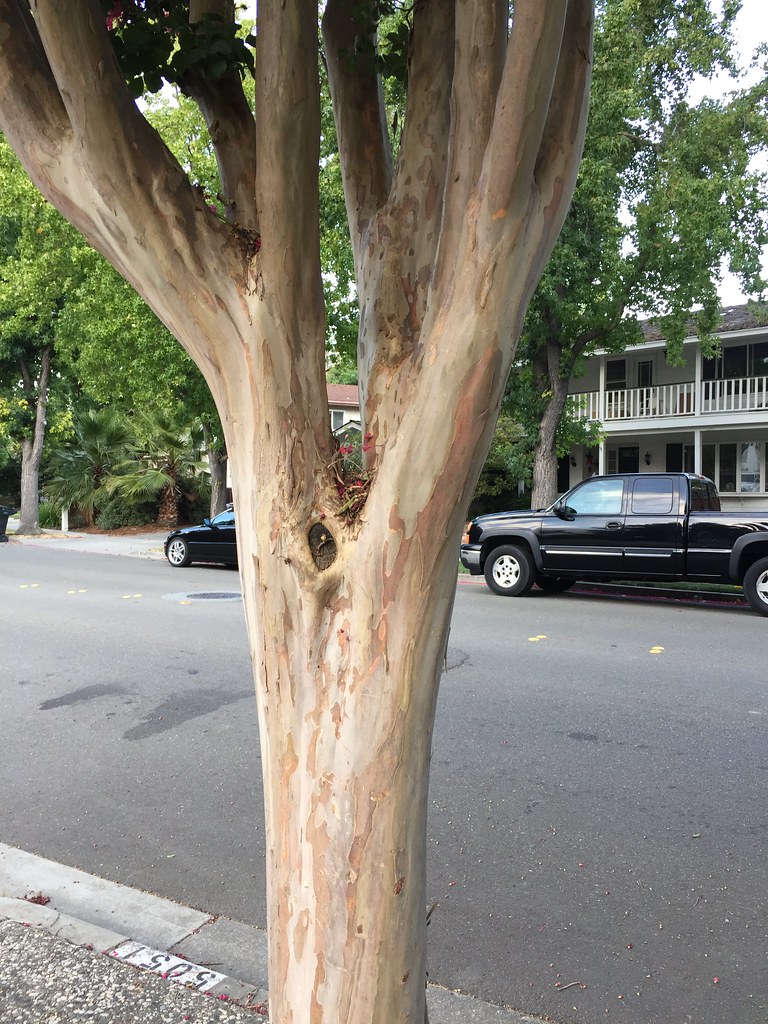
The distinctive bark of crape myrtle. Photo: Misterlevel, CC BY-NC-ND 2.0
In general, the goal is to produce a small tree with one, three, or five trunks — but, see below for alternatives. An odd number of a few trunks will result in the combination of stems that show off the bark and the flowers with spectacular color. If possible, choose a plant in the nursery according to the mature height and blossom color desired; and begin pruning the trunk(s) while the plant is young. Prune in winter or early spring. Some plants do well with alternate-year pruning, and some rarely need pruning. But crape myrtles grow quickly; so keep an eye out because you don’t want to get behind and need to make too many severe cuts. Since blooms appear on new growth, you can stimulate larger blooms for that vase on the table by reducing the number of sprouts of new growth. Suckers or sprouts inevitably spring up from the base. These can be broken off by hand during the growing season or snipped when you are pruning.
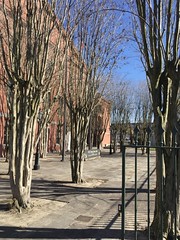
The photo at left shows trunks shortened to about head height and leaving knobs. The practice of cutting stems back to a particular height rather than pruning back to a bud, side branch, or main stem is called “topping.” Aside from altering the appearance, topping any tree leaves it vulnerable to pests and disease. In crape myrtles, the abundant shoots in spring are not firmly attached and may drop off when heavy blossoms appear. These are the hygienic arguments against topping, although the hardiness of Lagerstroemia indica often overcomes the risk.
As always, dead or diseased branches should be removed. Any crossing branches should be cut out to prevent rubbing, which leaves an opening for disease. Thinning of the crown allows better air circulation and a better spread of blossoms. For an extensive discussion of disease, pruning, and varieties of crape myrtle, see Sue Martin’s “Crape Myrtle – A Southern Icon” in the June 21018 issue of The Garden Shed, pmg.org/June 2018 or the article on choosing the right crape myrtle at Clemson Ext. or the Crape Myrtle Fact Sheet at Clemson Extension Home & Garden Information Center (HGIC).
The mature size of the cultivar and the desires of the homeowner can shape the ultimate goal when pruning. Below are some samples of different possibilities. Shorter crape myrtles may function more as a spreading shrub than a small tree as can taller specimens as shown in the first image. A spreading shrub will require many more short stems. One marked advantage of the smaller cultivars is that they can be pruned without ladders.

Photo: Nemo’s great uncle, CC BY-NC-SA 2.0

Photo: Skydiverbob, CC BY-NC-ND 2.0

Photo: vhines200, CC BY-ND 2.0

Photo: AJiso, CC BY-NC-ND 2.0
For a more humorous, yet informed discussion, try the Grumpy Gardener from Southern Living at Crepe Myrtle Pruning Step-by-Step. As for people who “know best” about pruning, they could drop the accusation of crimes committed out of ignorance or necessity. This might open the way for learning less defensively. Or, the real southerners could reply in our sweetest drawl, “I know, dear….”
Other references:
1. Va.Coop.Ext.Pruning Crape Myrtles/Pub.No. 43-451 presents a comprehensive discussion of pruning for Virginians.
2. IFAS Ext./Crapemyrtle Aphid offers the perspective of a warmer climate where aphids are a persistent problem.
3. pmgarchives.com/The Garden Shed, which features “A Pruning Primer” and has a comprehensive discussion of pruning guides and tools for many shrubs and trees.
4. N.C.State Ext./Plant Toolbox/ Lagerstroemia indica, which lists a number of cultivars and their mature heights.
Featured photo by Karen Russ, Clemson Univ.Ext.