
The Garden Shed
A Community Newsletter published by the Piedmont Master Gardeners
June 2024-Vol.10,No.6


For comments, questions or suggested topics for future Garden Shed articles contact us at: garden-shed@piedmontmastergardeners.org.
If you have specific gardening questions or need help to solve a gardening problem, our Horticultural Help Desk is a free community resource and can be contacted at 434-872-4583 or by email: albemarlevcehelpdesk@gmail.com.

Who We Are
We are members of the Piedmont Master Gardeners, which simply means we have all been trained to share the scientific expertise of Virginia Tech and the Virginia Cooperative Extension Service. More important, we are your friends and neighbors with a passion for gardening – and learning more about it. MORE
Table of Contents
Tasks and Tips
June is a busy month for edible gardeners as we harvest spring plantings, plant warm weather crops, and prepare for fall planting.
In the Edible Garden
Managing Slugs in Home Gardens
Learn about slugs, their habits and actions to take to minimize slug damage to garden plants.
Spiders in the Garden
Spiders are among a garden’s best friends. Spiders are superb predators and consume an immense number of insects. A piece in Science Daily says “Spiders feed on an estimated 400 to 800 million tons of insects and other pests annually; in comparison, all humans consume about 400 million tons in meat and fish.” However, spiders are indiscriminate hunters and are happy to eat honeybees. All spiders are carnivorous. Our use of pesticides caps their population since they depend on the insects for food, which we target. They are a part of nature’s Integrated Pest Management effort (IPM), but in our gardens they should merely be left alone to live their lives. The more spiders you have in your garden, the fewer the number of insects that will plague it. See Virginia Cooperative Extension’s Spiders: An Undeserved Bad Reputation.
True spiders comprise more than 90% of spider species and appeared about 300 million years ago. True spiders have fangs that face one another and five fused abdominal segments. Tarantulas are spiders, but not true spiders. There are over 52,000 species of spiders identified in the World Spider Catalog. Scientists speculate there are many more to be discovered. And while some may think of spiders as insects — and certainly that is the world they live in — they are not. In fact, they are an insect’s worst enemy. They prey on such insects as aphids, armyworms, clothes moths, earwigs, fleahoppers, flies, leaf miners, mosquitoes and roaches. In addition, spiders prey on other spiders and some spiders are more likely than others to eat spiders of the same species. Spiders are arachnids. Arachnids differ from insects. They have eight legs instead of an insect’s six, and instead of a body divided into three sections, an arachnid’s body is divided into two. All spiders display ingenuity, patience, and a level of cognition. Originally, spiders did not build webs, and some do not today, but when their prey took to the skies, they adapted. Spiders that do not build webs have either an excellent sense of touch or sight. All spiders are predators. Some quickly kill with venom and others wrap prey in immobilizing silk, waiting for its death from injection or immobility. Some spiders do not have venom, but nearly all do.
Spiders (the term is derived from Proto-Germanic terms meaning “to spin” — spinne is German for spider) belong to a subgroup within the phylum Arthropoda. Arthropods are invertebrates (animals lacking a backbone) with an exoskeleton (a hard external body covering), jointed appendages, and a segmented body. Spiders are arthropods, as are insects. Also included in the arachnid group are scorpions, mites, and ticks. And if insects look bizarre, spiders look like one of the stars of science fiction horror. The motion pictures Sting and Arachnophobia are scary; for other examples, visit Screen Rant’s 10 Scariest Spiders in Horror Movies, Ranked.

Now that’s a lawn ornament! Crystal Bridges Museum of American Art, Bentonville, Arkansas. Bronze Sculpture — Maman — by Louise Bourgeois. Photo: Snuffy Smiff, Wikimedia Commons, CCO 1.0 DEED

It’s easy to see why so many find spiders instinctively scary. They capture their prey through stealth and the technology of the web – “’Will you walk into my parlor?’ said the spider to the fly” — and some shrink-wrap their victims for consumption when needed. They generally have terrible eyesight and are propelled into action by the vibration caused by prey trapped on the web.
Generally spiders are not aggressive toward humans, but most of us have been raised to fear them. Knowing that the overwhelming majority are venomous does not help. Arachnophobia is the fear of arachnids. There is a medical literature for treating it; for instance, see: “Spider Phobia: Neural Networks Informing Diagnosis and (Virtual/Augmented Reality-Based) Cognitive Behavioral Psychotherapy – A Narrative Review published in Frontiers in Psychiatry (2021). For some practical advice, see WebMD’s What To Know About Fear of Spiders.

The internal anatomy of a female two-lunged spider. Original: John Henry Comstock. Vector: Pbroks13 (Ryan Wilson) – Anatomical information and original diagram from The Spider Book (1912, 1920) by John Henry Comstock. Additional anatomical information from Biology of Spiders (1996) by Rainer F. Foelix. Photo: Ryan Wilson, Wikimedia Commons, CC BY 3.0 DEED

Spiders are fascinating, and there are many sources to consult for detailed descriptions of their anatomy and behavior. Begin with My Wild Backyard’s excellent video Everything You Didn’t Know About Spiders. What follows is just to whet your appetite. It is condensed primarily from Britannica. Another excellent source of information is Wikipedia’s article on spiders. In fact, it is identified by Wikipedia editors as a good or especially solid article. Generally, female spiders are larger than males. With a few exceptions, all spiders are terrestrial. The overwhelming majority of spiders are nocturnal. Small or young spiders are distributed by the wind, a phenomenon known as ballooning. Only a few spider species have venom dangerous to humans. Although insects are their primary prey, there is evidence of some spiders feeding on small bats and birds. Spiders possess six pairs of appendages (4 pairs of legs and 2 pairs of mouthpart appendages). Spiders can even amputate their own legs. This ability is called autotomy. Like all arthropods, spiders molt as they grow. Different spider families have characteristic eye arrangements and can have as many as eight eyes. The hunting wolf and jumping spiders have excellent eyesight. There are hunting spiders that shoot a stream of sicky material that ensnares prey before they strike. Fangs are used to inject venom. Food is digested outside the mouth through the use of enzymes. Spiders chemically break down the tissue of prey and suck it up through a straw-like mouth part and then may manipulate what they can of the remaining body with their mouthparts. Spiders cannot chew or swallow as we do. They literally liquify their prey using a combination of venom and digestive fluids to derive nutrients. Some insects produce silk, but spider silk is especially sophisticated. Glands in the abdomen produce silk. It is extruded through spigots and regulated by abdominal pressure. Spiders have courtship rituals. You can watch spider sex at ABC (Australian Broadcasting Corporation) Science’s Why Sex Kills: Spider Mating with Dr. Ann Jones. Male spiders die after or during mating and the female of some species eat the male. After producing the last egg sac, females of some species die. Others may live for as many as two years providing care for the young. The life span of a spider is generally one to two years; most are dead in a season. Mortality varies by species. Life begins with an egg sac. Depending on the species, eggs in the sac can number from 4 to 600.
How intelligent are spiders? For an introduction to what goes on in the minds of spiders see the NPR piece What Goes On In The Minds of Spiders? Although tiny, it’s unexpected what spiders can apparently remember. There is evidence they have some numerical sense. And there is also evidence that they make decisions based on incoming data, which they seek actively. Their actions are not based solely on instinct. See also Psychology Today’s “Spider Smarts: Data Show Their Minds Extend Into Their Webs.” and “Do Spiders Think?”
E. B. White uses the spider Charlotte A. Cavatica (cavatica is Latin for belonging to, born in, or living in caves) to give wisdom in his novel Charlotte’s Web (also available as a film). Charlottle is a barn spider, Araneus cavaticus. In real life these spiders are very aggressive with one another. The spider’s patience is illustrated in the anonymously authored humble little spider of “The itsy bitsy spider climbed up the water spout,/Down came the rain and washed the spider out,/0ut came the sun and dried up all the rain,/And the itsy bitsy spider climbed up the spout again.” Today the talents of the spider are epitomized in the skills and capabilities of Spider-man.
Only two dangerous spiders are found in Virginia: widow spiders (only females bite) and recluse spiders (male brown recluse spiders have about half as much venom as females). Others are mistaken as dangerous: jumping spiders, wolf spiders, nursery web spiders, funnel weavers, and house spiders. To be well-informed on this subject, visit the fact sheets at the end of this section. Some people will have no reaction to a bite, but the severity of reaction spans all the way from none to severe. Virginia Cooperative Extension’s Spiders of Medical Concern in Virginia advises: “Even if a spider does bite someone it may not inject any, or only very little, venom into the bite. . . Most spider bites can be treated with just ice and a pain reliver.” Only two small families of spiders lack venom glands. Only about 1% of the over 50,000 species possess venom that can adversely affect a human. Nonetheless, the venom from a harmless species may cause severe symptoms for the young, old, or immunocompromised.
In the garden, spiders, including widow and recluse spiders, inhabit such places as debris piles, areas under rocks, and woodpiles. Precautions to take, to some extent, are like the steps to avoid snakebite. When in an area rich in spiders, shake out gloves, foot gear and clothing before wearing. If a bite from one of the two dangerous species (widow or recluse) occurs, “apply ice to the bite, elevate the wound, and seek prompt medical attention. Whenever possible, kill and take the spider to your physician for positive identification.” For a concise deep dive into medical concerns, visit: Virginia Cooperative Extension’s Spiders of Medical Concern in Virginia (also noted above) and VCE’s fact sheets for widow spiders and the brown recluse spider.

A typical orb web constructed by an Araneus spider. Photo: Chen-Pan Liao, Wikimedia Commons, CC BY-SA 3.0

What would a spider be without a web? A spider’s life literally hangs on a thread of silk. How strong is spider silk? See NOVA’s “Making Stuff” Explores Spinning of Steel-Strength Spider Silk. Actually, spiders create different kinds of silk for different construction uses. Half of spiders create webs not for entrapping prey, but as hiding places. Different spiders create different webs, from irregular to defined and immediately recognizable. Orb webs (wheel-shaped) are designed to capture flying insects (insects began to fly more than 100 million years ago), and are the most well-known. Often, they are rebuilt daily. Sheet-webs are designed like a deadly hammock hung between leaves or grass and can even cover a shrub. Cobwebs are designed to capture crawling insects. The tangled mess is intentional. They are built by the common house spider and the feared black widow. Woolly webs are distinguished by adhesive silk that snags prey with electrostatically-charged silk nanofibers. Funnel webs have a sheet that spans the exterior of the tunnel in which the spider hides and waits. Funnel-weaver spiders are harmless but Australia’s funnel-web spiders are dangerous. Trap-door spiders burrow into the ground and build a silk-hinged door at the entrance. For a deep dive into the above, along with instructive illustrations, see: “Learn How to Recognize a Spider By Its Web.” For easily understood illustrations of web design, visit Your Guide to Spidering.
Images of spiders are numerous and some of the best images on the Wikipedia family of sites are found at the Wikimedia Commons’ Featured Pictures of Spiders. Spiders in Virginia and Spider ID’s Spiders in Virginia are excellent resources with which to learn about the diversity of spiders in Virginia. Photographs and descriptions are provided. For a quick orientation to identification, you can begin by consulting wikiHow’s How to Identify Spiders. There are outstanding manuals and field guides, see especially Common Spiders of North America by Richard A. Bradley and Steve Buchanan (University of California Press, 2019) and Spiders of North America: An Identification Manual, 2nd edition by Darrell Ubick, Pierre Paquin, Paula Cushing, and Nadine Dupérré (American Arachnological Society, 2017). Both are available as Kindle ebooks. There are also apps for your phone. To fully appreciate the beauty of spiders — gorgeously other worldly – a magnifying glass or photograph is essential. Fifty percent of spiders are 1mm – 5mm in length. A hand lens will increase your enjoyment of your garden’s tiny citizens. When is a spider, not a spider? The daddy-long-legs or harvestmen – which has neither venom nor the ability to create silk — is of the related class Opiliondae. A distinguishing feature of Opiliones is a pair of eyes in the middle of their cephalothorax.
If you would like to welcome a spider into your garden, you need to make them feel at home; first, of course, don’t spray to kill them, and second, provide places where they can find refuge: small piles of leaves, mulch, twigs, and rocks can be delightful refuges for spiders. Sunflowers provide great places for web suspension, native plants attract insects they feed on, and loose layers of mulch between plants are attractive. Have these environmental features in place when spiders disperse in spring. See Maryland Cooperative Extension’s Let Spiders Help in Your Vegetable Garden for guidance on respecting the spider’s reproductive efforts to survive the seasons. If spiders become a hazard or a nuisance, consult Virginia Cooperative Extension’s 2024 Pest Management Guide — Home Grounds & Animals, see the section “Nuisance Insects of the Home and Yard.”
There are many resources with which to pursue a knowledge of spiders. Special attention can be given to the resources available from the European Society of Arachnology, the American Arachnological Society, the British Arachnological Society, the Asian Society of Arachnology, and Arachnofila – Associazione Italiana Di Aracnologia (use Google Translate to translate the Italian). For bibliographic information on the vast array of spiders. the truly dedicated and super-scholarly-inclined can visit the Natural History Museum of Bern’s (Switzerland) World Spider Catalog. Registration is required for free access to a wealth of full-text scientific material.
Featured image: Argiope aurantia. The black and yellow garden spider. Other names include yellow garden spider, writing spider, and zigzag spider. An orb weaver. Class: Arachnida, Domain: Eukaryota, Genus: Argiope. See Clemson Cooperative Extension’s Beneficial Yellow Garden Spiders. Photo: Patrick Edwin Moran, Wikimedia Commons, CC By 2.0
Resources
Arachnophobia. IMDb.
Beneficial Yellow Garden Spiders. Clemson Cooperative Extension.
Brown Recluse Spiders. By Theresa A. Dellinger and Eric Day. ENTO-135. Virginia Cooperative Extension.
Common Spiders of North America. By Richard A. Bradley and Steve Buchanan (University of California Press, Berkeley, 2019).
“Do Spiders Think?” By Mary Bates. Psychology Today.
Everything You Didn’t Know About Spiders. By Spencer Hoffman. My Wild Backyard.
Featured Pictures of Spiders. Wikimedia Commons.
How to Identify Spiders. By Kevin Carrillo and Christopher M. Osborne. wikiHow.
“’Itsy Bitsy Spider’” The History of the Classic Nursery Rhyme.” By Jane Alexander. Mental Floss (April 10, 2024).
“Learn How to Recognize a Spider by Its Web.” By Alison Hawkes. Bay Nature. See the associated Your Guide to Spidering.
Let Spiders Help in Your Vegetable Garden. Maryland Cooperative Extension.
Myth: Sone spiders are poisonous and others are not. The Burke Museum, Seattle, Washington.
“Spider.” By Lorna R. Levi, Herbert W, Levi, and Joseph Culin. Britannica.
“Spider-Man.” Wikipedia.
“Spider Smarts: Data Show Their Minds Extend Into Their Webs.” By Marc Berkoff. Psychology Today.
Spider Webs in the Garden. By Mary Jo T. Gibson. Penn State Extension.
“The Spider and the Fly.” Wikipedia.
“Spiders eat astronomical numbers of insects.” Science Daily (March 14, 2017)
Spiders: An Undeserved Bad Reputation. By Jim Revell and Tim McCoy. ETO-393NP. Virginia Cooperative Extension.
Spiders in Virginia. Spider ID. This project: “Spider ID provides an interactive framework for community-driven spider identification, a growing informational and pictorial library providing accurate spider resources to the public, and data collection and data visualization dedicated to spiders.”
Spiders in Virginia. Spiders USA.
Spiders of Medical Concern in Virginia. By Theresa A. Dellinger and Eric Day. ENTI-346. Virginia Cooperative Extension.
Spiders of North America: An Identification Manual, 2nd edition By Darrell Ubick, Pierre Paquin, Paula Cushing, and Nadine Dupérré (American Arachnological Society, 2017).
Spinning of Steel-Strength Spider Silk. Making Stuff. NOVA.
Sting. IMDb.
2024 Pest Management Guide — Home Grounds & Animals. Publication 456-018. Virginia Cooperative Extension.
The 10 Scariest Spiders in Horror Movies, Ranked. Screen Rant.
What Goes On in the Minds of Spiders? By Barbara J. King. NPR.
What to Know About Fear of Spiders. WebMD.
Why Sex Kills: Spider Mating. By Dr. Ann Jones. ABC Science. (Australian Broadcasting Corporation)
Widow Spiders. By Charles Hannum and Dini M. Miller. 444-422. Virginia Cooperative Extension.
World Spider Catalog. Natural History Museum, Bern.
Your Guide to Spidering: Know Your Spider Webs. Illustrations by Rachel Diaz-Bastin. Bay Nature. For discussion and excellent drawings see “Learn How to Recognize a Spider By Its Web.” By Alison Hawkes. Bay Nature (September 29, 2015).
Upcoming Events
 PMG Speakers Bureau: Growing a Better Lawn
Tuesday, June 4 @ 6:30 pm – 7:30 pm
Our lawns offer aesthetic and environmental benefits around our homes while providing a green space where children and pets can play. We can grow our lawns in ways that maintain these benefits while limiting harm to people and the environment. This in-person program is hosted by the Piedmont Master Gardeners and The Center at Belvedere and is free and open to all.
CAPE CHARLES GARDEN TOUR hosted by Eastern Shore Master Gardeners
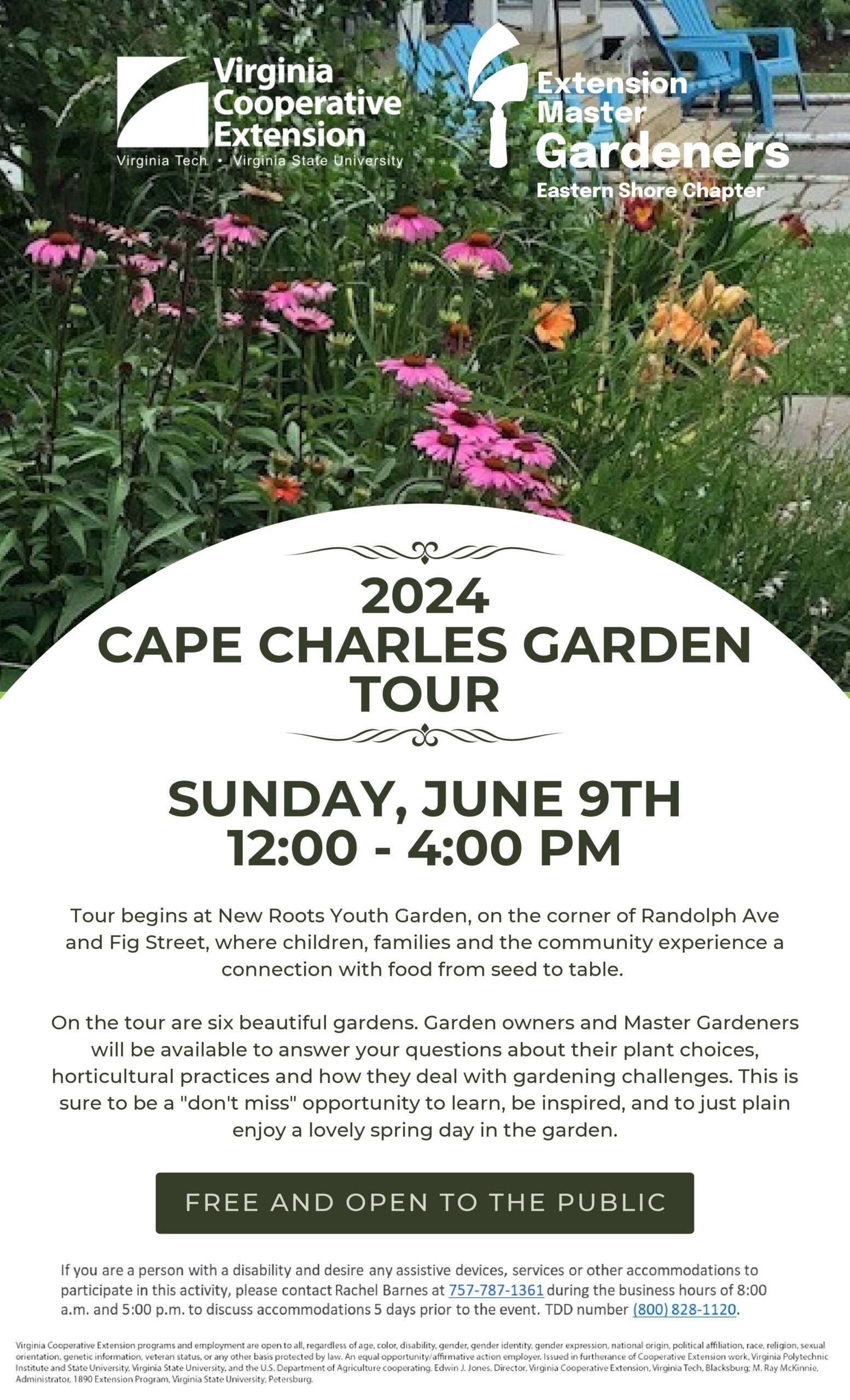
SUNDAY, JUNE 9 @ 12:00 – 4:00 PM, Cape Charles, Virginia
Garden Basics: Backyard Composting for Healthy Soil and a Healthier Planet
SATURDAY, JUNE 22 @ 2:00 pm – 4:00 pm. FREE
Composting makes sustainable and beneficial use of food and yard waste, reduces chemical fertilizer and insecticide use, and keeps organic wastes out of landfills. This workshop will cover: soil and plant nutrient basics, the benefits of natural soil building by creating compost from organic matter, and composting techniques appropriate for home gardeners.
We will also examine samples of compost batches in various stages of decomposition. Garden Basics is a partnership with the Bread and Roses ministry at Trinity Episcopal Church.
Space is limited. Please register below to reserve your place in the class. Registration closes at 5 p.m. June 21, 2024, or when the class is full.
June Zoom Talk & Guided Tree ID Walk
 Tree Basics Class on Zoom: Leaf Differences
Tuesday, June 25 @ 7:00 to 9:00 p.m.
We “be-leaf” that everyone can enjoy tree identification. There are loads of leaves with different shapes, sizes, margins, and textures to explore. Join Emily Ferguson, a Charlottesville Area Tree Steward, as she delves into these various categories to help with easier identification. Information for two follow-up tree ID walks to this talk will be advertised mid-June.
⇒ Find out more and Register Here
Early Summer Tree and Understory ID Walk in Simpson Park
Thursday, June 6 from 6:00 to 7:30 p.m.
Yancey Community Center – Simpson Park Drive, Esmont, VA
Simpson Park is a unique little forest preservation in the lovely community of Esmont in Southern Albemarle County. June is a great time of year to experience the forest and the diverse collection of hardwood and evergreen trees and shrubs in this park.
COMING UP IN JULY . . .
Garden Basics: Making Hypertufa Containers
July 20 @ 2:00 pm – 4:00 pm. FREE

Hypertufa containers last for years and are ideal for displaying flowers, bulbs, succulents, and other plants—indoors or out. You will learn:
- what hypertufa is,
- how to make a hypertufa container safely, and
- plants that do well in a hypertufa container.
You will also make a container to take home, with instructions provided in advance. Garden Basics is a partnership with the Bread and Roses ministry at Trinity Episcopal Church.
Space is limited. Please register below to reserve your place in the class. Registration closes at 5 p.m. July 19, 2024, or when the class is full.
Blue Ridge PRISM 2024 Summer Meeting
Guest Speaker: Heather Holm — “Bumble Bee Banquet” (with Q&A)
Wednesday, July 24, 2024. 
11:30 am – 1:00 pm
(via Zoom)
Mulch for the Home Landscape
When spring arrives, gardeners participate in the annual ritual of mulching their gardens. Used correctly, mulch benefits the garden by holding moisture, cooling the soil, suppressing weeds, preventing erosion, and protecting trees and plants from damage by mowing equipment. This article will explore kinds of mulch available and the correct ways to use them in the home landscape.
Organic Mulch
There is nothing new about mulch. Trees have been dropping their leaves onto the forest floor, protecting roots and enriching the soil, for millions of years. Organic mulches are derived from living sources such as leaves, pine needles, wood chips, bark, straw, grass clippings, or cocoa bean shells and mimic the mulching activity of the forest. Organic mulches eventually decompose, adding nutrients to and becoming part of the soil.
When deciding what kind of organic mulch to use, consider the source of the material. When I called several local mulch purveyors, I learned that wood mulch can be derived from many sources. Landscape rubbish such as trunks, branches and leaves from tree removal and pruning can be shredded into mulch. There is no way to know if pesticides were applied to trees or shrubs before they were shredded. Wood waste from construction, including pallets, can be chipped and added to tree mulch. One supplier said they removed any nails before chipping construction debris wood into mulch. It is harder, if not impossible, to derive the source of mulch when purchasing a bagged product. Prior to 2004, wood for constructing decks and plays sets was treated with chromated copper arsenate (CCA) to protect it from insect and fungal damage. While still used commercially, wood treated with these pesticides is no longer used in residential construction. For more information, see the EPA website: EPA Chromated Arsenicals (CCA). Old treated wood is still in existence but is not to be used in mulch. The Soil and Mulch Council is a trade association with voluntary membership. A seal from the Council on a bag of product certifies the product does not contain wood treated with CCA. For more information, see Soil and Mulch Council. The buyer still does not know where or how the mulch was derived or whether other pesticides are present.
Cypress mulch is prized for its ability to resist decay. Available in bags at big box stores and landscape supply retailers, its use has become controversial. Cypress mulch is harvested from wetlands in the lower south. These are fragile areas which do not regenerate quickly, if at all. Some cypress trees are harvested specifically to be turned into mulch, and with the decline of their wetlands, some environmental groups are calling for a boycott of cypress mulch.
Colored mulch is made from wood recycled from construction and demolition sites (C&D) and pallets. Very dry, it absorbs color easily. While it is beneficial to repurpose this wood and the dye itself has not been found to be harmful, there is no way of knowing if the wood itself is contaminated with toxic substances such as CCAs. The University of Massachusetts has discerned that some soil under colored mulch has been contaminated with CCAs or other toxic substances.

Leaf mulch
Photo by Deborah Harriman
Leaves, pine needles, and branches chipped from your own property are hopefully free of pesticides and herbicides and can be used worry free. Rake and chop leaves from the lawn and spread them as mulch; allow fallen leaves to stay on the beds. As well as suppressing weeds, holding moisture, and enriching the soil, fallen leaves also provide a safe haven for overwintering bees, butterflies, and other insects. As in the forest, new growth will pop up through the mulch in the spring.
How to apply organic mulch
- Remove weeds and grass by hand. Do not use herbicide.
- Edge the bed to keep the mulch in place and create a neat line.

Expose the root flare. Photo by Deborah Harriman
- Spread wood mulch 2-4 inches thick. Less than 2 inches will not do the job; more than 4 inches will prevent water from penetrating to the roots.
- Do not allow mulch to contact the trunks of trees and stems of shrubs. Keep the root flare of trees exposed. Mulching too close to the trunk can allow disease, insects and rodents an entry point. Over time, moisture in mulch can cause decay in the bark.
- Avoid mulch volcanoes, which are piled against the tree trunks. Volcanoes prevent moisture from penetrating to the roots and instead encourages them to grow up into the mulch, searching for water.
- Water a freshly-mulched area deeply so moisture penetrates to the roots. Shallow watering will encourage roots to grow upward in search of moisture and will actually require more watering.
- Over time, wood mulch will fade and become compacted. Fluff it with a rake to improve its appearance. Top with a thin layer of mulch when the original mulch has decomposed.
- Leaf mulch is self-sustaining and will replenish itself when leaves drop in the fall. If mulching with leaves in a windy area, scatter a few wood chips over the leaves to hold them in place.

Stone mulch
Photo by Deborah Harriman
Inorganic Mulch
Inorganic mulches include rocks, crushed stone, pea gravel, crushed brick, landscape fabric, plastic sheeting, rubber chips, and rings. Rocks and stones are used in areas where no planting is expected and are themselves considered part of the décor. Stone mulch is not maintenance free as weeds can take hold when seeds land on top and take root. Pea gravel is notorious for becoming weedy. Rocks and stones also have limited ability to hold moisture and do not add nutrients to the soil. They also absorb warmth from the air and can heat up the soil. This can be detrimental to organisms and microbes living in the soil below. Landscape fabric and plastic sheeting are not used alone as mulch. Landscape fabric is used as a base beneath mulch. Because it is semi-permeable, water can seep through. Plastic sheeting is impermeable and no water can get through. Not typically used in landscape beds, it is occasionally used under organic mulch in paths. Neither of these barriers add nutrients to the soil, and both prevent worms, insects and microbes from moving freely, inhibiting their ability to enhance the soil.
Tree rings and pathways made of rubber are now available in many garden catalogs. I have not found any research determining whether rubber material damages the soil or plants, but like plastic sheeting and landscape fabric, rubber heats up the soil, potentially damaging wildlife below and adds no nutritional value to the soil. Rubber also looks artificial and out of place in a natural setting.
Living Mulch
Using plants to cover the soil is a beautiful alternative to other forms of mulch. In place of invasive ground covers such as liriope, ivy, vinca and pachysandra, consider covering the soil with native plants. Allow the native plants to spread by roots, runners and seeds until they cover the ground. With a living mulch, expect a dynamic and changing landscape rather than a static bed where every plant stays where you put it. As the plants expand and grow, they will crowd out weeds, prevent erosion, and prevent run-off with their deep roots. As a bonus, native plants provide food for bees, butterflies and other beneficial insects and offer overwintering habitat for them. Using one type of native plant as a ground cover is an option, but a diversity of plants will create a living landscape, appealing to a variety of insects, birds and other living creatures. Unlike a traditional flower bed, the plants comprising a living mulch are allowed to mingle and fill in all of the allotted space. Over time, the garden becomes self-sustaining. The chore will mostly be thinning out plants that become too exuberant or too large for their space. With the ground covered with plants, there is no need to purchase and spread wood mulch every year.
Tips for using native plants as mulch

Living mulch of native plants. Photo by Deborah Harriman
When choosing a combination of native plants, base your selection on which plants grow well in the same conditions – moist or dry, sun or shade. Rather than just squeezing in plants close together, be aware of their habits so they will nestle appropriately as they mature. Unless you want a monoculture, avoid plants that are rampant spreaders and cannot share a space. Low-growing ground covers, whether used alone or in combination to make a tapestry are always appropriate. Another option is to plant in layers, incorporating some taller plants that look good in all seasons with shorter plants taking the stage later, and ground covers weaving through. Try for a sequence of bloom, with new plants arising as others diminish. Under an oak tree in my garden, creamy violet (Viola striata) is the ground cover base. Pussy toes (Antennaria plantaginifolia) grows in a sunnier, rocky area near the driveway, and woodland stonecrop (Sedum ternatum) mingles along the edges. White wood aster (Eurybia divericata) provides a low, green ground cover behind the violets in early spring. It matures to two feet in summer and sports white blooms August through September. Spikes of blue-stemmed goldenrod (Solidago caesia) bloom in the fall. In a sunny area, achieve the same effect by mimicking a meadow or grassland. Sun-loving milkweed (Asclepias), black eyed susan (Rudbeckia hirta), and goldenrod (Solidago) can be punctuated with the spikes of a grass such as little bluestem (Schisachyricum scoparium). In a moist area, vary the plantings with bee balm (Monarda), Joe Pye weed (Eutrochium), and blue mistflower (Conoclinium coelestinum). In a new planting, mulch the area with wood chips or leaves until the plants fill in. In a woodland area, allow fallen leaves to stay on the ground, providing a natural mulch. Do not cut back stems of living mulch in the fall. Plants left in place after they stop growing provide winter interest and offer seeds to birds and overwintering sites to insects. Wait until the soil is warm in the spring to do a final cut back to protect any creatures over-wintering in stems. If possible, cut the stems into smaller pieces and leave them in place as more mulch.
Refer to these sites to learn which native ground covers are suitable for your area:
Piedmont Master Gardeners The Garden Shed: Cover the Soil With Native Plants
Summary:
- When used properly, mulch benefits the plants by holding moisture and discouraging weeds. It enriches the soil as it decomposes.
- Mulch with leaves from your own property as much as possible to mimic the ecological activity of the forest.
- Consider the source when using wood mulch.
- Avoid colored mulch which has been found to leach toxins and do not use rubber pellets or rings which look out of place in a natural setting and provide no benefit to the soil.
- Stones are decorative mulch and should only be used in areas that cannot or will not be planted. Stone mulch offers little benefit to plant heath and no benefit to the soil. Pea gravel becomes very weedy.
- A living mulch of native plants crowds out weeds, hold moisture with their deep roots, prevents run off all while adding both beauty and ecological value to the landscape. Native plants will spread, eventually covering the soil and reducing cost and labor for the gardener.
Featured Photo: Deborah Harriman
SOURCES:
Colored Bark Mulch, UMass Amherst
Mulch – A Survey of Available Options
Mulching Trees and Shrubs, U Maryland Extension
Should I Boycott Cypress Mulch? Michigan State University Extension
Springtime Mulching, Virginia Cooperative Extension
The Edible Garden in June
June garden tasks include harvesting spring crops and continued planting of warm weather crops. Weed and pest management become important, and moisture requires vigilance as temperatures rise and rainfall typically decreases.
Planting and Harvesting

Interplanting. Photo: USDA
If you follow the planting schedule for Hardiness Zone 7b in Extension Publication 426-331, “Virginia’s Home Garden Vegetable Planting Guide” (remember our zone has changed but the map has not been changed yet), June is time to plant beans, cucumbers, eggplant, melons, okra, peppers, pumpkins, winter and summer squash, sweet corn, sweet potatoes, and tomatoes.
Harvests will likely be completed for spring crops including asparagus, some cabbage family members, and some greens. Idled space can be managed effectively in several ways that we will discuss.

Mulched sweet potato planting. Photo: R Morini
Soil Care
Regardless of current activity, caring for the soil makes sense. If new items are planted, mulch around and between them after plants have germinated, and are tall enough to catch the sun above the mulch. The mulch will help maintain moisture and reduce weed growth, while decomposing and strengthening the soil.

Buckwheat cover crop in bloom. Photo: R Morini
If bed space will be idled, mulching is an option to protect the soil, but a better one is to plant a fast-growing cover crop, like buckwheat, that grows well in summer and draws a lot of pollinators. It matures in about 6 weeks, so can be cut after flowering but before seed development, prior to fall planting. The cut vegetation can be used as green mulch or provide a nitrogen boost for a fall compost batch.
If the goal is a quick conversion to new crops, Interplanting — grouping plants together to cover the soil while reducing pest and disease issues — is another option.
Similarly, Intensive Vegetable Gardening advocates designing beds and grouping plants in ways that cover the soil and provide diversity that benefits soil health.
The Garden Shed article Plant Partnerships in your Garden offers advice on planting a diversity of plants together for soil enhancement, pest control, and other benefits.
We have talked many times about how using trellises can help maximize production in a given space. A good summer use is to plant greens or other cool weather plants behind active trellises to take advantage of the shade they provide, allowing the greens to stay cooler and extend their harvest season. Row covers can also slow bolting. Also try planting bolt-resistant varieties such as Muir, Magenta, Cherokee and numerous others to extend the greens-growing season. Search the internet for “summer crisp lettuces” to find options.
Successive plantings of beans and corn can extend their harvest seasons.
If intending to plant fall crops, check time to maturity of June plantings to be sure that bed space will be available in time for fall planting.
Water Management
Water is an increasingly valued resource. We are all wise to minimize water waste:
- Now that the ground has warmed, apply organic mulches such as leaves, straw, and clean grass to conserve soil moisture while also suppressing weeds and enriching soil as the mulch decomposes. Avoid mulching with hay, which contains seeds that can lead to weed issues.
- Vegetables require about an inch of water per week during the summer. Soaker hoses or drip irrigation make efficient use of water during dry spells.
- The soil surface dries quickly in summer heat. Put your finger a couple of inches into the soil to determine whether it is truly dry. You should be able to feel moisture. Moist soil also tends to be darker and stick together better than dry.
- Water plants in the morning and avoid splashing water and soil on leaves to reduce the risk of mildew and soil-borne disease transmission. Remove lower leaves on tomato plants to prevent inadvertent soil contact.
Other Suggestions for June Garden Management:
Avoid growing a single crop in the same space repeatedly. This can be done by rotating crops to different areas or by interplanting, mixing a diversity of crops together. Planting the same item in the same space in consecutive years invites pest and disease issues.
It is better to plant corn in short, wide blocks rather than a couple of longer rows. Corn is wind-pollinated, and bunching plants together results in more complete pollination and more fully-kernelled ears.
Cool mornings are the optimum time to pick vegetables for best texture and taste.
Stop harvesting asparagus when spears become thin, usually around mid-June.
Mound soil up around potato vines when vines are about 12” long. New potatoes grow on thin stems called stolons. Longer underground main stems produce more potatoes. Hilling also prevents the tubers from being exposed to the sun and turning green. Repeat once or twice during the growing season, adding 6-8” of soil or mulch to the original soil level.

Cabbage worms on kale. Photo: R Morini
In June, cole crops (cabbage, broccoli, kale, collards etc.) will likely be invaded by a variety of cabbage worms, including loopers, imported cabbage moth worms, and the dreaded cross-striped cabbage worm. They are tough to control but can be managed. Holes chewed in leaves and dark excrement piles on leaves are signs of attack. If hand picking, look for yellow eggs on the undersides of leaves as a start. Pull the caterpillars off leaves regularly; they do fast damage when uncontrolled. They can also be managed with row covers or with the organic pesticide Bacillus thuringiensis (Bt), available at garden centers. For more details, review Garden Shed article OMG What’s Eating the Broccoli and 2024 Pest Management Guide: Home Grounds & Animals/VCE.
It’s always good to have some compost cooking. If you’ve saved some leaves and/or yard trimmings from last fall, combine them with grass clippings and kitchen waste to generate compost that you can apply to your beds prior to winter. If you are short of “brown” inputs, torn up chemical-free papers including paper towels, napkins, pizza boxes, and corrugated boxes are good replacements. I find that roughly equal volumes of grass clippings/kitchen waste and mulched leaves/straw/wood chips are about right to achieve a hot compost batch.

Compost batch. Photo: R Morini
If your compost doesn’t get hot, add more nitrogen with grass and kitchen scraps. If it is slimy or gives off an ammonia smell, add leaves, paper, wood chips, sawdust (not pressure treated) or another carbon source. Keep the pile moist but not dripping, and turn it every week or so to keep it aerated. A second batch can take regular additions of materials as they become available throughout the summer. It decomposes more slowly and less uniformly than the hot pile, but still produces a beautiful product in the end. It’s worth the effort! For more detailed guidance, look at the Garden Shed article Backyard Composting with Practical Tips from the Pros or Making Compost from Yard Waste from the VA Cooperative Extension.
If a spring compost batch is ready for use, add some to beds and scratch it into the soil surface prior to planting, to give the soil an organic matter and nutrient boost.
At our plant sale in May, several people asked if it is okay to compost citrus peels. The answer is that if you are “vermicomposting” — where the decomposition is done primarily by special “red wiggler” earthworms — don’t include them. But if you are composting outdoors and the initial decomposition is done by bacteria, protozoans and fungi before earthworms move in, it is fine to add them.
Herbs planted in average soil need no fertilizer. Too much fertilizer may reduce flavor and pungency.
The best time to harvest most herbs is just before flowering, when the leaves contain the maximum essential oils. Cut herbs early on a sunny day.
Basil, a favorite summer herb, is susceptible to downy mildew. It is a fungal disease that can come from infected seeds, transplants, or via wind-blown spores from other infected plants. If your basil leaves turn yellow-brown and curl up, with a purplish fuzz on the leaf underside, remove and dispose of the plant to prevent spreading. Resistant varieties are available and work well. Look for them when purchasing seed. For more information on growing and using basil check Garden Shed article Basil: Beautiful and Aromatic.
If birds are threatening your strawberries, cover plants with netting or a row cover after plants are pollinated and berries are set. Hanging aluminum pie tins or CDs above the plants may also deter birds.
For information on fruit growing in your home garden, check out Tree Fruit in the Home Garden and Small Fruit in the Home Garden from the VA Cooperative Extension.
I hope that this information is helpful and look forward to meeting again next month at The Garden Shed.
Sources:
“Strawberries in the Home Garden,” NC State Extension,NC State.edu
“Vertical Gardening Using Trellises, Stakes and Cages,” VA.Coop.Ext. Pub.HORT-189
“Growing Potatoes in Home Gardens”, University of Minnesota Extension.
Featured photo: June Vegetable Garden. Photo: R Morini
The Ornamental Garden in June
Routine Gardening Chores this Month
- Deadheading — As annuals become established, deadhead spent flowers to encourage the plant to produce another round of flowers. A few minutes spent deadheading each week will keep those annuals blooming well into the growing season. TIP: Many of the newer varieties of annuals are self-cleaning and don’t need to be deadheaded.Pinching – The objective of pinching back annuals, such as petunias and coleus, is to keep the plants bushy and prevent them from becoming leggy. Pinch back the stem to just above a leaf node.
- Propagating – Late spring to early summer is a good time to propagate stem cuttings of woody ornamental plants such as camellia, cotoneaster, viburnum, deutzia, and lilac. Take softwood cuttings from tender new growth on woody plants, just as it begins to harden. To learn more about propagating plants, refer to Virginia Cooperative Extension (VCE) publication 426-002 on Propagation by Cuttings, Layering and Division and Creating New Plants from Cuttings/The Garden Shed.
- Staking – Install supports for plants that tend to collapse or flop over. Stake taller plants, such as foxglove, yarrow, and delphiniums, and cage mounding plants, such as peonies or chrysanthemums. This is particularly critical if your garden is in a windy site.
- Weeding – With the onset of warmer weather, stay on top of the weeds in your flowerbed. Pull weeds at least once a week or more often if you have the time and the inclination. For help with identifying weeds, try Weed Identification Photos/Maryland Ext
- Watering – Water trees and shrubs deeply and infrequently at the root level to help them get through the summer heat. This is particularly important during the first few growing seasons after a tree or shrub is planted. It’s also important for all plantings during drought conditions. If you use a sprinkler system for your annuals and perennials, water them in the mornings so that foliage can dry off during the day. For containerized plants, keep close tabs on their water requirements. This is particularly critical if you’re planning to go away on vacation. Group containerized plants together near a hose or other water source so that it will be easier for your neighbor or other helpful person to water your plants for you in your absence. Place the plants where they will be out of the afternoon sun. This will help them conserve water.
- Collecting and saving seeds – Given the rising costs of seeds these days, collecting and saving your own is both rewarding and economical. Collect seeds after flowers have faded and seeds are dark brown or black. Spread the seeds out and allow them to dry thoroughly so that they don’t become moldy. Place the dried seeds in paper envelopes or air-tight glass jars and label and date them. Store the seeds in a cool, dry, dark place over winter. Some people like to store seeds in their refrigerators. Important: While open-pollinated species will come back true from seeds, hybrids will not.
- Dividing daffodils – After daffodil foliage has died back, use a shovel or garden spade to dig up the bulbs. Dig several inches away from the clump to avoid damaging the bulbs and their offsets. Lift the clump of bulbs from the ground, being careful not to damage the roots. Gently twist the bulbs apart with your fingers. Discard any that look damaged or diseased. Re-plant the bulbs in a sunny spot with good drainage. Mix in a good amount of compost or other organic matter before you replant them. Plant them three times as deep in the soil as the circumference of the bulb. In other words, if the bulb measures two inches around its middle, plant it six inches deep.
- Removing spent rhododendron blooms – Now that rhododendrons have finished blooming, carefully remove the old blooms within 2 to 3 weeks after they have faded. This will promote better blooming next year, give the plant a tidier appearance, and help prevent insect infestations. The technique is simple: Grasp the spent blossom cluster (called a truss) and carefully pinch it off or push it aside with your thumb. This will reveal the developing flower buds for next year’s flowers. Be careful not to injure those as you remove this year’s dead flower clusters.
- Monitoring houseplants to keep them from sprawling. The move outdoors into brighter light and fresh air provides just the jump start that many houseplants need for a growth spurt. Jade plant is an example of a houseplant that tends to sprawl. To keep it under control, pinch off the side shoots to keep the plant growing upright. Don’t toss the side shoots that you pinched off. Pot them and start new plants.
- Monitoring plants for signs of powdery mildew – Garden Phlox (Phlox paniculata) is one of the classic mainstays of the sunny perennial border. But powdery mildew can devastate the foliage of this native plant and turn it into an ugly, unsightly mess. To combat this disease, plant garden phlox in full sun. Space the plants about 18 to 24 inches apart to allow for good air circulation. Thin out established clumps by snipping out the weakest stems, leaving only 5 or 6 sturdy stems. Water well, particularly during dry weather, with a soaker hose at soil level and avoid wetting the foliage. Mulch around the roots to help retain moisture in the soil.

Powdery mildew on Phlox paniculata. Photo: Mary Ann Hansen, Virginia Tech, Plant Problem Image Gallery, CC BY-NC. 4.0
- Training vines, climbing roses, and other twining or climbing plants. Vining plants normally go through a growth spurt in early summer. As they grow, train them onto supports before they become unmanageable. As you tie them up, spread them out to the extent possible to cover trellises better and to provide better air circulation.
Gardening Projects To Consider
Considering designing and installing a Rain Garden? A rain garden is an environmentally responsible way to capture rainfall and storm-water runoff. For an excellent introduction, check out this recent Garden Shed article: Rain Gardens. If you’re in the process of planning one, choose plants that can tolerate both occasional flooding and long periods of dry weather. VCE Publication 426-043 on Rain Garden Plants recommends one plant species for every 10 to 20 square feet. In the example given, a 140-square-foot garden should have 7 to 14 different plant species consisting of a mix of tall, medium and low growing species. Some plants recommended for rain gardens include:
- Trees: Black gum (Nyssa sylvatica), Carolina silverbell (Halesia tetraptera) and hornbeam (Carpinus caroliniana)
- Shrubs: American beautyberry (Callicarpa Americana), spicebush (Lindera benzoin), and winterberry (Ilex verticillata)
- Perennials: Beard tongue (Penstemon), black-eyed Susan (Rudbeckia), and blue lobelia (Lobelia siphilitica)
- Ferns: Cinnamon Fern (Osmunda cinnamomea), holly fern (Crytomium falcatum), and royal fern (Osmunda regalis)
- Grasses: Feather reed grass (Calamagrostis acutiflora), switchgrass (Panicum virgatum), and foxtail grass (Alopecurus pratensis)
Thinking about creating a butterfly garden? If so, check out Virginia Tech’s publication HORT-59NP, Creating Inviting Habitats for Birds, Butterflies, and Hummingbirds. You’ll find guidance on which host plants to grow, depending on the life cycle of the butterfly. Adult butterflies require nectar, whereas caterpillars require leaves or other plant parts. Native plant species support more butterfly and moth species than introduced plants. Incorporate a wide range of plants that bloom throughout the growing season. Also, group plants of the same species together to form a mass of color or fragrance. A mass planting makes it easier for pollinators to spot your garden and encourages them to swoop in for a closer inspection. If they like what they see, they’ll happily make your garden a regular stop on their daily food-foraging expeditions.
Pests, Wildlife, and Other Aggravations
Japanese beetles – The grubs of this devastating landscape pest pupate in the soil in spring and emerge as adults in June and July with voracious appetites. The best strategy for managing these beetles is prevention and early detection. When they first appear in the landscape, immediately remove them from affected plants. The logic in doing this is that the presence of the beetles on a plant attracts more beetles. A quick “organic” way to dispense with them is to pick them off plants by hand early in the morning when they are sluggish and drop them into a bucket of soapy water. VCE Publication 2902-1101 (ENTO-514NP), Japanese Beetle, provides information on this pest and strategies for controlling it. University of Kentucky Cooperative Extension Service Publication ENTFACT-451, Japanese Beetles in the Urban Landscape includes lists of landscape plants that are seldom damaged by Japanese beetles as well as plants that are likely to be attacked by them. To learn more about Japanese beetles and their control, be sure to read the recent Garden Shed article The Japanese Beetle.
Mosquitos — As the weather grows warmer this month, mosquitos make their appearance on the scene. It only takes a tablespoon or so of standing water to provide a potential breeding place for mosquitos. Monitor all potential mosquito breeding places such as birdbaths, drainpipes, or saucers under potted plants and remove standing water immediately.
Rabbits – Our first impulse is to blame deer for damage to our gardens, but rabbits tend to like the same plants. Organic deer repellent sprays containing rotten eggs and hot pepper should repel both animals. The downside to repellents is that most of them need to be re-applied after heavy rains. A better solution is to install a 3-foot tall physical barrier constructed of chicken wire or other small gauge wire with openings no more than one inch wide. Rabbits can tunnel, so bury the bottom of the fence about 6 inches deep into the soil. If it’s not possible to install a physical barrier, then use plants that are rabbit resistant. Penn State’s Cooperative Extension offers some suggestions in its publication on Rabbit-Resistant Garden and Landscape plants.
Poison Ivy – “Leaves of three, leave them be” is an easy way to help you identify poison ivy. It takes about 2 to 3 weeks on average to recover from the itchy rash caused by contact with urushiol (pronounced u-ROO-she-ol), the active ingredient in the plant’s sap. To remove this vine safely from your landscape, loosen the soil around the roots so that they will be easier to pull. Slip a plastic trash bag over your gloved hand, grasp the plant, and pull it out by its roots. Pull the trash bag up over the plant, securely tie the bag, and place it in the trash. DO NOT COMPOST OR BURN THIS PLANT. If, however, you are one of those lucky people not bothered by poison ivy, then consider leaving it alone. The berries are an important food source for many birds.
M.

Mile-a-minute vine.(Persicaria perfoliata). Photo: Leslie J. Mehrhoff, U. of Conn., Bugwood.org.
Invasive Alert: Mile-a-minute vine (Persicaria perfoliata, formerly Polygonum perfoliatum) gets its common name from its ability to grow 6” a day and 25’ in a single season. Tiny, sharp, recurved barbs line the veins on the backs of the leaves and on the stems, which inspired its other common name of Tearthumb. This invasive annual vine forms dense mats of foliage and scrambles over other plants blocking out light and killing them. Tiny white flowers begin blooming in June, followed by showy bright blue fruits that are dispersed by birds and by waterways (because the fruits float). The plant produces flowers and fruits continually from early summer until frost. Shallow roots make the plant easy to pull up, but the recurved barbs can easily pierce skin. So be sure to wear protective gardening gloves when manually pulling this vine. Both manual pulling and herbicide treatments should be done before seed setting in mid to late June. For large, infested areas, apply preemergent herbicides to the soil in early to mid-March.
For information on other invasive species to watch out for in June, see the Invasive Plant Control Calendar in the May 2022 issue of The Garden Shed.
Featured Photo: Cathy Caldwell
SOURCES:
Monthly Gardening Tips/June, Piedmont Master Gardeners/Gardening Resources
The Well-Tended Perennial Garden: Planting & Pruning Techniques (Tracy DiSabato-Aust, 2006)
Managing Slugs in Home Gardens
Slugs are slimy, soft-bodied, legless mollusks, built like snails with no shells. They can do damage to edible and ornamental plants by chewing through leaves, fruit and young plants. Let’s take a look at basic facts about slugs, their characteristics and preferences as well as actions we can take to minimize slug damage to our plants and crops.
Slug Basics
Slugs are typically grayish or brownish. Their head contains two sets of feelers: the upper set are their eyes and the lower ones are their smellers (see lead photo). Their size varies from ¼” to more than 4” long depending on the particular type. They are hermaphroditic, meaning that they contain both male and female reproductive organs. Their life starts as small round eggs that overwinter under plant debris, mulch, boards or in soil. They hatch in spring or early summer. They typically lay eggs at 2 years and can live as long as 6.

5” Leopard or great gray slug. Photo: Meg Norling
Slugs prefer cool, moist, shady environments. Their bodies emit a wet slime that protects them from desiccation or drying out. They feed off both ornamental and edible plants, including both fruits and vegetables and are most active from dusk to dawn and in full shade during rainy days when soils are moist. They prefer temperatures of 70 degrees or less, making spring and fall their most active periods.

Slug Nibbling Tomato. Photo: U of MN Extension
Slugs have file-like mouth parts that scrape ragged holes in seedlings, plant leaves and soft fruit. Favorite foods include basil, beans, cabbage, corn, lettuce, strawberries, marigolds and many other herbaceous and succulent plants. Ragged holes are an indicator of slug infestation. Slime trails that create a moist surface that they can travel over are another indication of slug activity when the slug itself is not visible.
When they are not feeding, slugs congregate in sheltered places like under ledges, porches or decks, stone walls, mulch, garden debris and in the soil.

Slugs on lilies. Photo: R Finneran, U of MN Ext.
Actions to Help Manage Slugs
Basic preventive measures that can help manage slug invasions include:
- Slugs prefer cool, moist and shady locations. Reduce these conditions by:
- Pruning lower branches to allow more light penetration and reduce moisture
- Thin dense plant groupings to improve air circulation, add light and reduce moisture.
- Water early in the day to enable moisture reduction prior to darkness when slugs are most active.
- Remove slug gathering places like boards, containers, stones, cardboard etc. from garden areas. While we recommend mulching garden beds to maintain moisture and restrict weeds, temporarily removing mulch during periods of high slug activity may be necessary.
- Place traps from boards or other sheltering materials, like melon or grapefruit rinds or cabbage leaves, raised at one end to allow entry, where slugs can gather after their nighttime feeding effort. Inspect and remove slugs in the morning before they set out to find food. Drop them into soapy water and let them drown.
- Inspect plants with a flashlight after dark and pick slugs off the plants. Drown them as you would if finding them under the gathering locations described above. Watering the ground late in the day assures moisture and more slug activity when you plan a night raid.
- Use beer or a water plus yeast mixture in a pan or similar jar lid to lure them into the liquid, to drown them. Place the top of the trap flush with the soil surface and leave about an inch of space from the ground to the liquid to prevent escape. Monitor and remove dead slugs every morning. Place multiple traps in the garden to cover all the at-risk areas.
- Encourage predators like beetles, toads, snakes, birds and chipmunks that feed on slugs.
- There is some data that encourages making the soil surface difficult for slugs to slide across to reach their target plants. Materials mentioned include crushed eggshells, coffee grounds and wood ash. The effectiveness is not as clear as other actions mentioned. Ditto for spreading diatomaceous earth around plants to abrade the slugs protective mucus layer causing them to dry out and die over a few days.
- Copper tapes and strips are available at garden centers. They can be wrapped around plant stems or along the ground to prevent slug movement to or onto the plants. Apparently, there is an electrical reaction between the slugs and copper that repels slug movement. Be sure that the bands are at least an inch wide to prevent slugs from raising their bodies to cross over them.
- Slug baits containing iron phosphate can be sprinkled on the soil surface. Slugs consume it, lose mobility and die in 3-6 days.

Slugs on vegetation (A, B) and slug eggs under plant roots (C). Photo: U of MD Extension
Wrap Up
Slugs can be a destructive garden invader feeding off a broad variety of fruits, vegetables and ornamental plants. They are tricky to catch since they are most active after dark and at different times during the growing season. Also, recommended treatments may run counter to our normal practices, like mulching around plants. Nevertheless, there are a variety of actions gardeners can take to prevent or at least minimize slug damage. I hope the data included here is helpful and that the source listing below provides the guidance needed to identify the culprits and minimize any negative effects they may bring.
Sources:
Slugs in home gardens | UMN Extension
Managing Slugs in Crop Fields and Gardens – Maryland Grows (umd.edu)
Slugs are making tracks on my garden favorites! – MSU Extension
https://xtension.oregonstate.edu/sites/default/files/documents/12281/managingslugssnails.pdf