
The Garden Shed
A Community Newsletter published by the Piedmont Master Gardeners
June 2020-Vol.6 No. 6

For comments, questions or suggested topics for future Garden Shed articles contact us at: garden-shed@piedmontmastergardeners.org.
If you have specific gardening questions or need help to solve a gardening problem, our Horticultural Help Desk is a free community resource and can be contacted at 434-872-4583 or by email: albemarlevcehelpdesk@gmail.com.

Who We Are
We are members of the Piedmont Master Gardeners, which simply means we have all been trained to share the scientific expertise of Virginia Tech and the Virginia Cooperative Extension Service. More important, we are your friends and neighbors with a passion for gardening – and learning more about it. MORE
Table of Contents
In the Edible Garden
It's time to get summer vegetables planted and growing.
In the Ornamental Garden
Echinacea – Americana in the Garden
You can try "new and different" or love her the way she is, but Echinacea is a must-have in the sunny perennial garden.
Tasks and Tips
Tasks and Tips in the Ornamental Garden
June is a maintenance month: water, weed, and keep your eyes and clippers sharp!
Echinacea – Americana in the Garden
Echinacea or coneflower is a member of the daisy or sunflower family (Asteraceae) and native almost exclusively to the eastern and central United States. Both narrow-leaf coneflower, Echinacea angustifolia and purple coneflower, Echinacea purpurea were used as traditional medicines by Native Americans. The tribes used physical applications to treat wounds, burns, and insect bites; chewed the roots to treat toothache and throat infections; and ingested the plants to treat pain, coughs, stomach cramps, and snake bites. Early pioneers traveling west across the plains were quick to pick up on the healing properties of this species. The first Echinacea preparation, known as Meyers Blood Purifier, arrived on the market around 1880, as an elixir for rheumatism, neuralgia, and rattlesnake bites.
John Banister, an English clergyman and naturalist, is credited with introducing E. purpurea to Britain, sending the first seeds in the mid-1680s to the Bishop of London, so that they could be planted in the Oxford Botanic Garden. By the late 1800s, purple cone flower was popular in European gardens as both a medicinal herb and as an ornamental flower. Echinacea remains one of the most popular herbal supplements in the U.S.A.
With the growing emphasis on incorporating native plants in home gardens to produce beneficial ecosystems, Echinacea has again surged in popularity. Part of this popularity is due to the development of native cultivars. These cultivars have introduced Echinacea in dazzling colors, in compact forms, with longer bloom periods, and stiffer stems. This tough, beautiful inhabitant of the Great Plains has become the subject of a cultivar explosion.
PLANT DESCRIPTION
Like all plants in the family Asteraceae, Echinacea flowers are inflorescences, a collection of 200-300 small fertile disk florets bunched together on the cone. The genus name, Echinacea, comes from the Greek word echinos, meaning hedgehog, referring to the sharp spines that protrude from the disk florets. The disk florets are surrounded by a ring of sterile ray florets or what we refer to as petals. The brightly colored ray florets attract pollinators to the disk florets where pollination occurs.
Echinacea species generally have a basal rosette of foliage and annual stems that arise each season from an underground rhizome or taproot. Purple coneflower (E. purpurea) has a fibrous root system, which makes it easier to transplant in the garden. Its leaves are broad, smooth, and usually toothed. All other Echinacea species have taproots, and leaves that are narrow, hairy, and usually entire (margins without teeth or serration).
ECHINACEA SPECIES
Identification of the number of species within the genus has varied throughout its history. Although there is still some inconsistency among sources, most agree on a list of nine species and four subspecies (McGregor, 1968). The species are found naturally growing in habitats from prairies to open woodlands and savannas, often on dry, rocky, or sandy soils in USDA Hardiness Zones 3-9.
Average height for the nine species ranges from about 1′-3’ with E. purpurea growing to 4’ tall and E. laevigata to 5’. Three of the species are used for medicinal purposes: E. angustifolia, E. pallida, and E. purpurea. The species E. purpurea, the purple coneflower, is the most readily available and the one most commonly grown in home gardens.
SPECIES
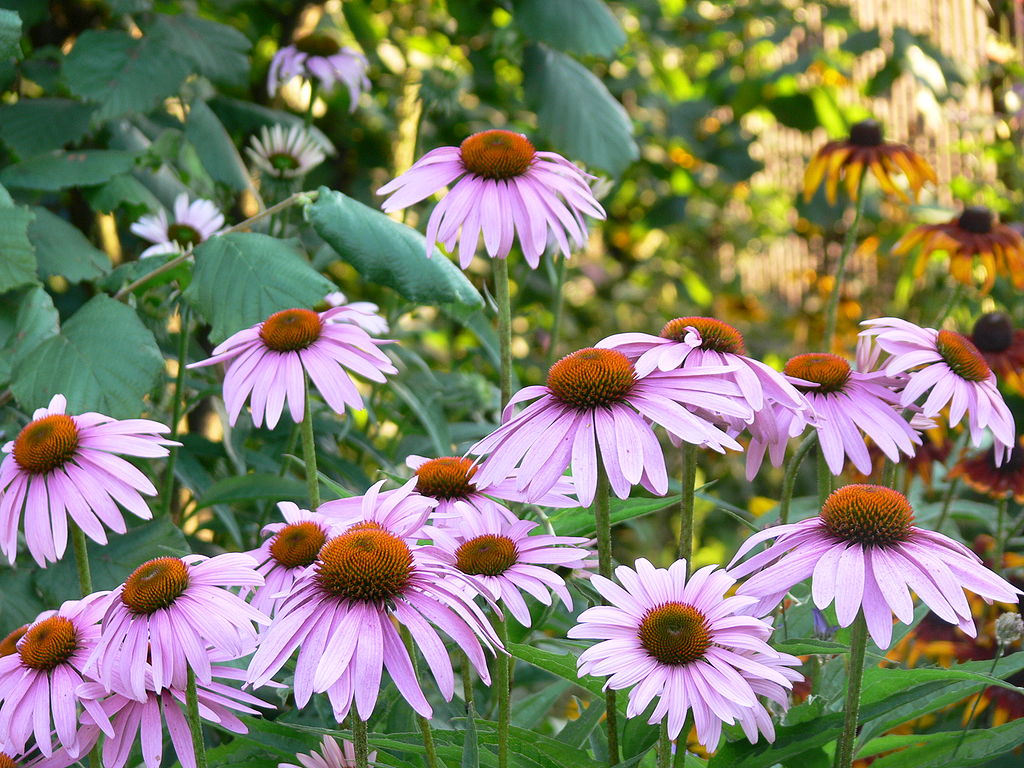
E. angustifolia Photo: Dy-e, Wikimedia Commons
E. angustifolia: Narrow-leaf coneflower or Black Samson
E. atrorubens: Topeka purple coneflower
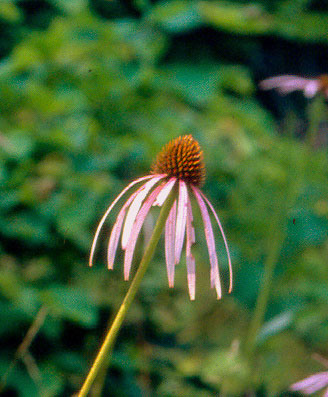
E. laevigata Photo: USFS, Unknown author, Wikimedia Commons
E. laevigata: Smooth purple coneflower Federally listed endangered species found in the Piedmont regions. This plant had much of its habitat destroyed when areas were converted to pine plantations.
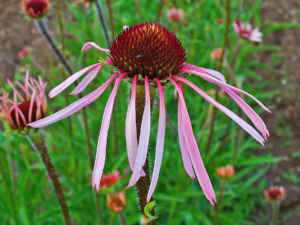
E. pallida Photo: Liez, Wikimedia Commons
E. pallida: Pale purple coneflower The states of Tennessee and Wisconsin list the species as threatened, mostly due to habitat loss and over-collection of roots, which are harvested for herbal medicine.
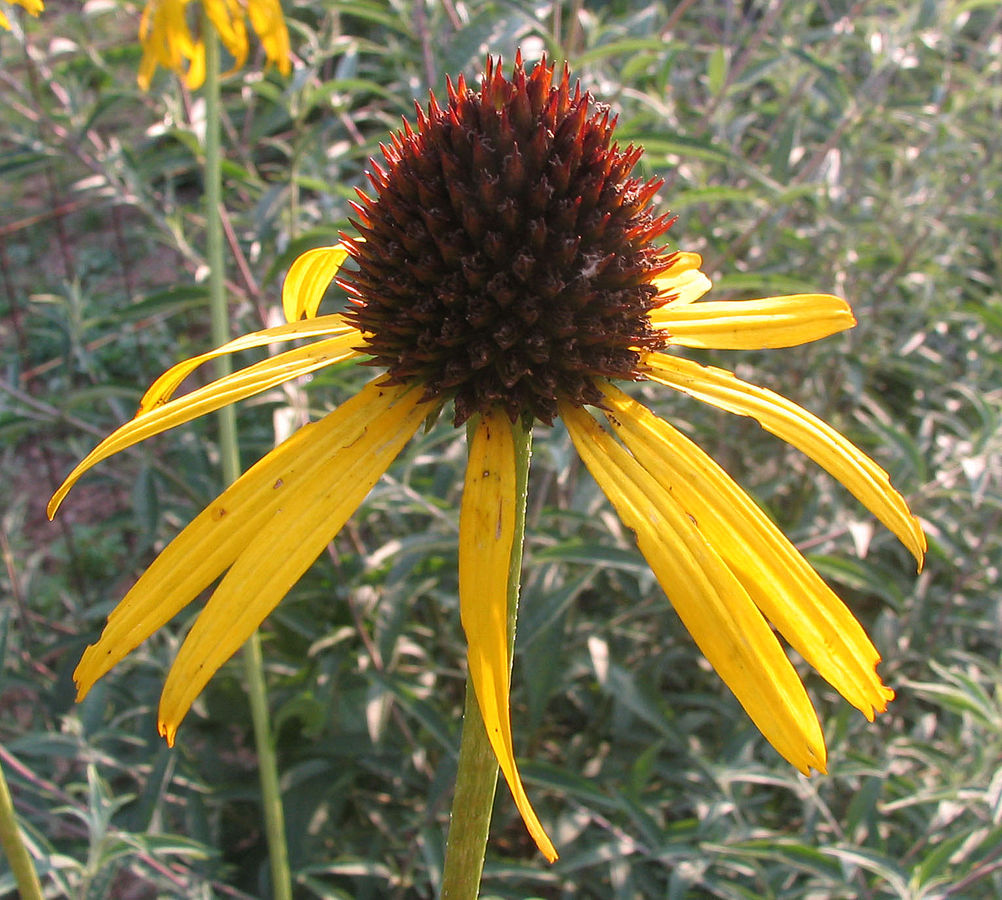
E. paradoxa Photo: Phyzome, Wikimedia Commons
E. paradoxa: Yellow coneflower. Central disk is dark brown and conical. Ray flowers vary from yellow (E. paradoxa var. paradoxa found in the Ozarks) to light purple (E. paradoxa var. neglecta, found only in Arbunkle Mtn. area of Oklahoma).
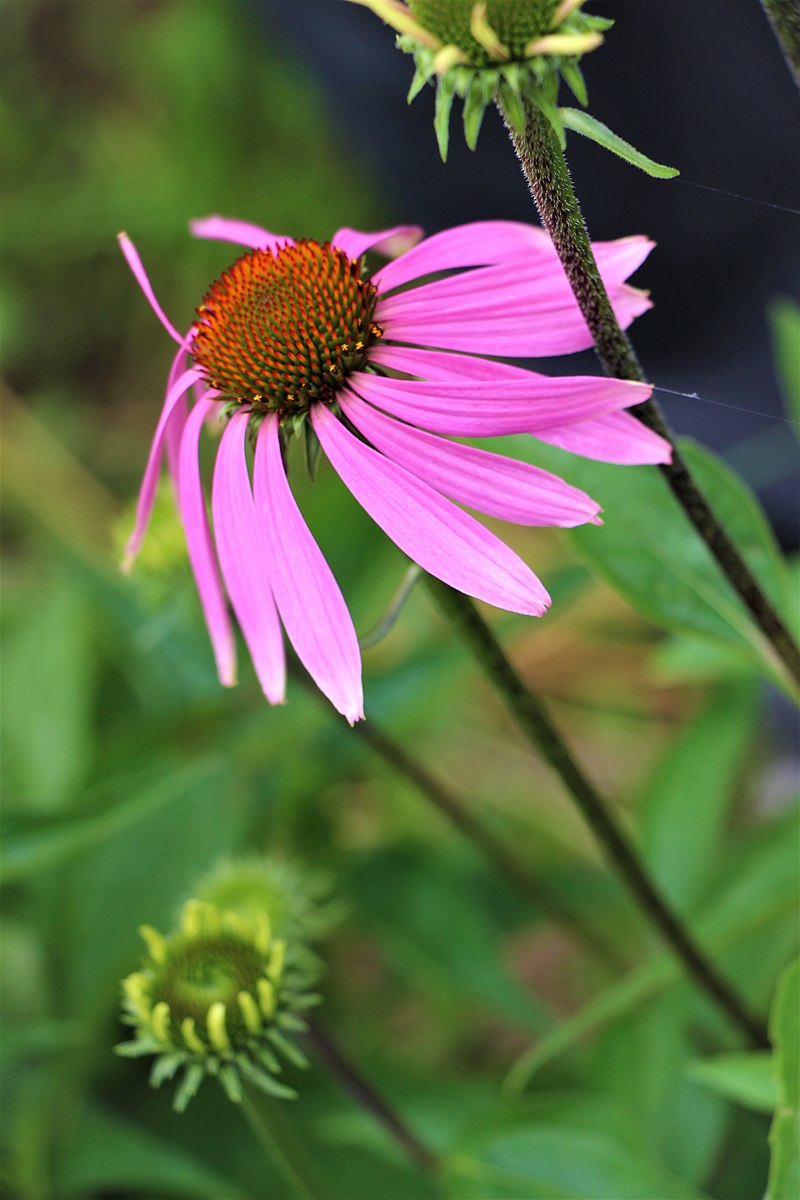
E. purpurea Photo:Lena Jaginyan, Wikimedia Commons
E. purpurea: Purple coneflower. Ray flowers vary from rose to deep purple, rarely white.
E. sanguinea: Sanguine purple coneflower. It is the southernmost Echinacea species. The specific epithet sanguinea, which is Latin for “blood”, refers to the color of the petals.
E. simulata: Wavy leaf coneflower. Pollen is yellow which helps distinguish it from E. pallida.
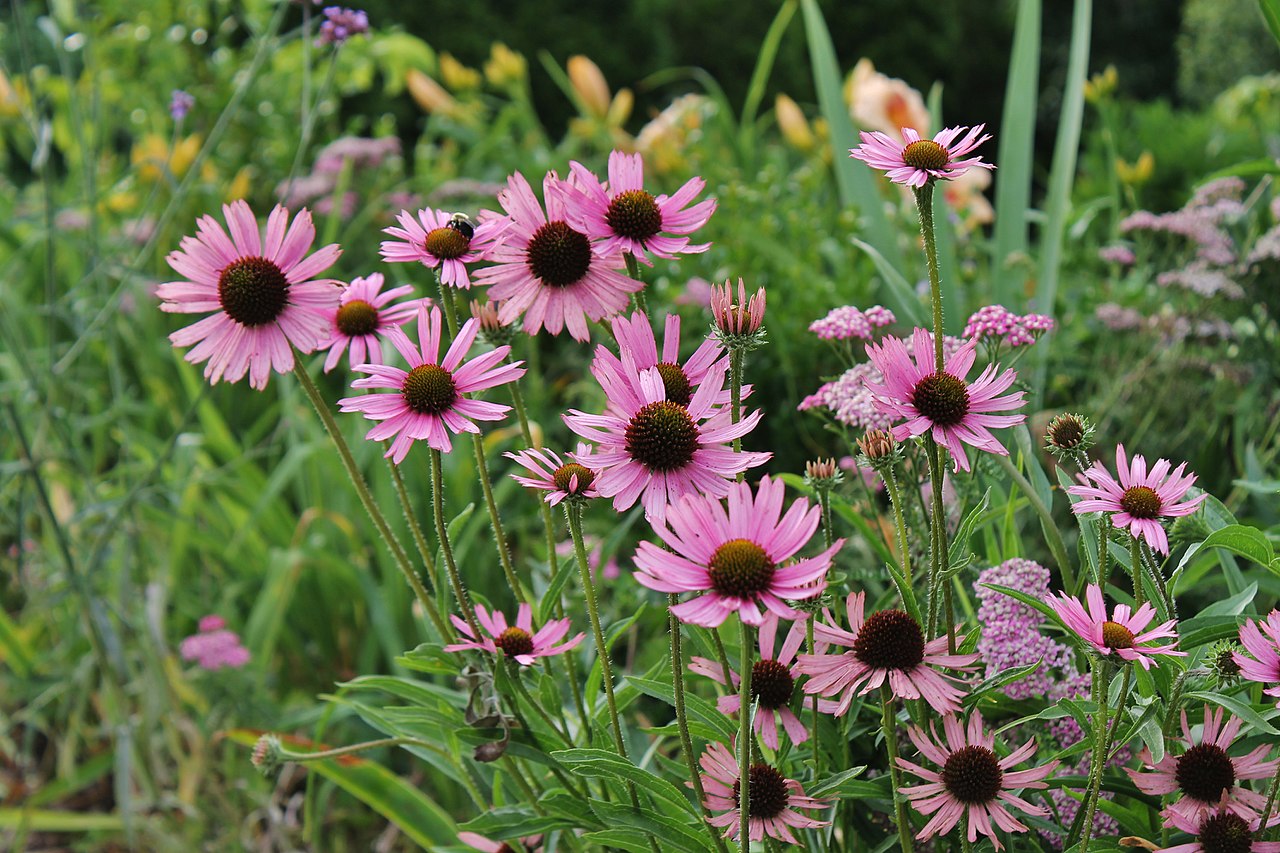
E. tennesseensis Photo: Romontant1, Wikimedia Commons
E. tennesseensis: Tennessee purple coneflower The official wildflower of Tennessee. In 1979, it was one of the first plants to be listed as endangered by the U.S. but was removed from the list in 2011 after successful conservation efforts to restore populations. Seeds are available commercially. Note in the photo above the upturned ray florets or petals, a characteristic that differentiates this species.
REPRODUCTION
Echinacea reproduces only by seed in the wild. Coneflowers cannot self-pollinate and must rely on insects to transfer pollen between plants to insure successful seed development. Insect pollinators include a diverse mix of flying insects including native bees, wasps, and butterflies. Where Echinacea species overlap in the wild, pollinators carry pollen from one species to another; there are many populations of naturally-occurring interspecies crosses with intermediate traits. Flowering typically occurs from early to late summer. Only a small percentage of seeds that mature in the fall germinate. Seedlings in the wild grow slowly, sometimes taking up to three years for a small rosette of basal leaves to put out a flower stalk.
Due to the lack of any specialized mechanism for seed dispersal, it is improbable that purple coneflower would colonize habitats distant from a seed source. As coneflower habitats decrease in the wild, seed banking efforts have helped prevent this popular flower from becoming extinct.
Echinacea will reseed itself in the garden. In fact, many coneflowers in the garden are new plants from reseeding that have replaced the originals. Mature clumps of coneflowers (3-4 years) can be divided in spring or fall. Although they are most commonly grown from seeds or divisions, coneflowers also grow from taproot cuttings taken in late autumn or early winter when the plant is dormant.
CARE
Coneflowers prefer well-drained, moist loam, but can tolerate a variety of soils including poor soils. They are tolerant of both acidic and alkaline soils in a pH range of 6-8. Coneflowers are not heavy feeders. In the absence of a soil test, they can be maintained with an application of a slow release fertilizer at a rate of 1 pound per 100 square feet in late March or early April, just before new leaves emerge. Echinacea likes well-drained soils, and for a number of the new cultivars, excellent winter soil drainage is essential or they may become short-lived perennials. Deadheading, though not necessary, results in some reblooming later in the season and prevents reseeding when not desired. Alternatively, seed heads left on the plants provide food that attracts seed-eating birds including juncos and finches, especially goldfinches.
DISEASES AND PESTS
Echinacea is subject to several diseases such as stem rots, powdery mildew, anthracnose, and aster yellows, as well as damage from aphids, Japanese beetles, and eriophyid mites. Proper spacing will increase air circulation between plants to keep leaves dry and help prevent the spread of powdery mildew and diseases. Removing plant debris also helps to reduce disease problems.
Aphids can be treated by spraying with a hose. Insecticidal soap sprays can be used for more serious infections. Eriophyid mites are microscopic in size and live inside the flower buds where they suck nutrients from the flowers. Damage results in tufts of stunted and distorted flower parts sprouting from the coneflower. Plants that are affected by eriophyid mites should be cut back to the ground in the fall and all plant debris should be removed and destroyed.
Aster Yellows is transmitted to the plant as leafhoppers feed on the plant. This disease causes a witches broom in the flower head, occasional greening of the petals, and stunting. Infected plants should be promptly removed and destroyed to prevent further spread of the disease.
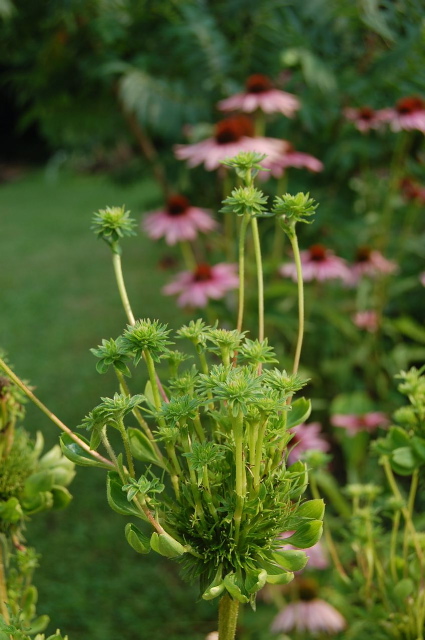
Aster yellows on E. purpurea Photo: Estreya, Wikimedia Commons
CULTIVAR INTRODUCTION
There are now over 200 Echinacea cultivars. Echinacea hybrids are sometimes marketed as Echinacea hybrida, Echinacea x hybrida, or simply with the genus and cultivar name, e.g. Echinacea ‘Sunrise.’
The popularity of Echinacea started to surge after a few landmark cultivar developments. In 1997, Jan van Winsen of The Netherlands found a double-flowered seedling in his cut flower fields. It was the first of its kind in the world. It was eventually successfully marketed as ‘Razzmatazz’ in 2003. The cultivar was an immediate hit and led to the breeding and release of many other double-flowered purple coneflowers.
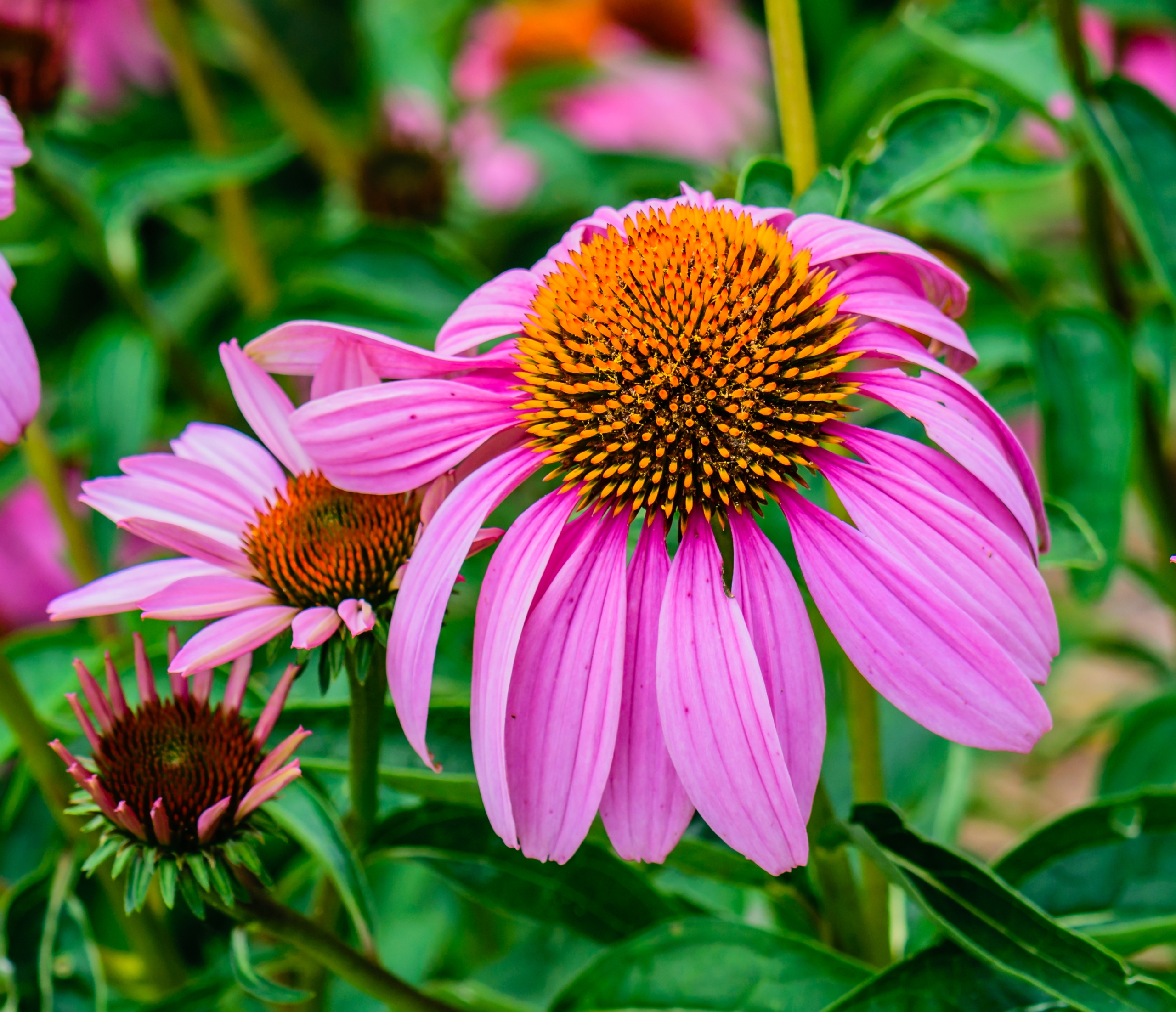
E. purpurea ‘Magnus’ Photo: PumpkinSky, Wikimedia Commons
German horticulturalists had been working since the 1960s on selecting cultivars of E. purpurea, and E. purpurea ‘Magnus’ was the break-through cultivar. It was introduced to commerce by German seedsman Klaus Jelitto, originally being selected from native U.S. plants by Swedish nurseryman Magnus Nilsson near Paarp, Sweden. The 1998 Perennial Plant of the Year award from the Perennial Plant Association catapulted ‘Magnus’ into the spotlight. Consumers loved its bold, giant flowers with rosy purple petals that spread out flat rather than drooping like most coneflowers.
Another huge boost of attention came from the cultivar introductions by Jim Ault, Ph.D., Director of Ornamental Plant Research at the Chicago Botanic Garden. Cross-pollinating by hand, it took him 6 years and more than 200 plants to get his first introduction, Echinacea ‘Art’s Pride’, a cross between E. purpurea ‘Alba’ and E. paradoxa (yellow coneflower). Ault had succeeded in developing the first orange coneflower, which caused a sensation in 2004. Ault went on to introduce many cultivars in the Meadowbrite™ series, including ‘Pixie’, ‘Orange’, ‘Mango’ and ‘Burgundy Fireworks’, and many other cultivars as well. In addition, ItSaul Plants in Atlanta was also developing Echinacea cultivars and introduced the Big Sky™ series.
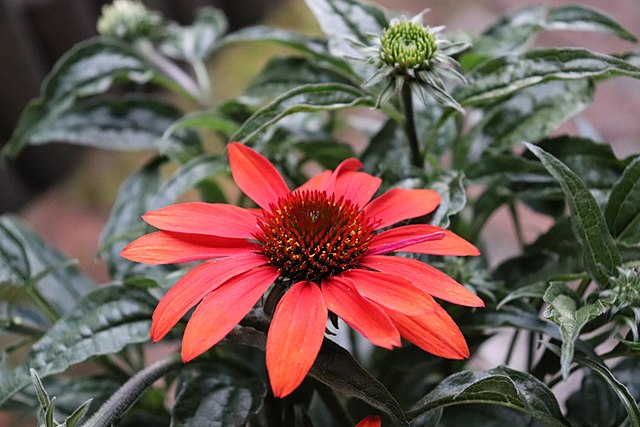
Echinacea ‘Cheyenne Spirit’ of Kieft-Pro Seeds Photo: S.G.S., Wikimedia Commons
Note: Many cultivars are sterile, which means they don’t produce seed that can be used by wildlife, nor can they self-seed in the garden to maintain the presence of a desired plant. Sterile cultivars can still produce pollen but the ability to produce pollen and nectar seems to be specific to a particular cultivar. Double-flowered varieties are sterile or near sterile, and have reduced quantity and/or accessibility of floral rewards. The question of whether native cultivars may be substitutes for native species in terms of maximizing attractiveness to pollinators is a complex and relatively new research topic that will be discussed in the July issue of The Garden Shed. Annie White of the University of Vermont is working on trial studies of pollinator attractiveness which include Echinacea cultivars. Douglas W. Tallamy, author of Bringing Nature Home and Nature’s Best Hope is also continuing work on pollinator trials with Mount Cuba and the University of Delaware.
MEDICINAL PROPERTIES
Herbal supplement sales are expected to reach $8.5 billion globally by 2025, with Echinacea representing the largest percentage. In 2017, the Echinacea segment accounted for the largest revenue share, 34.9% of the global market. According to the HerbalGram data published in 2017, Echinacea is the most prominent and third most popular herbal supplement in the mainstream retail distribution network in the U.S.A.
In Germany, herbal supplements are regulated by the government and are offered by prescription. Much of the research on the efficacy of Echinacea has been done in Germany. The products on the market are manufactured in a variety of ways, include numerous species harvested from many sources and use different plant parts. In addition, there are problems concerning the botanical identity of Echinacea species used in commercial preparations. The lack of standardization may contribute to the lack of rigorous clinical evidence supporting the diverse claims implied for these products.
Many studies have been done on Echinacea and the common cold, but there is no confirming evidence for curing a cold or for reducing the chances of catching a cold. Much less research has been done on the use of Echinacea for other health purposes, such as boosting the immune system. Currently, the National Center for Complementary and Integrative Health (NCCIH) is funding research to identify the active constituents in Echinacea and to study the effects on the human immune system of substances in bacteria that live within Echinacea plants.
Native Echinacea species are dwindling in the wild from loss of habitat, slow recolonization, and over-harvesting for the herbal industry. Despite the presence of many large herbal farms that grow Echinacea, professional wild harvesters take up to 200,000 lbs. of Echinacea root every year, faster than the species can regenerate.
SUMMARY
With its ability to “make do” in less-than-ideal conditions, E. purpurea is a welcome addition to sunny perennial gardens. It is drought tolerant, deer resistant, and accepting of many types of soil conditions, including poor soils. It self-seeds in the garden, has a long bloom time, and attracts pollinators. High pH? Fine. Low pH? That’s okay, too. Purple coneflower needs good drainage, but is that too much to ask? There is a plethora of Echinacea cultivars on the market, offering a range of heights from the front to the back of the garden. The colors are dazzling. The trade-off might be that not all cultivars are beneficial to pollinators, or a particular cultivar may not be as hardy or as long-lived as the straight species. If you want to live on the wild side, you could try a few cultivars just for fun. But don’t abandon E. purpurea. It’s earned its place.
SOURCES
“From Nursery to Nature: Evaluating Herbaceous Flowering Plants Versus Native Cultivars for Pollinator Habitat Restoration,” University of Vermont, ScholarWorks @ UVM, Graduate College Dissertations and Theses, Annie White, 2016, https://scholarworks.uvm.edu/graddis/626/
K. 2003. Forsch Komplementarmed Klass Naturheilkd. 10 Suppl 1:9-12 [Article in German]. https://www.ncbi.nlm.nih.gov/pubmed/12808356
Echinacea purpurea ‘Magnus’, University of Vermont Extension, http://pss.uvm.edu/ppp/jan98per.html
“Coneflowers for the Mid-Atlantic Region,” Mt. Cuba Center Research Report 2009, Jeanne Frett and Victor Piatt, https://mtcubacenter.org/trials/echinacea/
“The Conservation Status of Echinacea Species,” Kansas Biological Survey, University of Kansas, Edited by Kelly Kindscher, www.fs.usda.gov › FSE_DOCUMENTS › fsm91_054353
“From Prairie to Garden,” Chicago Botanic Garden, Beth Botts, https://www.chicagobotanic.org/plantinfo/prairie_garden
“Coneflowers: Native Vs. Hybrid,” Dyck Arboretum of the Plains, Katie Schmidt, https://dyckarboretum.org/coneflowers-native-hybrid/
“Native Cultivars versus Native Plants & Their Attractiveness to Pollinators,” Kim Eierman, Ecobeneficial, https://www.ecobeneficial.com/2014/04/native-cultivars-vs-native-plants/
Echinacea, Clemson Cooperative Extension, Home and Garden Information Center, https://hgic.clemson.edu/factsheet/echinacea/
Business Wire, https://www.businesswire.com/news/home/20190315005239/en/Global-8.5-Billion-Herbal-Supplements-Market-Product
“A Better Cone Flower?” The Chicago Tribune, Beth Botts, 8/26/2007, https://www.chicagotribune.com/news/ct-xpm-2007-08-26-0708230311-story.html
“Insecticidal Soaps for Garden Pest Control,” Clemson Cooperative Extension, https://hgic.clemson.edu/factsheet/insecticidal-soaps-for-garden-pest-control/
“Echinacea Explosion – The Coneflower Chronicles,” Plant Delights Nursery, https://www.plantdelights.com/blogs/articles/purple-coneflower-echinacea-purpurea-plant
“Echinacea purpurea Root,” American Botanical Council, http://cms.herbalgram.org/expandedE/EchinaceaPurpurearoot.html?ts=1589908161&signature=4b9b1f4ed678301c51bac4d322d0b32e
“Echinacea for Preventing and Treating the Common Cold,” NCBI, https://www.ncbi.nlm.nih.gov/pmc/articles/PMC4367446/
Feature Photo: E. purpurea, purple coneflower, Photo: H. Zell, Wikimedia Commons
Tasks and Tips in the Ornamental Garden
For many ornamental gardeners in our area, June is a maintenance month. Plants have been selected and planted, the temperatures are climbing steadily, and now we need to weed, pinch back, deadhead, water, and monitor for pests and diseases.
Just a reminder: The Piedmont Master Gardeners website has a new feature: monthly gardening tasks and tips are now appearing under Gardening Resources on the main page of the PMG website. For more June tips and tasks, take a look at Gardening Resources/Monthly Gardening Tips/Piedmont Master Gardeners
DAFFODILS
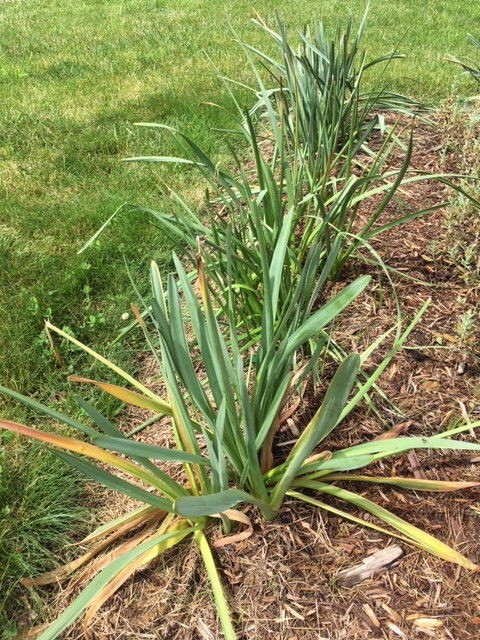
Daffodil foliage at different stages Photo: Susan Martin
Don’t cut back daffodils until the foliage turns yellow or just let the foliage die back. Bulbs store food through the foliage for about 6 weeks after blooming is finished. Note that not all daffodils will turn yellow at the same time. The foliage of earlier bloomers will be ready for cutting before mid-to-late bloomers. If your daffodils were done flowering in mid-April, they should turn yellow by early June.
June is the time to divide crowded clumps of daffodils that aren’t producing as many flowers. When the leaves have turned almost all brown, carefully dig up the bulbs and separate them. Either replant them right away or store them until fall and plant then. Remember to take a picture of your daffodil plantings, or place a physical marker where you plan to add more bulbs in the fall.
DEADHEADING
Many perennials benefit from deadheading, which is removing seed heads after flowering is finished to allow the plant to store more energy for next year’s bloom. As soon as plants are allowed to set seed, chemical messages are sent to stop flower production. Removing spent blooms short-circuits this message so that the flowers will continue to bloom.
Flowers with larger blooms can be deadheaded by cutting one spent flower at a time. Such flowers include peonies, daffodils, roses, and zinnias. Another technique is shearing across the top of a plant that has many small blooms. This technique can be used in June-July for either pre- or post-bloom management. Early bloomers such as catmint (Nepeta), mountain bluet (Centaurea montana), bellflowers (Campanula) can be sheared by about one-third after blooming to encourage a second bloom and to neaten the plant’s appearance. Later-blooming plants with small flowers, such as sneezeweed (Hellenium autumnale), can be sheared by about 6-8” before blooming to encourage strong branching and denser growth.
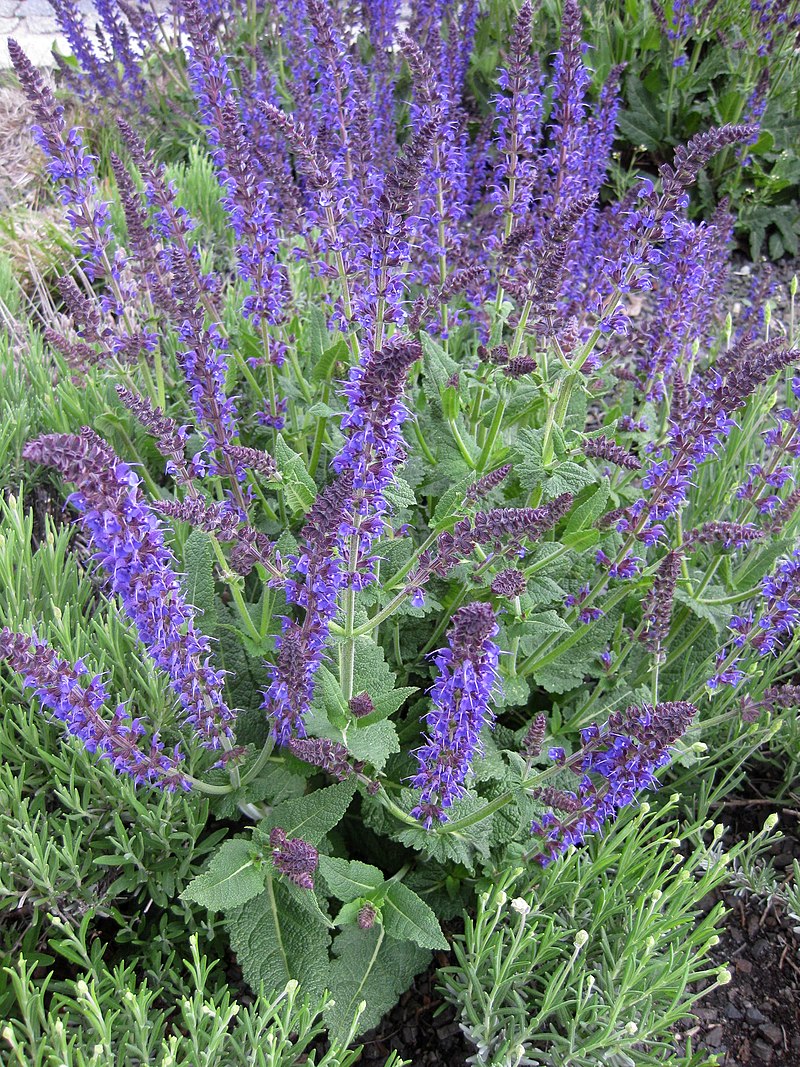
Salvia nemorosa ‘May Night’ Photo: Wilhelm Zimmerling PAR, Wikimedia Commons
There is another deadheading technique for plants that have flower spikes that rise from basal foliage (leaves immediately above the crown of the plant). Salvia nemorosa ‘May Night’ is an example of a plant with 6-10″ flower spikes that rise on short stems from rosettes of dark green basal foliage. Lance-shaped leaves are arranged in pairs directly across from each other. The small individual flowers on “May Night” spikes open from the bottom of the spike up. As the flowers at the tip fade, but before they set seed, snip individual stems away just above a pair of leaves that has small flower buds emerging from the joint. Cut between where the leaves emerge from the stem and the stem itself. Lateral branches will grow to produce new, smaller flower spikes. As the season goes on, the foliage tends to get very large and spent-looking. At this point, trim the stems back several leaf notches, or trim stems all the way to the basal rosette. Pale beardtongue (Penstemon pallidus) is another example of a plant with basal rosette leaves.
PINCHING BACK
Late-bloomers, such as asters, chrysanthemums, and sedums, can be pinched back until mid-July to encourage a fuller, sturdier shape. This term means that you literally pinch out the growing tip of each stem between your thumb and forefinger. Pinching back will delay blooming somewhat, but the fuller plant shape and stronger stems are worth the wait. The technique also helps you tweak bloom times. If you have a big grouping of asters, for example, you might pinch one group a little earlier and more frequently than others so that the bloom season is extended overall.
REFRESHING
Lungwort (Pulmonaria) is a beautiful, low-growing, early-spring blooming perennial that likes a moist place in the shade garden. In mid-summer, remove the flower stalks to stop seed production and to give more energy to the plant. When the foliage starts to turn yellow, trim off the spent leaves down to the base. This makes the foliage healthier and neater, especially when it has been damaged by slugs. Brunnera macrophylla is another spring-blooming shade plant whose leaves can get brown and damaged by slugs. Remove the oldest, yellowest leaves down to the base. Although neither of these plants rebloom, they will look fresher with new foliage.
PRUNING
June is prime time for pruning some shrubs. Check the Virginia Cooperative Extension (Va. Coop. Ext) Publication 430-462, “Shrub Pruning Calendar” for information on which shrubs to prune in June and which shrubs not to prune in June.
WATERING
Annuals and Perennials
As June temperatures rise, keep an eye on watering, especially for newly-added perennials and annuals. Remember that plants will dry out even more quickly on windy days. The general rule of thumb is one inch of water per week for established plantings. Watering plants more deeply but less frequently encourages them to set deeper roots; this helps plants become more drought resistant. Mulch perennials with a 2-inch layer of compost, pine bark, or pine straw to help keep down weeds and conserve moisture. Avoid overly heavy mulching that could cause crown rot.
Container Plantings
As the summer continues, container plants need more water. More water evaporates in the heat, and the plants grow larger. Depending on the size of the pot and the types of flowers, you may need to water twice a day, once in the morning and again at the end of the day. When choosing plant groupings for containers, be mindful of water requirements. Group plants that require moist conditions in one container, and group drought-resistant plants in another container. Water the plants until the water comes out of the drainage holes. Water the soil, not the leaves and flowers. Wet foliage can lead to fungal diseases or to scorched spots on leaves. Water-soluble liquid fertilizer should be applied approximately every two weeks. For more information on caring for container plants, see The Garden Shed.
Newly Planted Trees and Shrubs
Newly-planted shrubs are considered established when their root spread equals the spread of the above-ground canopy. This usually takes between 1-2 years. For trees, establishment is estimated by allowing 1.5 years per inch of tree caliper. Therefore, a 2” caliper tree will take about 3 years to establish on average.
How much water is enough? This answer depends partly on how much water the soil retains. Assuming well-draining soil, these recommendations are provided by the University of Minnesota Extension:
- 1-2 weeks after planting, water daily.
- 3-12 weeks after planting, water every 2 to 3 days.
- After 12 weeks, water weekly until roots are established.
- When watering newly-planted trees, apply 1-1.5 gallons per inch of stem caliper at each watering.
- When watering newly planted shrubs, apply a volume of water that is 1/4 – 1/3 of the volume of the container that the shrub was purchased in.
Place 2-3” mulch around the base of the tree AWAY FROM THE TRUNK. Too much moisture build-up between the trunk and the mulch can cause wood decay diseases, and fungus infections.
LOW MAINTENANCE PERENNIAL GARDEN
There are lots of maintenance tasks in the June garden, which brings us to the larger question, “Is there such a thing as a low-maintenance perennial garden? The Chicago Botanic Garden offers some tips:
Give careful consideration to plant choice and plant location. Matching the requirements of a plant to the characteristics of the site takes some planning, but will save hours of work in the garden. Soil and water conditions are important things to consider. Here is an example from my own garden:
Sedge (Carex) is a groundcover that attracts butterflies and is a good native alternative to Liriope. I chose Carex flaccosperma which has a beautiful bluish tinge and foliage that’s a little broader than some of the other sedges. C. flaccosperma requires moisture and a shady location. My planting was along a main path, near a water source. But did I want to spend all that time watering for a less-than-optimal result? The beautiful, bluish green color faded to yellowish-green. The planting location is too sunny and too dry; I’ll need to find a shadier spot for growing this sedge. For more information on Carex, see The Garden Shed.
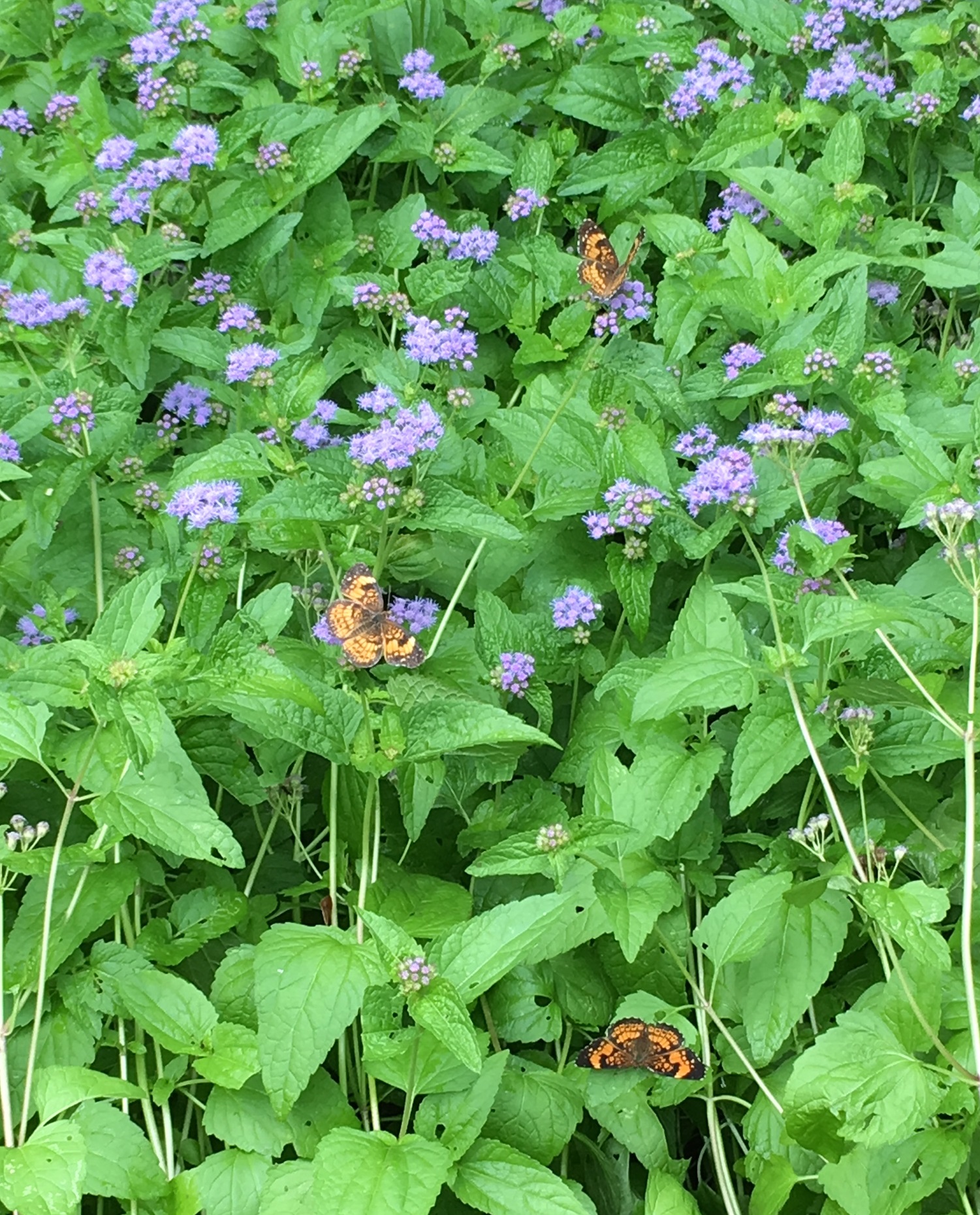
Mist Flower, Conoclinium coelestinum Photo: Susan Martin
Some plants are aggressive spreaders, perhaps too aggressive for a low-maintenance gardener. An example from my garden involved mist flower, Conoclinium coelestinum, a native perennial that spreads through both creeping rhizomes and through self-seeding. The seed is both abundant and wind-carried. The perennial has a beautiful blue-colored flower that looks very similar to annual ageratum, and blooms profusely from mid-to-late summer. I was very happy with it the first season, but a little less so the second. By the third season I was spending way too much time pulling out little starter plants. Although they come out easily, it was very time consuming to keep the spread under control. I finally decided to pull out all of the mist flower, giving some away with “fair warning” to other gardeners. For another gardener, with a different type of landscape, the spreading qualities of this plant might work very well. For more information on this plant see The Garden Shed.
If you want the garden to look pristine, you have to deadhead and groom weekly. On the other hand, a looser, more naturalistic look, requires less maintenance. Most plants will benefit from deadheading for continued bloom, but you can choose whether or not to take on this chore. Many native plants can look very attractive with spent seed.
Some plants to consider that do not require deadheading include: Astilbe, blue false indigo (Baptisia australis), Russian sage (Salvia yangii, previously known as Perovskia atriplicifolia), Blue star (Amsonia tabernaemontana), Blue star (Amsonia hubrichtii), various ornamental grasses, and sedge. For reduced maintenance, you might also wish to avoid plants that require labor-intensive division such as irises and lilies.
MONITOR FOR MILDEWS
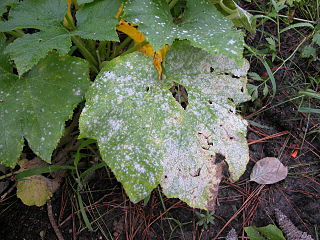
Powdery mildew Photo: Ejdzej, Wikimedia Commons
Ornamental plants are subject to two common types of mildew that will manifest early in the season, around June 1, depending on conditions. Powdery mildew is a true fungal pathogen that produces white, flour-like colonies, usually on upper leaves. The fungus can cause severe leaf drop, and affects vigor and resistance to stress over time. The fungus can affect many ornamental plants that are favorites in the perennial garden, including: wild bergamot (Monarda fistulosa), bee balm (Monarda didyma), garden phlox (phlox paniculata), tickseed (Coreopsis grandiflora), purple coneflower (Echinacea purpureum), and zinnia.
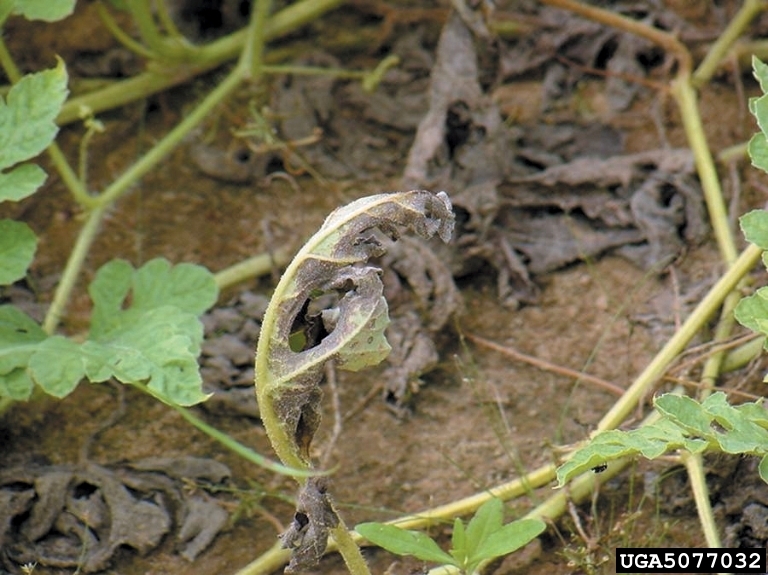
Downy mildew on watermelon leaf Photo: David B. Langston, Wikimedia Commons
Downy mildews, on the other hand, are a completely different kingdom of organisms, more closely related to algae than to fungi. Downy mildews produce grayish, fuzzy looking spores and mycelium on the lower leaf surfaces. The distinction between powdery mildews and downy mildews is important, because the fungicides effective against one are not usually effective against the other — although, as with every rule, exceptions do exist.
Preventative controls for each disease are important and include the following steps: selecting disease-resistant varieties and cultivars, providing good air circulation among plantings, and disposing of diseased foliage. The early use of fungicides may be necessary. Different fungicides are effective for each disease. See powdery mildew and downy mildew.
INSECT PESTS
Japanese beetles begin appearing in June with adult activity often peaking in early July. Adult Japanese beetles are mainly leaf feeders that consume the tissue between leaf veins. Because the veins of the leaf are left intact, the damage is often referred to as skeletonization. Handpicking is an early deterrent. See The Garden Shed for sources on treatment.
Azalea Lace Bug and Rhododendron Lace Bug both have two generations per year. Please note: Lace bugs should not be confused with the beneficial lacewing insects that have long wings held vertically against their sides, Lace Bugs, Univ. Conn. Ext.. ( If you haven’t done so already, read about those beneficial lacewings in this month’s feature article, Natural Pest Control/The Garden Shed.) Lace bug damage is first noticed as yellow spots on the upper leaf surfaces of affected plants. Lace bugs actually feed on the undersides of leaves with their piercing-sucking mouthparts. When feeding damage becomes severe, the leaves take on a gray, blotched appearance or can turn completely brown. As lace bugs feed, they produce brown varnish-like droppings that spot the underside of the leaves. Try to control the first generation from mid-May to mid-June; two sprays may be necessary. Sycamore Lace Bug should also be treated in June or when nymphs appear. Multiple generations occur each year and defoliation may occur in severe cases. For control measures, see this link from the University of Georgia Extension.
Aphids can attack shrubs, trees, perennials, and annuals. Catching the infestation early is key. For information on identification and treatment see this link from Virginia Cooperative Extension.
Check for ticks whenever you spend time out in the garden. See “Managing the Tick Problem” from The Garden Shed.
SOURCES
The Piedmont Master Gardeners website has a new feature: monthly gardening tasks and tips are now appearing under Gardening Resources on the main page of the PMG website. For more June tips, take a look at Gardening Resources/Monthly Gardening Tips/Piedmont Master Gardeners
See past issues of The Garden Shed for June Tasks and Tips in the Ornamental Garden: 2015, 2016, 2017, 2018, and 2019.
“Maintaining a Perennial Garden,” Chicago Botanic Garden, https://www.chicagobotanic.org/plantinfo/maintaining_perennial_garden
“Watering Newly Planted Trees and Shrubs,” University of Minnesota Extension, https://extension.umn.edu/planting-and-growing-guides/watering-newly-planted-trees-and-shrubs
“Daffodil FAQs,” The American Daffodil Society, https://daffodilusa.org/daffodil-info/daffodil-faqs/
“How and When to Prune a May Night Sage Plant,” SFGates, https://homeguides.sfgate.com/prune-may-night-sage-plant-40509.html
“Shrub Pruning Calendar, Virginia Cooperative Extension, pubs.ext.vt.edu/430/430-462
“Successful Container Gardens,” University of Illinois Extension, https://web.extension.illinois.edu/containergardening/fertilizing.cfm
“Container Gardening II: What to Grow & How,” The Garden Shed, https://pmgarchives.com/article/container-gardening-part-2-what-to-grow/
“Powdery Mildew on Phlox and Monarda,” University of Vermont Extension System, Leonard P. Perry, https://www.uvm.edu/~pass/perry/cohmild.html
“Downy Mildew,” Purdue Extension, https://www.extension.purdue.edu/extmedia/BP/BP-68-W.pdf
“Fungal Disease: Powdery Mildew,” University of Illinois Extension, hortanswers, https://web.extension.illinois.edu/hortanswers/detailProblem.cfm?PathogenID=147
Japanese Beetles, West Virginia Extension Service, https://extension.wvu.edu/lawn-gardening-pests/pests/japanese-beetle
Lace Bugs, Virginia Tech Cooperative Extension, Eric Day, Publication 444-212. https://www.sites.ext.vt.edu/departments/entomology/factsheets/lacebug.html
Control of Lace Bugs on Ornamental Plants, University of Georgia Extension, https://extension.uga.edu/publications/detail.html?number=B1102&title=Control%20of%20Lace%20Bugs%20on%20Ornamental%20Plants
Aphids, Virginia Cooperative Extension, https://www.pubs.ext.vt.edu/444/444-220/444-220.html
“Managing the Tick Problem,” The Garden Shed, https://pmgarchives.com/article/managing-the-tick-problem/
Feature photo, Monarda didyma, Andrey Korzun, Wikimedia Commons
Upcoming Events
Get Gardening
Virginia Cooperative Extension Webinar Series
Thursdays, June 4, 11, 18, 25
2:00-2:30 P.M.
Designed for beginner gardeners, this 13-part series of 30 minute lessons taught by professional staff of the Virginia Cooperative Extension is available to the public for FREE on Facebook Live. REGISTER here for upcoming live lessons. The series has covered topics such as Basics of Home Vegetable Gardening, Raised Bed Gardening, Successful Seeding and Transplanting, and Gardening for Wildlife. Past webinars are available for viewing through https://www.faceb…
Plant Pest & Problem Walks (on Zoom)
Montpelier in Partnership with Virginia Cooperative Extension Service
Join extension agent Ashley Appling and Montpelier’s Curator of Horticulture, Allyson Whalley, who team up to explore common pests and diseases found in the landscape. Learn to diagnose problems, different methods of control, and the resources to help combat your landscape problems. Each class explores current seasonal pests and diseases. Zoom attendance is FREE.
- Wed June 17, 10 am – 12 pm
- Thur July 16, 10 am – 12 pm
- Thurs Aug 13, 10 am – 12 pm
Register by clicking this link and we’ll send you an invite to participate:
For more information, contact Ashley Appling at (540) 727-3435 or ashappling@vt.edu
Master Gardener College
Virginia Cooperative Extension
June 25-28, 2020
Master Gardener College will take place online year using ZOOM videoconferencing. This format presents a wonderful opportunity for Master Gardeners who have never attended this event at Virginia Tech’s campus in Blacksburg. Registration is $50, and of course there are no travel expenses. When you register for College, you have the option of attending sessions live AND watching recorded sessions later. Once all session recordings are posted, you will have access to 20+ sessions! Click here for more information and to register.
Ecology in the American Landscape: At Home With Nature
Co-sponsored by New Directions in the American Landscape (NDAL),
American Horticultural Society (AHS), and Wild Ones – Native Plants, Natural Landscapes
June Webinars
Developed by Larry Weaner, this live, interactive, national webinar series for home gardeners and educators will cover an eclectic variety of topics while generally emphasizing the importance of place-based ecological landscapes. One-hour sessions are $25; 30-minute-sessions are free.
Topics include:
Native Meadows: Let’s Get Real
The Self-Sufficient Landscape: Being Your Own Plant and Seed Source
Native Design, Planting Maintenance: Breaking the Rules
Foraged Flavors:More Than Just Edible
Living in the Wild: My Home Landscape
Conversations With an Owner-Operator Landscape Gardener
Five Easy Steps to Home Composting
Dealing With Weeds, Deer, and Other Garden Hurdles
How to Navigate Nature With Children
For dates, times, and to register, click here.
Blue Ridge PRISM (Partnership for Invasive Species Management)
Invasive Plant Workshops
Event planning needs to remain flexible in the face of Covid 19. The June PRISM events have been switched to a FREE videoconferencing format through ZOOM. Registration is still required. For events planned for dates after June 30, refer to the website for updated details. Fall workshops are $10.
Blandy Experimental Farm – Boyce
Wednesday October 7 (1:00 – 5:00pm) – REGISTER HERE
Ivy Creek Natural Area
Saturday June 20 (1:00 – 5:00pm) – REGISTER HERE (ZOOM VIDEOCONFERENCING)
Thursday October 22 (1:00 – 5:00pm) – REGISTER HERE
Southeastern Plant Symposium at Home – Webinar
Hosted by the JC Raulston Arboretum and Juniper Level Botanic Garden
Friday, June 12 – 10:00 am–3:00 pm
We’ve revamped the schedule of our second annual Southeastern Plant Symposium and created an online version to help us and our participants slow the spread of COVID-19. Join us as we host the best of the best to talk about cutting-edge plants. Online via Zoom. Instructions will be provided by e-mail. Advance registration is required; cost $50. Please register online using our registration e-store. Contact Chris Glenn at chris_glenn@ncsu.edu for more information about this symposium.
Conserving Bumblebees in Our Natural Areas
USDA Forest Service and Natural Areas Association Webinar
Tuesday, June 30
12:00 Noon EDT
Come learn what the Xerces Society is doing to help conserve the buzz in our meadows and natural areas by protecting bumble bees and what you can do to help. Included will be information about bumble bee ecology and life history, as well as ways to manage land and participate in community science projects that will help track and conserve our essential native pollinators. Presented by Rich Hatfield, Senior Conservation Biologist, Endangered Species Program, The Xerces Society for Invertebrate Conservation.
This webinar is free; see this link for more information and to register.
The Edible Garden in June
Wouldn’t you know it, after a couple of months of touting the rollback of Hardiness Zone 7A’s final frost date to April 15-25, and gloating about the last frost way back in early March, we get frosts in early May. Apparently, it is getting warmer, but also more variable. Vigilance, vegetable gardeners, vigilance. I hope you were able to get your tomatoes, cukes, beans, etc. protected. Happy to say that my garden made it through with some last minute row covers.
If you’ve been following the planting schedule in Extension Publication 426-331, “Virginia’s Home Garden Vegetable Planting Guide,” you should be harvesting a nice crop of spring vegetables. As we move into June it is still planting time for beans, cucumbers, eggplant, melons, okra, peppers, pumpkins, winter and summer squash, sweet corn, sweet potato and tomatoes.

Trellises conserve garden space
If your space is getting tight, you might want to try some intensive gardening techniques. These include vertical gardening, inter-planting and succession planting. There is some thought required to find complementary pairings of different plants and to arrange them in the most productive ways. Benefits include high production per available space and potential insect and disease management advantages. Check out the possibilities in Extension Publication 426-335, “Intensive Gardening Methods.”
Other suggestions for garden management this month:
Rotate crop locations to minimize the buildup of pests and pathogens. A 3-year cycle is commonly recommended.
Thin the seedlings of carrots, beets and other root crops to the recommended spacing to avoid crowding.
Now that the ground has warmed, apply organic mulches such as leaves, straw and clean grass to conserve water, suppress weed germination, and enrich soil as the mulch decomposes.
Repeat plantings of corn, beans, and other summer vegetables as the cool weather crops go to seed, to extend the harvest season.
Monitor soil moisture. As a general rule, vegetables require about an inch of water per week during the growing season. Soaker hoses or drip irrigation make the most efficient use of water during dry spells.
Water in the mornings and avoid splashing water and soil on plants to minimize the risks of mildew and soil-borne disease transmission. For the same reason, remove lower leaves on your tomato plants to prevent inadvertent soil contact.
Cool mornings are also the optimum time to pick vegetables for best texture and taste.
Asparagus –– stop harvesting when spears become thin.
Growing lettuce under a shade screening material will slow bolting and extend the harvest season. Also, try planting bolt-resistant varieties such as Muir, Sierra and Nevada.
Continue to mound soil up around potato vines to prevent the tubers from being exposed to the sun and turning green. You can also add a layer of straw or leaf mulch to help control weeds.
By June, our cole crops (cabbage, broccoli, kale, collards etc) will be invaded by a variety of cabbage worms, including loopers, imported cabbageworm moths, and the dreaded cross-striped cabbage worm. They are tough to control but can be managed. Holes chewed in leaves and dark excrement piles on leaves are the signs of attack. If hand picking, look for yellow eggs on the undersides of leaves as a start. Pull the caterpillars off leaves regularly; they do fast damage when uncontrolled. They can also be managed with row covers and with the organic pesticide Bacillus Thuringiensis (Bt), available at garden centers. For more details review OMG What’s Eating the Broccoli from the June 2018 issue of The Garden Shed.
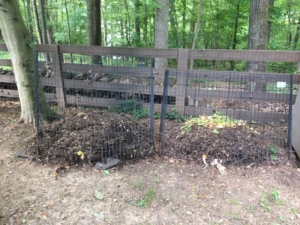
Compost heaps brewing inside former puppy pens
I always like to encourage folks to have some compost cooking. If you’ve saved some leaves and/or yard trimmings from last fall, combine them with grass clippings and kitchen vegetable cuttings to generate compost that you can apply to your beds prior to winter. I find that roughly equal volumes of grass clippings and mulched leaves is about right to achieve a hot compost batch. If it doesn’t get hot, add more grass and kitchen scraps. If it is slimey or gives off an ammonia smell, add leaves, wood chips, sawdust (not pressure treated) or other carbon source. Keep the pile moist but not dripping and turn it every week or so to keep it aerated. A second heap can take regular additions of materials as they become available throughout the summer. It decomposes a bit more slowly and less uniformly than the hot pile, but still produces a beautiful product in the end. It’s worth the effort! For more detailed guidance look at the article Backyard Composting with Practical Tips from the Pros in the January 2018 issue of The Garden Shed.
Collapsible puppy pens make a simple, inexpensive compost containment system (see photo). Clip the open ends together for containment. Unclip and swing open to turn the pile.
Herbs planted in average soil need no fertilizer. Too much fertilizer may reduce flavor and pungency.
The best time to harvest most herbs is just before flowering, when the leaves contain the maximum essential oils. Cut herbs early on a sunny day.
To control earworms on corn plants: apply several drops of mineral oil to the corn silk.
Thin overloaded fruit trees; this will result in larger and better fruit at harvest time.
Renovate the strawberry patch after harvest. Mow the rows, thin out excess plants and apply mulch for weed control.
For more tips on a variety of gardening topics, check out the Monthly Gardening Tips listed on the PiedmontMasterGardeners.org website under Gardening Resources.
Sources:
Adapted from the Albemarle/Charlottesville VCE Office, “Monthy Horticulture Tip Sheets,” albemarle.ext.vt.edu/hort-tip-sheets/6-14-veg.pdf ; albemarle.ext.vt.eduhort-tip-sheets/6-14-fruit-nuts.pdf; albemarle.ext.vt.eduhort-tip-sheets/6-14-herbs.pdf
“Vertical Gardening Using Trellises, Stakes and Cages,” https://www.pubs.ext.vt.edu/content/dam/pubs_ext_vt_edu/HORT/HORT-189/HORT-189-pdf.pdf
Cover photo: “Growing Courgettes IMG_2796” by tomylees is licensed under CC BY-NC-SA 2.0
Hazelnuts
What can be better than an edible plant, native to Piedmont Virginia, that can be grown as a bush or small tree in your yard or home orchard? The American hazelnut (Corylus americana) grows in most of the eastern half of the United States and is relatively hardy, disease resistant, and adapts to various growing conditions. You may encounter tasty hazelnuts in grocery stores or as the ingredient in Nutella. However, commericially available hazelnuts usually come from Oregon or Turkey and would likely be either the European filbert/hazelnut (Corylus avellana) or a hybrid, the most common hybrid in commercial production being C.avellana x maxima. (Note that the Corylus avellana is referred to as either the European filbert or European hazelnut). These commercially-grown nuts have been selected for their larger size and better taste. All hazelnuts can be eaten raw, roasted, or in baked goods and granola, although one North Dakota orchardist describes his “wild hazelnut” as producing a “bitter nut.”
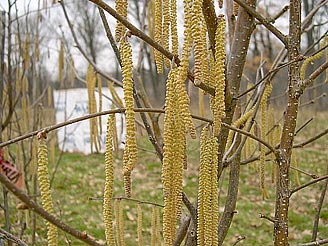
Catkins on a male hazelnut
Our native tree has alternate simple leaves that are 2½ to 5 inches long, with serated edges in an oval shape. The ½-inch brown nut is enclosed in a husk that starts green, turning to brown as it ripens and opens. It needs sun or partial shade with moist soil and a moderate Ph. It often grows in clumps 3-12 feet high. If a tree is desired, you can cut back the stems that grow from the base of the plant until the tree produces enough shade so it will no longer produce sprouts. This could require several years’ patience, and it’s not clear to me how readily our native hazelnut can be shaped into a tree. European filberts and hybrids often are commercially cultivated as trees. Fall color varies in hazelnuts, including yellows, reds, and orange.
Research revealed that my two shrubs are both males with 1- to 3-inch light brown catkins that appear well before the leaves. Females have inconspicuous, thin red catkins that look like threads. Since pollination is by wind and requires both male and female plants, I’ve produced no nuts.
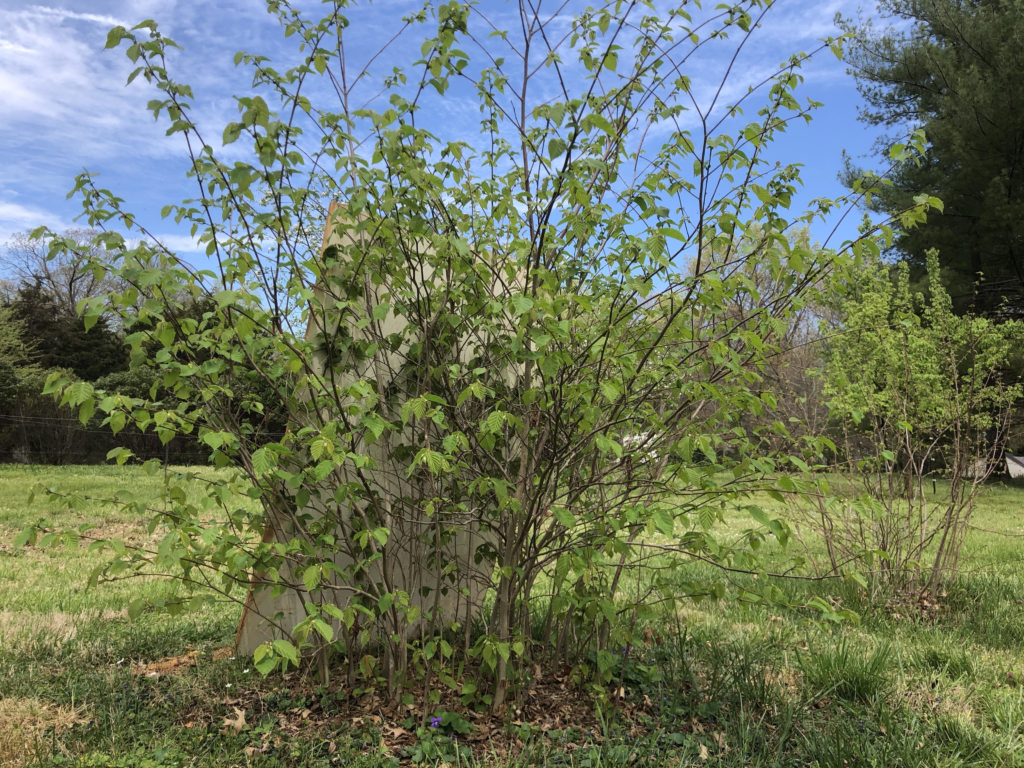
American hazelnut growing in the author’s yard. Photo: David Garth
Native shrubs produce nuts for birds, squirrels and other wildlife. Corylus americana has no significant insect or disease problems although the greenery may attract leafhoppers and others insects as well as deer.
If you want to grow the best nuts for eating, the situation becomes a little more complicated due to the Eastern Filbert Blight (EFB). Fortunately for our native Corylus americana, the Blight does little or no damage to it, although the native plant does harbor this disease and would threaten its cousins.
For a detailed account of the Eastern Filbert Blight, see “Hazelnut (Corylus avellana)-Eastern Filbert Blight” at Pacific NW Ext./handbooks.org//Hazelnut-Eastern Filbert Blight. There are resistant cultivars and spray programs that promise control. However, if you choose to grow anything other than Corylus americana, you must choose your cultivar and pollinator carefully.

Harry Lauder’s Walking Stick. Photo: Gerald Klingaman, Univ.Ark.Ext. Plant of the Week
You’ve probably heard of a hazelnut relative that is popular with ornamental gardeners. The distorted stems of Harry Lauder’s Walking Stick (Corylus avellana ‘Contorta’), a sport of the European filbert, make it an interesting wintertime specimen that we can grow here in our area. Please note, however, that contorted ornamental hazelnuts can be infected with Eastern Filbert Blight.
But back to our blight-resistant American native. If you’re going to give the American hazelnut a try, I suggest planting both male and female shrubs together, thus creating a love nest producing nuts without taking extra space. I find close mowing controls the spreading stems. However, at harvest time you will have to compete with squirrels and their fellow thieves. Be forewarned.
References:
“American Hazelnut,” U.S.Dept.Agr.Natural Resources Conservation Service/Plant Guide
The Hybrid Hazelnut Consortium, www.arborday.org/programs/hazelnuts/consortium
” Eastern Filbert Blight,” Univ.Wisc.Ext. (2016)
“Edible Shrubs for your Landscape,” National Gardening Association/garden.org (recommends the hazelbert)
“Plant of the Week: Harry Lauder’s Walkingstick,” Univ.Ark.Ext./www.uaex.edu
Natural Pest Control: Attracting Beneficial Insects
If you’d like to keep destructive insects off of your garden plants, there is a way to do it without using toxic sprays, and, indeed, without spraying at all. Simply attract beneficial insects to your garden and let them do all the work.
I first learned about beneficial insects while studying Permaculture, which is a design system that mimics nature to turn your garden into a balanced ecosystem. A successful Permaculture ecosystem does not need external additives such as chemical sprays and toxic powders, relying instead on natural systems for pest control. Not all bugs are bad for the garden. The “bad bugs” are those that damage plants. The “good bugs,” or beneficial insects, are those that prey on the bad bugs. If your garden is buzzing with beneficial insects, you will find that the bad bugs will be few and far between. This is using nature’s natural systems to your advantage, a key element of Integrated Pest Management. To review those principles, look at the article in last month’s issue, “Integrated Pest Management” May 2020, The Garden Shed.
The first thing to do to attract beneficial insects to your garden is to stop using chemical pesticides immediately. These will kill both good and bad bugs. To attract the beneficial insects, all you need to do is create the kind of ecosystems they like and wait for them to find you. If you build it, they will come.
Attracting beneficial insects to your garden is as easy as planting flowers, because that’s exactly what you’ll do. Specifically, you’ll need to plant the types of flowers that beneficial insects seek out for nectar and pollen. The goal is to interplant the flowers that attract beneficial insects near the plants you wish to protect from the bad bugs. Strive to have their favorite nectar sources blooming throughout the gardening season to keep the good bugs near your plants. Select a variety of flowers that will provide a long bloom season.
Beneficial insects have definite flower preferences. Most of them have short mouthparts and lack the specialized mouthparts needed to access nectar from deep or tubular flowers, so they need small flowers with shallow, exposed nectaries. Flowers with shallow nectaries include those of the following families:
The Umbelliferae family, which have flowers born in umbels or flat-topped clusters, such as fennel, dill, cilantro, parsley and carrot.
The Asteraceae or Compositae family, which includes small and flat flowering varieties such as yarrow, chamomile, daisy, feverfew, and aster.
The Brassicaceae family also offers many options for nectar sources, such as sweet alyssum (Lobularia maritima), basket-of-gold (Aurinia saxatilis), and candytuft (Iberis empervirens) as well as the flowers of garden vegetables like broccoli and mustard.
The Mint family, which includes spearmint, peppermint, lemon balm, and natives such as mountain mint (Pycnanthemum), as well as hyssop, monardas, salvias, stachys, and others.

Photo: Va. Tech. Dept. of Horticulture, “Farmscaping Techniques for Managing Insect Pests”
Interplanting flowers to attract beneficial insects is also being used in commercial agriculture, where it is called farmscaping. Virginia Tech has compiled a useful list of popular farmscaping plants. Improving Pest Management and Pollination with Farmscaping, Another list of plants and the beneficial insects they attract has been compiled by the Natural Resources Council of Maine. https://www.nrcm.org/wp-content/uploads/2016/05/Plants-that-attract-beneficial-insects.pdf.
THE SHORT LIST
For those of you who want to skip the research, I have compiled a brief list of plants that seem to attract the greatest variety of beneficial insects:
Sweet alyssum (Lobularia maritima) should be at the top of your list, as it is long-blooming, easy to grow, and a favorite of beneficial insects. This low-growing hardy annual will bloom all season, from spring until frost. It is easily grown from seed and can be direct seeded in the garden in early spring. It is also a lovely ornamental for the front of the border or for planters and is delightfully fragrant with a scent reminiscent of honey. They will grow in full sun or part shade.

Sweet alyssum, NC State Extension. Photo: Carl Lewis, CC BY 2.0

Sweet Alyssum
Photo: Jim Robbins, CC by NC-ND 4.0
Yarrow, both common yarrow (Achillea millefolium) and fern-leaf yarrow (Achillea filipendulina), attract a great variety of beneficial insects. These perennials are available in many colors, from the tall yellow common yarrow to the many newer varieties of fern-leaf yarrow in pastel and gem tones, to the wild native white fern leaf yarrow to be found on roadsides and fields everywhere. They are drought-tolerant sun lovers and easy to grow.

Photo: “Peckover, July 2011” by Sunchild57 Photography. CC BY-NC-SA 2.0

Photo: “Achillea” by infoerbe, CC BY-NC-SA 2.0.
Dill, Coriander, and Fennel, in bloom, attract many beneficial species. Dill and coriander grow and bolt quickly, but they can be seeded weekly or biweekly throughout the season to provide a procession of blooms as well as delicious leaves to flavor your dishes in the kitchen. Let some of your dill and coriander go to seed. The seeds are useful in cooking, and can also be saved and planted next season.

Photo: “0707130539” by Mr_robin53, CC BY-NC-ND 2.0

Photo: “Cosmos Twins” by Dulup, CC BY-SA 2.0

Photo: “Marigolds in the Garden” by MattX27, CC BY-SA 2.0
Cosmos, Marigold, Zinnia. These colorful, long-blooming, easy-to-grow annuals can be direct-seeded in the garden or bought individually as bedding plants and incorporated into the garden for easy care blooms until the first frosts of autumn.

Photo: “Flowers” by mag3737, CC BY-NC-SA 2.0
GET TO KNOW YOUR ALLIES
It’s a good idea to be able to identify the beneficial insects when they arrive, so that you don’t inadvertently kill them. While there are a lot of insects (and spiders) that can be beneficial to your garden, I’m going to focus on a short list of species that are most widely known to be useful in keeping pests at bay.
Ladybugs or Lady Beetles (Coccinellidae) (Harmonia axyridis, Asian Lady Beetle)
These are probably the most identifiable beneficial insects around, the iconic little red beetle with black polka-dots. Adult ladybugs will be attracted to your flowers for their pollen, and hopefully will plant her eggs in your garden. While adult ladybugs are omnivorous beneficial predators, the larval stage of the ladybug is a voracious consumer of aphids and other harmful soft-bodied pests. Ladybugs only live an average of 3 to 6 weeks, but will lay up to 1,000 eggs during that time, and the average ladybug may eat as many as 5,000 aphids during its lifetime. So, plant flowers to attract them, but also learn to recognize their larval stage and leave them be.

Photo Credit: University of California Integrated Pest Management Program
Lacewings (Chrysopidae and Hemerobiidae)
Just like the ladybugs, it is the larvae of the lacewings that prey on harmful pests, so you will want the adult lacewings to visit your nectary flower plants and lay their eggs in your garden. The adult lacewing feeds only on flower nectar, but their larvae will eat aphids, caterpillars, mealybugs, leafhoppers, insect eggs, and whiteflies. These are reportedly the most effective predators you can find. Full-grown laceworm larvae can consume 100 or more insects a day.

Green Lacewing. Photo Credit: University of California Integrated Pest Management Program

Brown Lacewing. Photo Credit: University of California Integrated Pest Management Program
Hoverflies or Syrphid Fly or Flower Fly (Syrphidae)
You will want hoverflies to visit your flowers for pollen and nectar, because they will lay their eggs near aphids and other soft-bodied insects, and their larvae will eat up to 60 aphids per day. The adults resemble little bees, but they do not sting. They lay eggs (white, oval, laid singly or in groups on leaves) which hatch into green, yellow, brown, orange, or white half-inch maggots that look like caterpillars. They raise up on their hind legs to catch and feed on aphids, mealybugs and others.

Hoverfly. Photo Credit: University of California Integrated Pest Management Program
Parasitic Mini-Wasps (Trichogramma spp; Ichneumidae; Braconidae)
These tiny wasps do not sting. They lay their eggs inside the eggs of moths and butterflies, whose caterpillar stages inflict much damage on our crops. Their prey include the alafala caterpillar, armyworms (but not beet armyworms), bagworms, bollworms, cabbage looper, cankerworm, codling moth, corn borers, corn earworm, cutworm, fruitworms, leafworms, peach borers, squash borers, tomato hornworm, wax moth, and webworms.
The adult cycle lasts only 9 – 11 days, during which an adult female may lay eggs in up to 300 pest eggs on average. It is believed that the adults feed on the nectar of tiny flowers such as those listed. These wasps are so tiny (less than 1 millimeter or 1/50th of an inch) that you probably won’t be able to identify them.

Parasitic wasps. Photo Credit: University of California Integrated Pest Management Program
Tachinid Flies (Tachinidae)
These flies are very beneficial parasites of many damaging caterpillars such as corn earworm, cabbage worm, cabbage looper, cutworms, armyworms, as well as some damaging bugs such as stink bugs, squash bug nymphs, beetles, and fly larvae. The adults deposit white eggs on foliage or directly on the body of a host. The larvae are internal parasites, feeding within the body of the host and killing it, then emerging to pupate. Tachinid flies may complete one to several generations per year.

Tachinid flies. Photo Credit: University of California Integrated Pest Management Program
Praying Mantis (Mantidae)
The praying mantis is a well-known insect eater, but keep in mind that it does not discriminate and will also eat your beneficial insects if it gets a chance. It is generally believed, however, that their usefulness outweighs this drawback.

Praying mantis. Photo Credit: University of California Integrated Pest Management Program
These are only a few of the beneficial predators. For more information on beneficial allies, the University of California Agriculture & Natural Resources has compiled useful lists of beneficial insects, as well as a color poster of these allies. http://ipm.ucanr.edu/PMG/NE/index.html Get to know your allies and be sure not to harm them. You may refer to the Virginia Cooperative Extension’s slideshow of some of the bad bugs. https://www.pubs.ext.vt.edu/2909/2909-1414/2909-1414.html
MORE FLOWER CHOICES
While planting the flowers on the short list will attract beneficials to your yard, for more variety, there are many other choices to consider, including but not limited to the following:
Agastache: Agastache scrophulariifolia and Agastache foeniculum (North American native)
Ajuga reptans (carpet bugleweed)
Antennaria neglecta (field pussytoes) (Native)
Anthemis tinctoria (chamomile)
Asclepias (butterfly weed) (Native)
Aster novae-angliae (Native)
Aurinia saxatilis (basket of gold alyssum)
Chrysanthemum parthenium (feverfew)
Coreopsis (Native)
Dianthus (pinks)
Echinacea (Native) (read all about the echinaceas in this issue, “In The Ornamental Garden”
Eutrochium (Joe Pye) (three species) (Native)
Hedeoma pulegioides (American pennyroyal) (Native)
Helianthus annuus (sunflowers) (Native)
Helianthus maximilianii (prairie sunflower) (Native)
Lavendulan augustifolia (lavender)
Liatris (Native)
Liriope muscari (lilyturf)
Melissa officinalis (lemon balm) (Native)
Mentha Pulegium (pennyroyal)
Mints (Native)
Monarda (bee balm) (Native)
Perthenium integrifolium (wild quinine) (Native)
Phlox paniculata (Native)
Phlox subulate (creeping phlox) (Native)
Potentilla (cinquefoil) (Native)
Pycnanthemum (mountain mint) (Native)
Sedum (Native)
Solidago canadensis (goldenrod) (Native)
Tanacetum vulgare (tansy)
Thyme
Veronica Americana (Native)
Veronica spicata (spike speedwell)
GO NATIVE
Consider choosing native species. Since the beneficial insects are often native species themselves, they will be naturally inclined to prefer the native flowers as food sources, so consider native species whenever possible.
THINK BIG
Beneficial insects like blooming shrubs and trees, too, so consider extending your bloom season with trees and shrubs, especially natives such as redbud (Cercis canadensis), serviceberry (Amelanchier arborea, edible berries), elderberry (Sambucus canadensis, edible and medicinal), American holly (Ilex opaca), summersweet (Clethra alnifolia, fragrant blooms), Virginia sweetspire (Itea virginica), winterberry holly (Ilex verticillate) and deciduous holly (Ilex decidua, an important source of winter food for birds). If you’re ambitious, you can get a jump start on the season by planting a winter crop of buckwheat, which beneficial insects find highly attractive, and which is useful for soil improvement and weed control. https://www.canr.msu.edu/uploads/234/78912/buckwheat.pdf
STRATEGIC NEGLECT
If you grow vegetables, let some of them strategically go to flower. The good bugs love carrot flowers as well as the blooms of the mustard family like turnips, broccoli and kale. Beneficial insects love all blooming herbs, so let at least some of your herbs blossom.
Reconsider the clover, violets, and dandelions in your grass. Beneficials and pollinators love them, so let them bloom.
Stop spraying the undersides of leaves to remove aphids manually, as you may also be removing the eggs that will hatch into aphid eaters.
TO SUM IT ALL UP
Establishing this type of system takes patience and will initially require that you let some damage be done to your plants while you wait for the cavalry of beneficials to appear, but it pays off in the long run, and it is better for the environment. So make your garden a magnet for beneficial insects, and they will happily battle your pests for you while you relax on your veranda enjoying your garden.
SOURCES
“Attracting Beneficial Insects,” PennState Extension https://extension.psu.edu/attracting-beneficial-insects
“Attracting Beneficial Insects with Native Flowering Plants,” Anna Fiedler, Michigan State University MSU Extension https://www.canr.msu.edu/resources/attracting_beneficial_insects_with_native_flowering_plants_e2973
“The Virginia Gardener Guide to Pest Management for Water Quality,” Virginia Cooperative Extension https://www.pubs.ext.vt.edu/content/dam/pubs_ext_vt_edu/426/426-615/426-615_pdf.pdf
“Permaculture Design,” North Carolina Extension Gardener Handbook https://content.ces.ncsu.edu/extension-gardener-handbook/appendix-g-permaculture-design
“Beneficial Insects,” University of Florida IFAS Extension https://edis.ifas.ufl.edu/topic_beneficial_insects
“Encouraging Beneficial Insects in Your Garden,” Oregon State Extension Service https://catalog.extension.oregonstate.edu/sites/catalog/files/project/pdf/pnw550.pdf
Featured Photo of syrphid (hoverfly) on alyssum flower by Steven Ash, courtesy of the Univ. of Delaware Coop. Extension, “The ‘New’ Companion Planting: Adding Diversity to the Garden,” https://www.udel.edu/academics/colleges/canr/cooperative-extension/fact-sheets/adding-diversity-garden/