
The Garden Shed
A Community Newsletter published by the Piedmont Master Gardeners
August 2019-Vol.5 No. 8

For comments, questions or suggested topics for future Garden Shed articles contact us at: garden-shed@piedmontmastergardeners.org.
If you have specific gardening questions or need help to solve a gardening problem, our Horticultural Help Desk is a free community resource and can be contacted at 434-872-4583 or by email: albemarlevcehelpdesk@gmail.com.

Who We Are
We are members of the Piedmont Master Gardeners, which simply means we have all been trained to share the scientific expertise of Virginia Tech and the Virginia Cooperative Extension Service. More important, we are your friends and neighbors with a passion for gardening – and learning more about it. MORE
Table of Contents
In the Ornamental Garden
Black Cohosh and Doll’s Eyes–Tall, Shade-loving, and Native
Brighten up your shade garden with native bugbane and baneberry.
In the Edible Garden
Eggplants: Easy to Grow with Surprising Variety and Versatility
Eggplants grow well in Central Virginia and add many international possibilities to the garden and table.
Tasks and Tips
The Ornamental Garden in August
All work and no play in the August garden is NOT the answer.
Tasks and Tips
In the Vegetable Garden- August
August is the time to clean up tired spring plantings and get seeds and plants for fall harvest in the ground.
Upcoming Events
Learn more about climate change. Or, be a student again at Master Gardener College.
Recipe of the Month
Eggplant and Tomatoes with Caper-Shallot Vinaigrette
A delicious way to combine your eggplant and tomatoes
Black Cohosh and Doll’s Eyes–Tall, Shade-loving, and Native
Black cohosh (Actaea racemosa) was used by Native Americans as an herbal remedy and its popularity continues to this day. This plant is native to eastern North America and is found throughout Virginia except for the outer coastal plain. It grows in a variety of woodland habitats, and is often found in small woodland openings. If you are not interested in growing this native for its medicinal properties (and PMG is not endorsing its use), is it still an excellent addition for your shade garden? If you are looking for a plant with dramatic flair, the answer is a resounding “Yes!” Before we consider its ornamental value, let’s quickly address its use in herbal medicine.
MEDICINAL PROPERTIES
Black cohosh is a member of the buttercup family (Ranunculaceae). Other names for this rhizomatous forest herb include snakeroot, black bugbane, rattleweed, macrotys, and rheumatism weed. It is reputed to have analgesic, sedative, and anti-inflammatory properties. Native American and Chinese herbalists have traditionally used black cohosh root for a variety of ailments, and as an insect repellent. This last property is responsible for the common name, bugbane. Currently, people use black cohosh as a dietary supplement for hot flashes and other menopausal symptoms. In 2014 consumers in the U.S. spent about $60 million on black cohosh supplements. Black cohosh contains potent phytochemicals that have an effect on the endocrine system. How it works is not yet clear. Further research is needed to assess its effectiveness as well as its long-term safety. Possible liver damage is one side effect that is under study. For more information on black cohosh studies, see the Source list at the end of this article.
ORNAMENTAL CHARACTERISTICS
Black cohosh offers a combination of ornamental characteristics that is both prized and difficult to find:
- a total height (foliage plus flowering spikes) of 4-6’
- shade loving
- striking white blooms in late summer
- attractive deep-green, coarsely-serrated leaves, similar in appearance to astilbe foliage
- deer resistance
- native to eastern North America
BLOOM
Black cohosh has small, numerous, creamy white flowers that appear in terminal inflorescences up to one meter long. With stem height, the blooms extend up to 2 meters in height, rising on wiry stems well above the foliage in late summer. Flowering commences at the bottom of each raceme and progresses apically (toward the tip). The long white inflorescences arch gracefully, lighting up the shady forest.
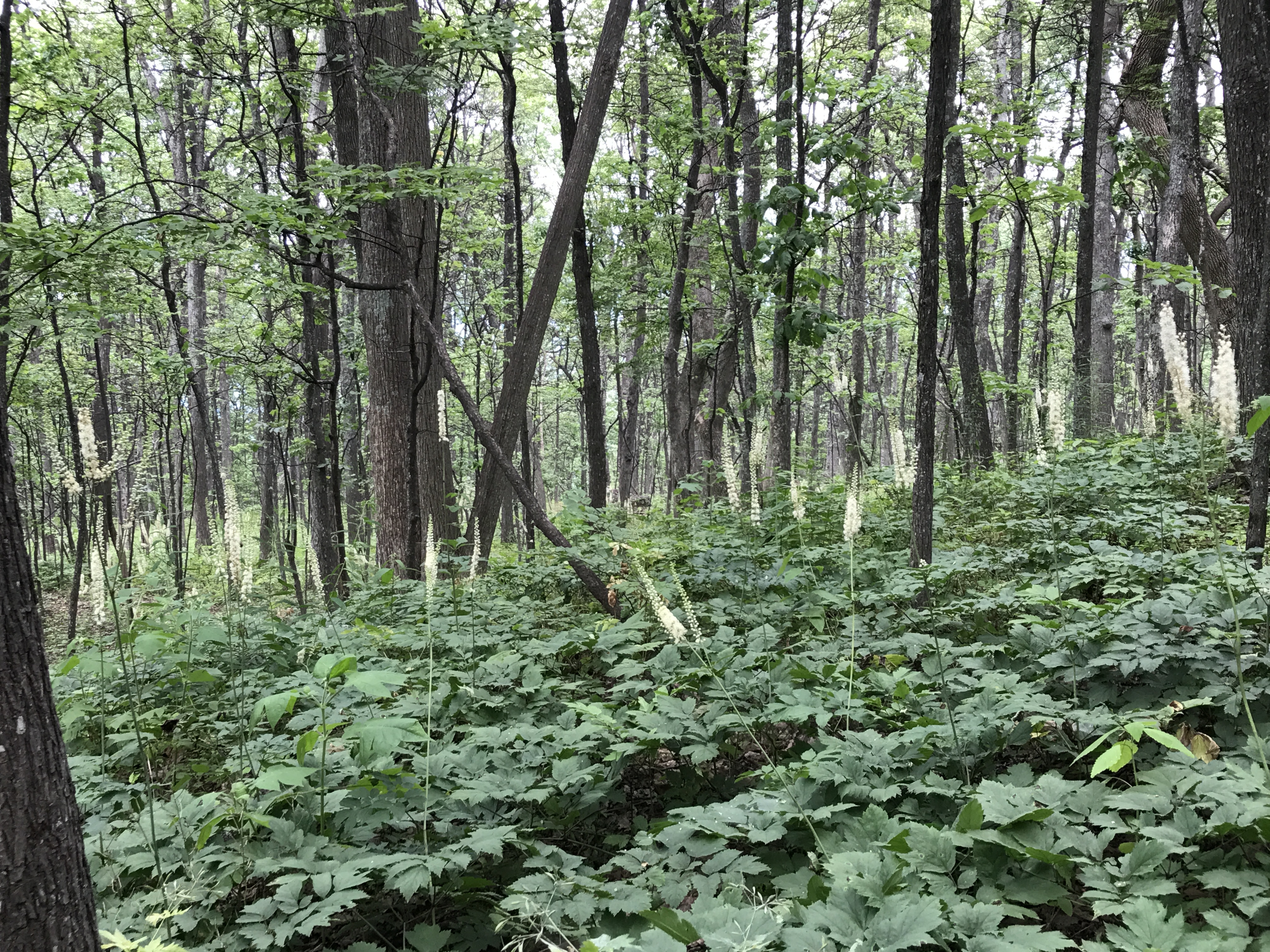
Black cohosh near Humpback Rocks Photo: Susan Martin
A few years ago while hiking on Humpback Rocks (Milepost 5.8, Blue Ridge Parkway), we came across a stand of black cohosh in peak bloom, which inspired me to add this plant to our shade garden. The plant’s height makes it a standout architectural plant at the back of the garden. Although most impressive when planted in groups, the plant can also add drama as a solo specimen plant.
CULTIVATION
Cultivation is easy if growing requirements are met: medium-to-deep shade, rich humusy soil, and adequate moisture. Leaf margins may brown (scorch) and growth may slow if soils are not kept consistently moist. Foliage generally does not need staking, but taller flower spires may need some support. Plants can be cut back to the ground in late fall to tidy the garden, if desired, but is not necessary.
PROPAGATION
Cohosh comes from an Algonquin word meaning rough in reference to the appearance of plant rhizomes. Plants can be propagated by rhizome division or by seed. To germinate, seeds require exposure first to warm temperatures and then to cold. Ripe seeds can be sown directly outdoors. Be aware that it may take years before plants reach flowering size. In the nursery trade, two varieties are usually available: dissecta, with deeply-cut leaflets, and cordifolia, with shallowly-lobed leaflets resembling maple leaves.
POLLINATOR HOST
Flowers emit a sweet/fetid odor that attracts carrion-eating pollinating flies, gnats, beetles, and bumblebees seeking pollen and nectar. The plant is host for the Appalachian azure butterfly (Celastrina neglectamajor). Caterpillars feed exclusively on black cohosh flowers; adults feed on flower nectar. Unfortunately, black cohosh is being forced out in some woodland areas by the nonnative invasive, garlic mustard (Alliaria petiolata). More information is needed on this threat.
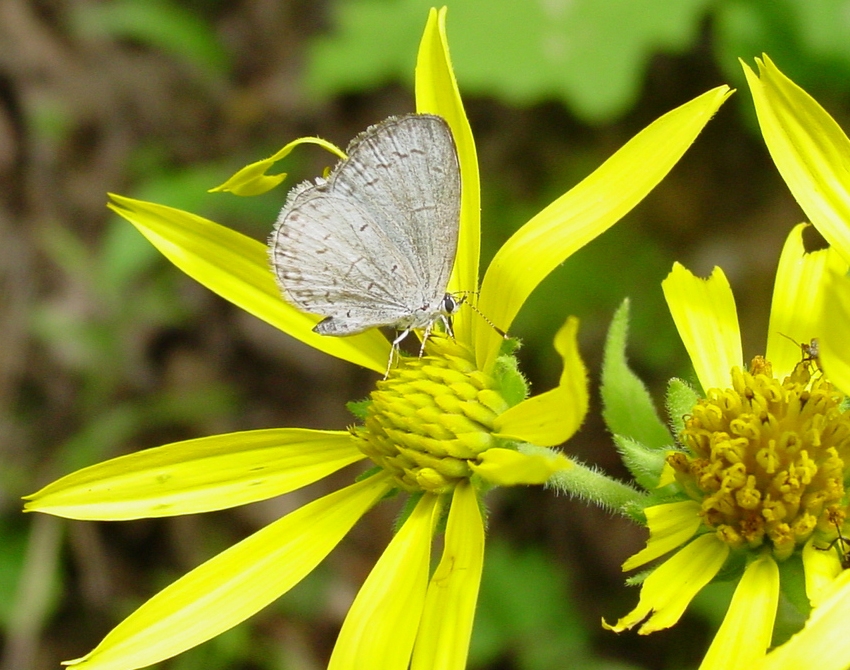
Appalachian Azure, (Celastrina neglectamajor) Photo: pondhawk Wikimedia Commons
PESTS AND DISEASES
Black cohosh has no serious insect or disease problems. Rust and leaf spot are occasional problems.
SIMILAR PLANT – DOLL’S EYES
Black cohosh is closely related to doll’s eyes, also commonly called white baneberry (Actaea pachypoda). These two native perennials share similar characteristics and are difficult to distinguish based on foliage early in the season. As the season progresses, distinguishing characteristics emerge.
Doll’s eyes typically grows to 30” tall and is primarily cultivated in woodland and shade gardens for its attractive white berries and astilbe-like foliage. It naturally occurs in deep woods, north-facing wooded slopes, bluff bases, and ravines.
BLOOM
In spring, tiny white flowers appear in short, oblong terminal clusters atop long greenish stems rising above the foliage. The flowers lack nectar and provide only pollen to visiting insects. These visitors are mainly Halictid bees. Flowering stems thicken after bloom and turn an attractive red, as pea-sized white berries develop in summer in elongated clusters.
BERRIES
The berries are extremely poisonous if eaten, hence the common name of baneberry. Baneberry is the common name for several species of plants in the genus Actaea. This group in the buttercup family (Ranunculaceae) has toxic fleshy berries, hence the name “bane” meaning something that causes death or a deadly poison. Each doll’s eye berry has a distinctive small dark purplish spot (formed by the flower stigma) which is thought to resemble the eyes of old-fashioned china dolls, hence the common name. Berry toxicity is likely the main reason that wildlife seems to ignore the fruit, although birds seem to be immune to the toxins. Many species of native birds actually thrive on the plant. Such birds include the Ruffed Grouse, Yellow-Bellied Sapsucker, and American Robin. The White-Footed Mouse also eats the berries. Because the foliage is toxic from a cardiac glycoside, it is not eaten by mammalian herbivores.
PROPAGATION
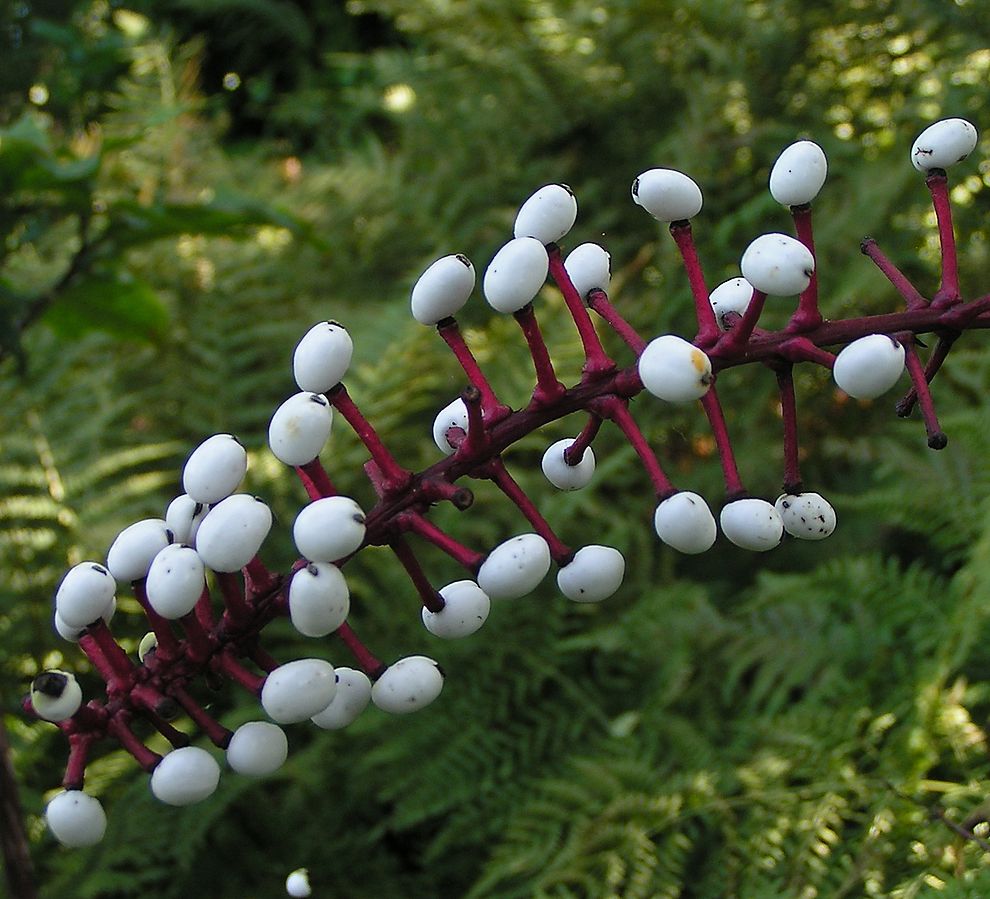
Doll’s eyes Photo: Creative Commons
Self-seeding may occur in optimum growing conditions where the berries fall to the ground. If naturalization is desired, berries may be picked and immediately planted into the ground as soon as they ripen in the fall in order to promote colonial spread. It typically takes 2 or more years for seeds to germinate under natural conditions. Baneberry can also be propagated by division in early spring. Plants are slow growing and take a few years to grow large enough to flower.
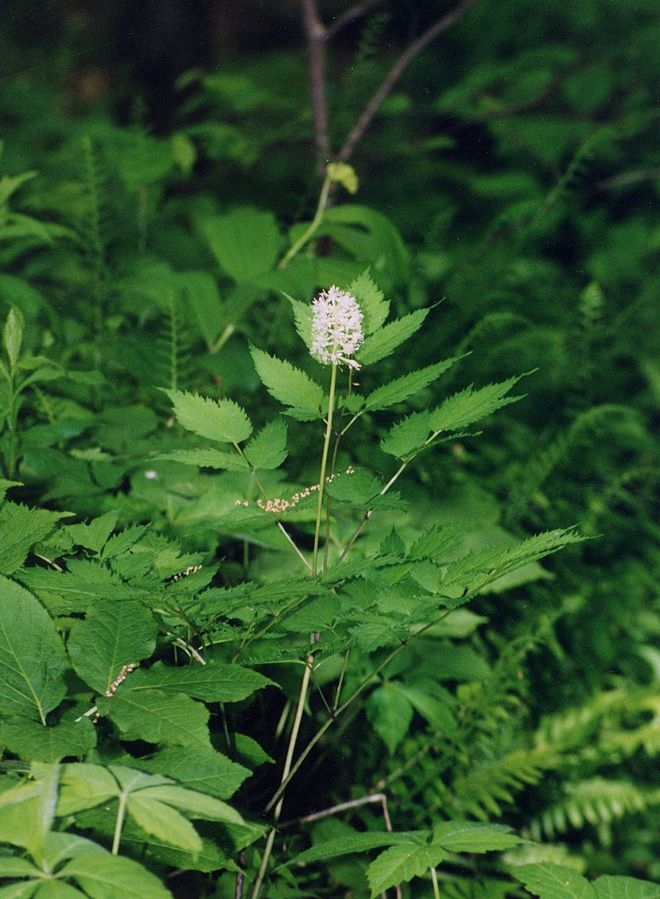
Actaea pachypoda Photo: USDA, Wikimedia Commons
DIFFERENCES BETWEEN THE TWO SPECIES
In summary, A. racemosa and A. pachypoda share similar physical characteristics and are difficult to distinguish based on foliage early in the season. After flowering, there are distinctive differences:
- A. racemosa can reach a much greater height (at least twice as tall).
- The terminal inflorescenses of racemosa are up to 12” long while the terminal clusters of A. pachypoda are cylindrical and much shorter.
- A. racemosa produces both pollen and nectar; A pachypoda produces only pollen.
- A. racemosa blooms in late summer; A. pachypoda blooms in spring (May to June).
- The stems of A. pachypoda turn red after the plant has bloomed.
- A. racemosa has dried fruits; A. pachypoda has fleshy berries.
- The white berries of A. pachypoda extend from the stem on thick, reddish stalks from July to October.
- The berries and all parts of A. pachypoda are very poisonous to people and mammals, although birds seem to be immune to the toxin.
- The roots and rhizomes of A. racemosa are used for making dietary supplements for post-menopausal symptoms and other illnesses.
RED BANEBERRY
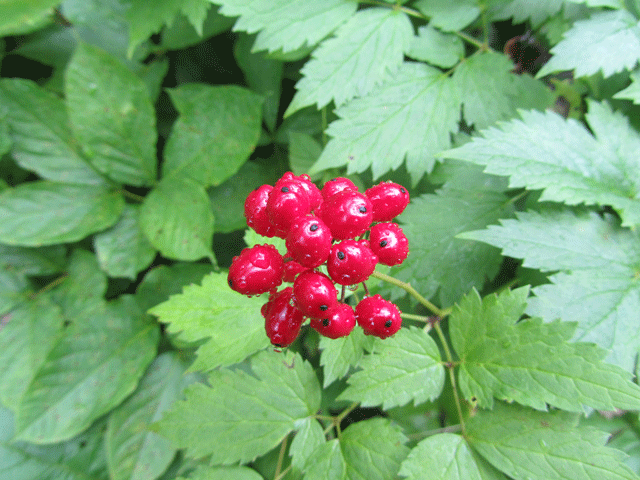
Red baneberry Photo: Homer Edward Price, Creative Commons
There is also a red-fruited form of this species, red baneberry (A. rubra), distinguished by its thick floral stalk. Growing in bushy clumps, red baneberry bears fluffy clusters of small white flowers in spring. The berries that ensue in mid-to-late summer are brilliant red, though sometimes white, with a very small black dot at the end of the berry. This dot is less noticeable than the dot on the white berries of doll’s eyes. The leaves are alternate, compound, toothed, and more dissected than the leaves of doll’s eyes. All parts of baneberry plants, including the berries, are poisonous and should never be eaten. Red baneberry’s natural habitat reaches its southern limits in New Jersey, Indiana, Iowa, and Kansas.
SUMMARY
Black cohosh brightens a shade garden with white flowers that appear on gracefully arching white terminal inflorescences up to a meter long. When massed at the back of the garden, the plant’s height and large astilbe-like foliage adds a strong architectural definition. It is the host plant for the Appalachian azure butterfly (Celastrina neglectamajor). Black cohosh’s position in the forest under-story, and its role as a food source for the Appalachian azure, is threatened by the nonnative invasive plant, garlic mustard (Alliaria petiolata). Doll’s eyes offers many of the same ornamental characteristics as Black cohosh, with the addition of attractive but highly toxic white berries.
SOURCES
“Herbs at a Glance: Black Cohosh,” National Institute of Health, National Center for Complementary and Integrative Health, https://nccih.nih.gov/health/blackcohosh/ataglance.htm
Black Cohosh, National Institutes of Health, Office of Dietary Supplements, https://ods.od.nih.gov/factsheets/BlackCohosh-HealthProfessional/
“The Truth About Black Cohosh Supplements for Menopause,” Consumer Reports,February 19, 2016, https://www.consumerreports.org/vitamins-supplements/the-truth-about-black-cohosh-supplements-for-menopause/
“Black Cohosh for Menopause Symptoms,” Michigan Medicine, University of Michigan, https://www.uofmhealth.org/health-library/tn9522
“Wildflower of the Year Actaea racemosa,” Black Cohosh, Virginia Native Plant Society, https://vnps.org/wildflowers-of-the-year/wildflower-of-the-year-2017-actea-racemosa-black-cohosh-2/
Actaea racemosa, Missouri Botanical Garden Plant Finder, http://www.missouribotanicalgarden.org/PlantFinder/PlantFinderDetails.aspx?kempercode=j790
Appalachian azure, Butterflies and Moths of North America, https://www.butterfliesandmoths.org/species/Celastrina-neglectamajor
Appalachian azure, New York Natural Heritage Program, https://guides.nynhp.org/appalachian-azure/
Black Cohosh, Illinois Wildflowers, https://www.illinoiswildflowers.info/woodland/plants/black_cohosh.htm
Doll’s Eyes, Illinois Wildflowers, https://www.illinoiswildflowers.info/woodland/plants/doll_eyes.htm
Actaea pachypoda, Missouri Botanical Garden Plant Finder, missouribotanicalgarden.org/PlantFinder/PlantFinderDetails.aspx?kempercode=h520
“Baneberry, Actaea spp.,” Master Gardener Program Division of Extension, University of Wisconsin-Madison, https://wimastergardener.org/article/baneberry-actaea-spp/
Actaea pachypoda, NC State Extension, https://plants.ces.ncsu.edu/plants/all/actaea-pachypoda/
Actaea racemosa, NC State Extension, https://plants.ces.ncsu.edu/plants/all/cimicifuga-racemosa/
Actaea pachypoda, USDA Plants Database, https://plants.usda.gov/core/profile?symbol=ACPA
Actaea rubra, USDA Fire Effects Information System (FEIS), https://www.fs.fed.us/database/feis/plants/forb/actrub/all.html
Red baneberry, Acteae rubra, Ontario Wildflowers, http://ontariowildflowers.com/main/species.php?id=18
The Ornamental Garden in August
Weather in the first half of August often remains July-hot and dry; the month begins with an average high of 87° and drops to an average high of 84° by month’s end. The probability of precipitation drops from 39% on August 1 to 29% by August 31. Plants are starting to look fatigued and brown around the edges. The beautiful expanse in our front yard of lily of the valley (Convallaria majalis) and dwarf crested iris (Iris cristata) has started to yellow, furrowed by paths from our terrier running up and down and across. The May Night salvia (Salvia x sylvestris ‘May Night’) has slug damage the size of quarters; the hostas are either eaten by deer or swiss-holed by slugs and snails. And then there’s the lacy damage of Japanese beetles and the webs of spider mites that pop up overnight. Tent caterpillars have moved in en masse. How did all this happen seemingly overnight? Was I too remiss? Too hot? Too summer-lethargic? In rightful fear of chiggers and ticks, I make myself put on combat garb when it’s time to weed or trim. This means wearing long-sleeved shirts and long pants with boots when it’s in the 90s. And so I avoid going out to do battle. The enemies take advantage as I watch from inside. I make a list of supplies; I lay out a plan that is realistic in the face of soaring temperatures and drought.
AUGUST TO-DO LIST
- Weeding still needs to be tackled. I like to think that my very persistent weeding throughout spring and early summer has reduced the weed seed bank, which is why things seem to be under fairly good control. I also had set out some additional mulch in June as an optimistic replacement for hand-pulling weeds.
- Keep deadheading annuals such as marigolds to invigorate blooming. I toss the seedheads into the bed and seedlings usually appear by early fall for a fresh look. Towards the end of the summer, you could save some seedheads to dry out, but as cultivars, they won’t grow true to color or blossom size next year.
- Deadhead perennials unless you want to leave seedheads for birds and aren’t worried about encouraging seedlings.
- Cut back slug-holed leaves on hostas and salvias.
- If catmint (Nepeta racemosa) hasn’t been cut back in July, it is probably looking rather “tatty” at this point. You can freshen it up by either shearing across the top, or if time permits, snip out brown stems down to the ground. Leave the greener stems. Do NOT cut catmint to the ground for winter. Leave the basal leaves for protection.
- Cut back the yellow foliage and the spent flower stalks of daylilies.
- Watch for signs of drought stress: wilting that does not correct by early evening; leaf scorch; shedding of leaves. Water in early morning for a total (with rain) of about 1” per week, preferably with a soaker hose.
- Fertilize annual plants and plants in containers.
- Do not fertilize trees, shrubs or perennials at this point.
- Divide irises and daylilies up to the end of August.
- Plant fall-blooming bulbs such as autumn crocus (Colchicum autumnale) for bloom in September and October.
- Freshen up containers for cooler weather with annuals such as snapdragons (Antirrhinum majus), violas, pansies, and ornamental kale (Brassica oleracea acephala). See tips on how to transition summertime containers to more autumnal colors in the September 2018 issue of The Garden Shed.
CHECK FOR POWDERY MILDEW
Check for powdery mildew on roses, garden phlox (Phlox paniculata), bee balm (Monarda fistulata), and other susceptible plants. Cut out mildewed areas, bag, and dispose.
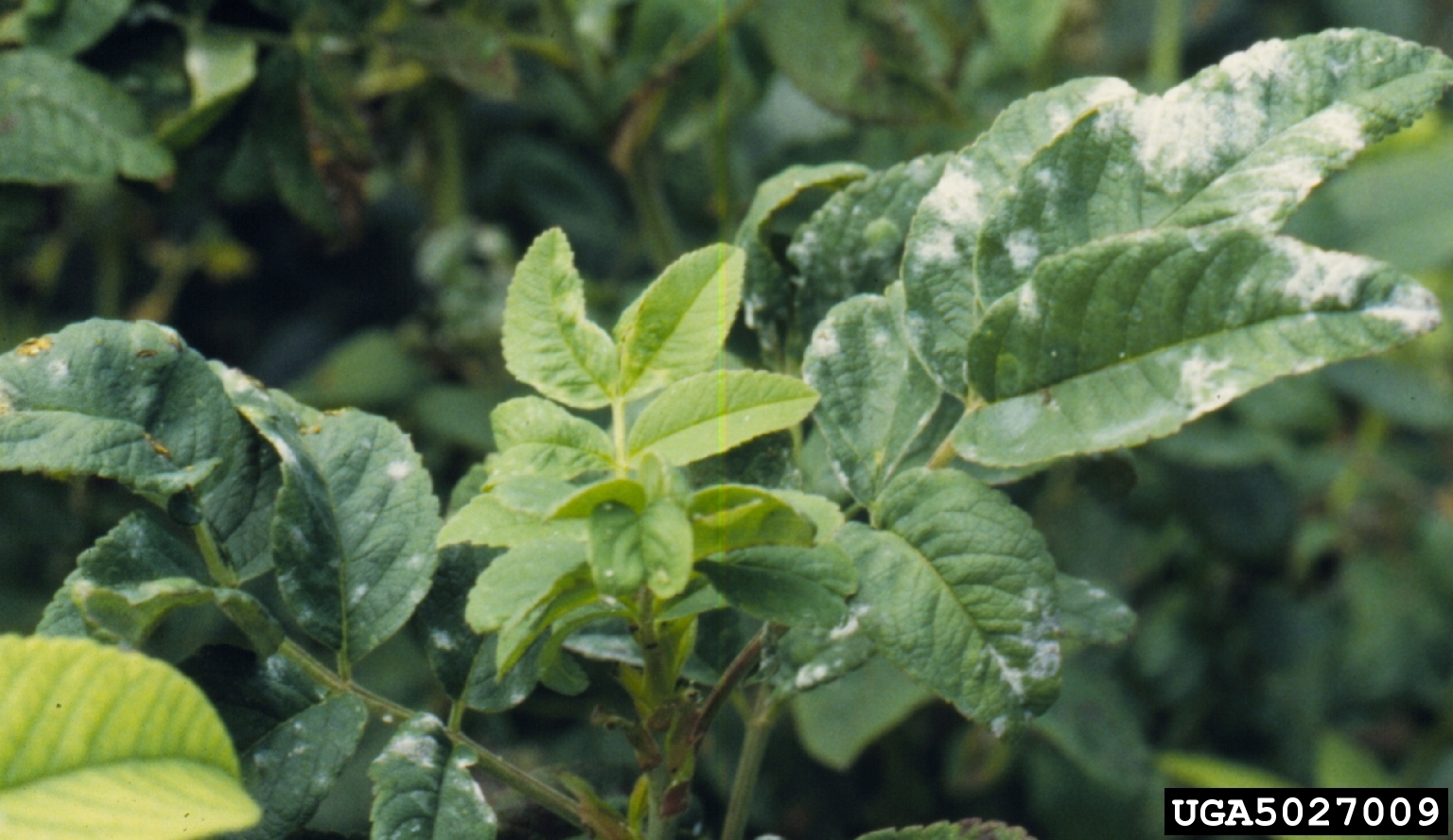
Powdery mildew symptoms on rose leaves.
Jody Fetzer, New York Botanical Garden, www.forestryimages.org
Warm, dry days and cool nights are most conducive to infection. If mildew is a problem this year, compare your garden to recommended good cultural practices: space plants adequately to allow good air movement throughout the foliage; water plants early in the day so leaves dry quickly; do not over fertilize (especially with nitrogen); remove diseased plant debris at the end of the season to minimize survival of the fungus over the winter. If these practices seem to be in place, make a note to seek out cultivars with resistance to powdery mildew.
In addition to good cultural practices, a number of fungicides have proven effective for control of powdery mildew diseases. See the VCE publication Powdery Mildew on Ornamental Plants for information on fungicides.
CHECK FOR GARDEN PESTS
There are many signs of insect damage at this time of year from spider mites, scale, rust and fall webworms. See the Ornamental Garden in August, 2016 for a summary of these pests including signs of damage and treatment.
Spider mites have been a problem in our garden this season. Red spider mites are also a very common problem on houseplants. Spider mites feed on the leaves through their piercing-sucking mouthparts. They remove contents from individual plant cells, leaving behind the cell wall, which makes the emptied cells appear silvery. The most noticeable symptom of infestation is white stippling on the leaves. Heavily infested plants take on a faded, yellowish or greyish cast. Severely infested plants are covered by a thin layer of webbing created by the large numbers of spider mites.
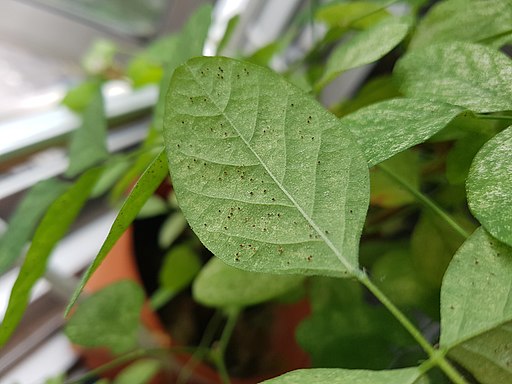
Spider Mites Photo: Mokkie, Wikimedia Commons
As with treating aphids, spider mites can be rinsed off plant leaves. Rinsing treatments must be done frequently enough to ensure the mites will not climb back up the plants. Mid-season washing of the leaves can help reduce the potential for spider mite population booms. Unfortunately, rinsing is not effective on high populations, so be on the lookout for early signs of infestation. If mites are established, an effective choice would be either an insecticidal soap or horticultural oil. These miticidal products are designed to coat the mite’s exoskeleton and cause suffocation. Although these products can also kill beneficial mites and insects upon contact, they do not have residual activity. NOTE: Most insecticides are not effective on mites and some, especially carbaryl (Sevin), result in increased mite damage by killing their natural enemies. See publications from Virginia Cooperative Extension and Clemson Cooperative Extension for more information.
BENEFICIAL INSECT – ASSASSIN BUG
If you want help with deterring insect pests in the garden, Piedmont Master Gardner Ralph Hall recommends that you welcome the assassin bug (Arillus cristatus), also known as the wheel bug. This beneficial insect feeds on aphids, caterpillars, Colorado potato beetles, Japanese beetles, leafhoppers, and Mexican bean beetles. It also feeds on its cousin, the brown marmorated stink bug! But appreciate from afar—although the assassin bug is not aggressive to humans, a stray hand could be the victim of a very painful bite that can take two weeks to disappear.
Assassin bug identification
- An adult wheel bug is easy to identify because of the very prominent semi-circular structure found on the dorsal side of its body.
- A second distinguishing feature is its odor.
- A third feature is its mouthpart, which forms a long, narrow beak that extends posteriorly beneath the body. This deadly proboscis is both sword and siphon. It is used to inject a paralyzing toxin into the prey’s body, and to suck out the prey’s bodily fluids. The process of paralyzing and killing the target takes about 30 seconds.
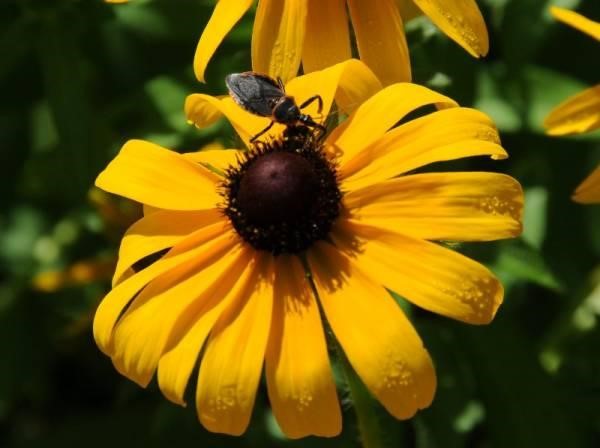
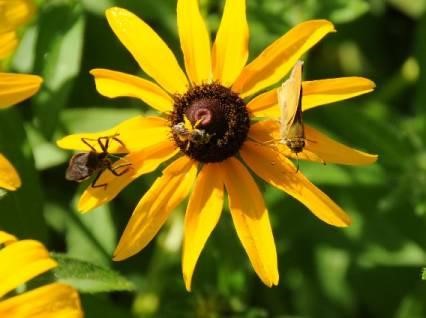
These photos, provided by BJ Taylor, show an assassin bug trying to catch prey while visiting black-eyed Susans (Rudbeckia). In the top photo, the assassin bug is covering a little bee that winds up escaping. In the lower photo, the assassin bug is eyeing the bee and a moth.
INVASIVE SPOTLIGHT – JAPANESE STILTGRASS REVISITED
When I look out at our August landscape, I see an army of Japanese stiltgrass. It creeps beyond the border of our neighbor’s woods each night, seemingly determined to ram its way through our front door. Japanese stiltgrass is a formidable invasive that many of us are combating.
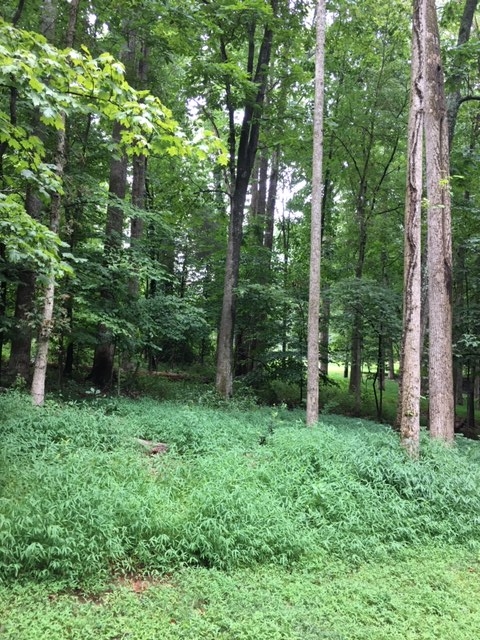
Japanese stiltgrass on the march. Photo: Susan Martin

Japanese stiltgrass Photo: Susan Martin
Flowering begins any time from July into October, and seeds ripen and drop to the ground from August to December. Mowing and weed-whacking can greatly reduce seed formation. Mowing is feasible only in open areas, not in forest settings. Mowing is best done just before flowering in August and September and needs to be done only once if you wait until then. Cut stiltgrass as low as possible, scalping the ground, to remove all flowers. Japanese stiltgrass is easily killed with low concentrations of herbicides. Researchers at Virginia Tech showed that a grass-selective herbicide is the most effective control method. When a grass-selective herbicide is used, more native plants return than when a non-selective type of herbicide is used. The recommended time for spraying is from July into early September before stiltgrass flowers and sets seed. See the June 2018 Garden Shed for more information. Also, check the Blue Ridge PRISM (Partnership for Regional Invasive Species Management) website for a factsheet on Japanese stiltgrass.
SUMMARY
I seem to have focused this month on all work and no play. When I wander around our yard, I don’t just see Japanese stiltgrass, spider mite webs, powdery mildew, and weeds! I enjoy the deepening colors of summer’s end: the purple of aromatic aster (Symphyotrichum oblongifoliumaster), the dusty pink of stonecrop (Hylotelephium ‘Herbstfreude’ AUTUMN JOY), the vibrant orange of butterfly weed (Asclepias tuberosa), the golden yellow of sweet goldenrod (Solidago odora). I see and hear the constant hum of pollinators, the pileated woodpecker flashing through the trees, the whir of hummingbirds fortifying themselves for the migration. I know that the days will be getting shorter and I remind myself to treasure each one. It’s beautiful out there — in August, as in every month.
SOURCES
See past issues of The Ornamental Garden in August: 2018, 2017, 2016, 2015.
Average Weather in August in Charlottesville, https://weatherspark.com/m/20225/8/Average-Weather-in-August-in-Charlottesville-Virginia-United-States
Assassin Bug, Blogs @ VT, Eric Day, Virginia Tech, http://blogs.lt.vt.edu/cander29/2015/12/04/assassin-bug
Brown Marmorated Stink Bug, Rutgers, https://njaes.rutgers.edu/stink-bug/faq.php
Brassica oleracea var. acephala, https://plants.ces.ncsu.edu/plants/brassica-oleracea-var-acepola/
“Powdery Mildew of Ornamental Plants,” Virginia Cooperative Extension, https://www.pubs.ext.vt.edu/450/450-603/450-603.html
“Powdery Mildew on Phlox,” Iowa State University Extension and Outreach, https://hortnews.extension.iastate.edu/2003/7-18-2003/mildew.html
“Integrated Pest Management for Spider Mites, Clemson Cooperative Extension, https://hgic.clemson.edu/factsheet/integrated-pest-management-i-p-m-for-spider-mites/
Factsheets, Blue Ridge PRISM, http://blueridgeprism.org/factsheets/
Photos source, https://www.forestryimages.org/
Eggplant and Tomatoes with Caper-Shallot Vinaigrette
Eggplants and tomatoes come together in the garden this time of year. This recipe can be served either as an appetizer or as a side dish, with or without bread.
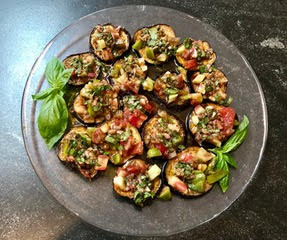
Ingredients
- Japanese eggplant (2) or medium eggplant sliced in rounds about a ¼ inch thick
- Tomatoes: either 2 Roma tomatoes or 1 large not too soft tomato, chopped
- Olive oil: 7 tablespoons plus more for brushing eggplant
- Shallot minced to make 1 rounded tablespoon
- Capers drained to 1 rounded tablespoon, then minced
- Sherry vinegar: 1 tablespoon
- Balsamic vinegar: 1 tablespoon
- Garlic: 1 large clove, minced or pressed
- Basil: chopped, ¼ cup more or less to your taste
- Salt and pepper to taste
- Baguette sliced as either bread, or alternatively, as bruschetta — brushed with olive oil, toasted & rubbed with garlic
Preparation
- Brush sliced eggplant with olive oil on both sides. Bake or grill the eggplant. It can be roasted in a 425 degree oven for 25 minutes, turning halfway through, or cooked on a grill.
- Chop the tomatoes and set aside.
- Make the vinaigrette: In a small bowl, combine the shallots, capers, garlic, and chopped basil. Add the sherry and balsamic vinegars. Whisk in the 7 tablespoons of olive oil. Salt and pepper to taste.
- Arrange the cooked eggplant on a platter. Top each piece of eggplant with chopped tomatoes. Spoon vinaigrette evenly over the eggplant and tomatoes. Allow to marinate at room temperature for 1 hour before serving.
Serve
- Serve with sliced baguette or bruschetta (bread toasted with olive oil and rubbed with garlic). Either are great for plopping a piece of eggplant on or sopping up marinade.
Eggplants: Easy to Grow with Surprising Variety and Versatility
For many of us, the word eggplant connotes a tear-drop shaped, shiny purple vegetable that we can grill or prepare parmigiana style. In fact, there are many varieties, including some that, true to its name, are about the size, shape and color of white chicken eggs. It is truly international, called aubergine and melanzane in the Mediterranean regions and brinal in its native India and South Asia. Australians refer to them generally as eggfruit. In parts of Africa it is called garden egg. And it has as many styles of preparation as it has names.
Eggplant is a member of the Solonaceae or nightshade family, related to tomatoes, peppers, potatoes and tobacco. The plants have spiny stems and generally long, lobed leaves. Flowers range in color from white to purple and can be quite attractive, which, along with their colorful fruits, make them adaptable as annual landscape plants. Heavily laden plants may need support as fruit matures.
Botanically, eggplant is classified as a fruit, with its many small edible seeds. They are best harvested before reaching full size, both because their nicotine content adds a bitter taste to older fruits and because leaving mature fruit unpicked reduces plant productivity.
Growing Conditions
Eggplants are tropical perennials, but for most gardeners they are grown as annuals in Zones 5-12.
Eggplants love heat. Seeds germinate well between 70 and 90 degrees. A heat mat is a definite plus and a plastic cover for the seed tray can also help germination. Growing time is typically between 100 and 140 days from germination to harvest, depending on variety. Start seeds 6-8 weeks before last frost and harden plants off for a couple more weeks before transplanting. Warming soil with black plastic and/or growing in raised beds or containers can provide an earlier and smoother transition for transplants.
Outdoors they need full sun and are heavy feeders, requiring fertile, well-drained soil, high in organic matter. The pH should be slightly acid, in the 6-7 range. Plants need consistent soil moisture, about an inch of water per week. Plant 18-24” apart in rows 36” wide. As noted, they need warm temperatures with night time temps of 70º or higher. When conditions are right, harvest should begin 55-85 days from transplant. They are ready to pick when shiny and when the fruit has a little give when squeezed gently. If the skin has dulled and the seeds are dark, discard them. Because stems are tough, fruit should be cut from the plant rather than pulled off. Stems are spiny so wearing gloves may make sense.
If plants are bearing into the fall, pinch blossoms 2-4 weeks before expected frost to encourage ripening of already formed fruit.
Pest and Disease Concerns

Flea beetle damage on eggplant
The eggplant flea beetle is the major pest worry. It is a black oval-shaped beetle that progresses from egg through larval stage to adult in 30-45 days and typically has two generations per year in Virginia. Adults overwinter in soil and debris, emerging in late May/early June. The adults chew small holes in leaves that reduce the plant’s photosynthetic capability, thus affecting the size of individual fruits and overall yield. Plants can be protected with row covers until flowering. Insecticidal soap and spinosad can help control beetles. Pyrethroids can be employed for heavy infestations. Gardening lore says that placing onion peels around plant bases repels the beetles, but I can’t vouch for its efficacy. Unfortunately, there is no effective biological control.
The eggplant lace bug is probably the next most serious pest. It progresses from egg through 5 instars (immature stages) to adult in about 20 days and goes through 5 generations per year. Nymphs suck plant liquids from the underside of leaves, which show scorching damage before dying. Discarded skins and fecal deposits on leaf undersides are telltale signs. Ladybugs, spiders and pirate bugs are beneficial predators. Insecticidal soaps, neem oil, and pyrethrins can help if heavy infestations demand them.
The most serious disease concern is verticillium wilt, which disrupts water uptake and causes plants to wilt and eventually die. It is a good idea to look for resistant varieties if possible and definitely avoid planting eggplants where other nightshades have recently been grown.
Growing in Containers

Photo: Cornell University Growing Guide
Eggplants are readily grown in containers and can actually be displayed as ornamentals given their interesting vegetation, pretty flowers and colorful fruits. Smaller varieties are recommended for containers, which likely means starting plants from seed to have a choice of varieties beyond standard nursery offerings. Using relatively large containers can help with moisture management.
Moisture requirements dictate developing a fast-draining but moisture-retaining potting soil mix and a container with generous drainage holes. Plants are quickly damaged if they are allowed to dry out in summer heat, so consistent watering is a key to success. Verticillium wilt and flea beetle damage are less of a problem if good quality potting soil is used, a big plus. If using a sterile potting soil, mixing in compost and an all-purpose fertilizer when planting and periodically during the season is a good idea.
Health Benefits
Eggplant is considered nutrient-dense, with an abundance of fiber, vitamins and minerals, with few calories. It is also high in an antioxidant called nasunin, which can help prevent heart disease and cancer. In the end, the way it is cooked affects its ultimate benefits, but it definitely starts out as a beneficial food source.
Varieties

Photo: Transguyjay
If you are interested in growing the large purple eggplants that we are most familiar with in the US, transplants are readily available at most nurseries and garden centers. For other types, seeds are available if you shop around. Popular early varieties include Ichiban, Dusky and Little Fingers. Mid-season varieties include Black Beauty, Classic, Ghost Twister and Neon. There is an abundance of information about the range of varieties online.
Give it a try

Photo: aylwinlo
Growing up in an Italian family, I learned to enjoy eggplant prepared in the traditional Mediterranean ways. More recently, in travels and with the increasing diversity of restaurants and cuisines in our area, I’ve learned to love it served many different ways. And, one of these days, I’ll perfect my grilling technique as well.
In any case, eggplant is a versatile and nutritious vegetable that grows well in the Central Virginia climate, with a little care in the areas of moisture and pest management. I encourage you to give growing it a try.
Be sure to check out the recipe for Eggplant and Tomatoes with Caper-Shallot Vinaigrette in this month’s Garden Shed.
Sources:
“Potatoes, Peppers and Eggplant,” Va. Coop.Ext., https://www.pubs.ext.vt.edu/content/dam/pubs_ext_vt_edu/426/426-413/426-413_pdf.pdf
“Flea Beetles Attacking Eggplant in Virginia,” Va. Coop. Ext. https://www.pubs.ext.vt.edu/content/dam/pubs_ext_vt_edu/ENTO/ento-270/ENTO-270.pdf
“Eggplant Lace Bug,” Va. Coop.Ext. https://www.pubs.ext.vt.edu/content/dam/pubs_ext_vt_edu/3104/3104-1548/3104-1548_pdf.pdf
https://harvesttotable.com/how_to_grow_eggplant/
https://www.healthline.com/nutrition/eggplant-benefits
Cornell University Growing Guide: Eggplant, http://www.gardening.cornell.edu/homegardening/scene26b5.html
https://extension.umd.edu/hgic/topics/eggplant
https://www.thespruce.com/how-to-grow-eggplant-in-containers-848173
https://www.thespruce.com/how-to-grow-eggplant-4125803
Upcoming Events
SAVE THE DATE!
Celebrate the Piedmont Master Gardeners’ 30th Anniversary Event
“The Future of Our Landscapes in a Changing Environment”
Sunday, September 8
Paramount Theater, Charlottesville
3:00 p.m., Exhibitor tables, poster contest, and concessions
4:00 – 6:30 p.m., Program and Q/A Panel
 The Piedmont Master Gardeners and Virginia Cooperative Extension celebrate a milestone — 30 years of volunteering, educating and working within the community. How can this work continue in a meaningful way? One way is to explore how local individuals and groups can mitigate climate change. Learn about global environmental trends and wide-ranging impacts in a narrated National Geographic photojourney. Adult tickets $10; 18 and under FREE. Purchase tickets at www.theparamount.net or 434-979-1333, M-F 10:00 a.m. – 2:00 p.m.
Master Gardener College 2019
September 19-22, 2019, Norfolk, Virginia
View our registration information page. Registration closes on August 30th! Book your room at The Main before August 15th! (some nights have limited availability, so please check availability with The Main). Please call the hotel directly to book your room. Booking online will result in inaccurate rates being assessed for your reservation. The direct number for The Main is 757-763-6200.
The Nature Foundation at Wintergreen
3421 Wintergreen Dr., Roseland, VA
Phone: 434-325-8169
Email: info@twnf.org
Hikes
Saturday, August 3
Saturday, August 10
Saturday, August 17
Saturday, August 24
Saturday, August 31
10:00 a.m. – 12:00 p.m.
Join a Foundation Naturalist for an interpretive hike. Explore Wintergreen’s natural environment! These hikes are rated moderate. Nonmember fee is $8, members free. Meet at the Nature Foundation. To REGISTER for the hikes and to see a full listing of events, go to: https://www.twnf.org/nature-events/
Virginia Native Plant Society, Jefferson Chapter
Native Plant Walks at Ivy Creek Natural Area
Saturday, August 17, 9:00-11:00 am.
Tana Herndon will lead a walk to look for late summer meadow flowers including spotted horsemint and slender ladies’-tresses orchids and beginning blooms of fall flowers including thoroughworts and early goldenrods. Depending on water levels along the reservoir, we might also find cardinal flower and swamp milkweed.
Meet by the kiosk near the parking lot at Ivy Creek Natural Area, 1780 Earlysville Rd., Charlottesville. All walks are free and open to the public. Walks are co-sponsored by the Ivy Creek Natural Area.
VCE Woody Plant ID Classes
James Madison’s Montpelier
11350 Constitution Hwy, Montpelier Station, VA 22957
Friday, August 23
Friday, August 30
10:00 a.m. – 12:00 p.m.; rain or shine
Classes will be taught by Shawn Appling, Culpeper horticulture extension agent. Topics will include basic botany related to identification, as well as the tips and techniques needed to identify trees, vines, and shrubs in Northern Virginia. Please remember to wear comfortable shoes and appropriate clothing for the weather. The first class will meet in the Lewis Hall Classroom. The three remaining classes will meet at the visitor center.
Classes are free, but registration is required. To REGISTER contact the VCE – Culpeper Office at (540) 727-3435 ext. 0 or email heather18@vt.edu and provide the following information:
1. Name
2. Phone number
3. Email address
4. Date of desired program
McIntire Botanical Garden Butterfly Walk
Monday, August 26th
The Butterfly Walks are a great opportunity to enjoy the garden site’s rolling hills, forests, and fields while observing the beauty of the butterfly in their natural habitat. Walkers will assemble at the McIntire Road entrance to the garden near the intersection with the John Warner Parkway and across the street from the Charlottesville High School stadium.
There is no fee, but each walk is limited to 20 participants; REGISTER by emailing us at info@mcintirebotanicalgarden.org
Workdays at Quarry Gardens
1643 Salem Road, Schuyler
Fridays, 9:00 a.m. – 1:00 p.m.
Rachel Floyd, the Center for Urban Habitat’s native landscape designer and manager, is at the Quarry Gardens each Friday from 9 a.m. until 1 p.m. and would welcome assistance from knowledgeable volunteers. Learn from Rachel and enjoy the company of other native habitat stewards. Directions may be found on the website, http://quarrygardensatschuyler.org. Bring hand pruners, trowels, gloves, and a snack and dress for the weather. Water and restrooms are available in the Visitor Center. Work will proceed in light showers, but not heavy rain or snow. If you plan to be there, please notify Bernice Thieblot at bernice.thieblot@gmail.com.
In the Vegetable Garden- August
Spotted Lantern Fly Update: A June 26 Washington Post Article drawing on the hands-on experience of Extension Agent Mark Sutphin described the increasing threat presented by this pest now present on the northern edge of Winchester, VA. They are known to attack 70 plant species, favoring Tree of Heaven but also do heavy damage to grape vines, fruit trees and various timber woods including oak, black walnut and maple trees.
They don’t travel far on their own but are transported into new areas by human activity. These are a sucking insect that weakens plants and reduces harvests by stealing nutrients while excreting a sticky “honeydew” that breeds sooty mold that collects on leaves and other surfaces in the area, further reducing photosynthesis and discoloring home and yard items on which it is deposited.

Spotted lantern fly states: egg mass, nymphs (2, 3), adult: Photo: phillytrees.org
Spotted Lantern Fly is now present in PA, DE, NJ, MD and a 17-square-mile area in northern VA. Currently, sticky tape tree wraps are used to try to catch them, but with limited effectiveness. Other work is underway searching for predators as well as biological and chemical solutions, but spotted lantern fly is, at a minimum, a serious short-term threat to commercial and homeowner properties. If you see any evidence of this pest, please call your extension office immediately.
August is a transition month: the vegetable garden is moving from late spring and summer crops to cool weather or fall crops. The gardener who fails to plant a fall garden is missing out on a remarkable growing season. Here in central Virginia, we can harvest fresh produce well into the fall and often into early winter. No matter how ragged the summer garden looks, a fall garden offers us not only a second growing season, but also a second chance to plant those early spring crops that failed in the summer heat. August in central Virginia is definitely fall planting season. Timely planting is the key to success.
The VA Cooperative Extension pegs the Piedmont area’s average first frost date at October 19-29. Hardiness zone 7a puts it a little later at November 15. In any case, for planting purposes, consider the time from planting to harvest to give your fall crop time to mature. For the truly analytical among us, Virginia Cooperative Extension Publication 426-334, “Vegetable Planting Guide and Recommended Planting Dates” offers a calculator to help you decide what to plant and when to plant it.
More Gardening Tips and Tasks For August:
- When choosing vegetables for the fall garden, select those that are semi-hardy, as they will tolerate a light to moderate frost, and look for those with quick maturity (fewest days to harvest). This information will be listed on the seed packet or in the seed catalog.
- Vegetables that can be planted in August include leafy greens such as lettuce, spinach, collards, kale, and mustard. Radishes, turnips, beets, and carrots can all be started from seed in August. Chinese cabbage, broccoli, cauliflower, and Brussels sprouts can be transplanted in August and still have enough time to produce a good harvest. When selecting plants for transplanting at the local gardening center, be sure you are selecting edible (not ornamental) varieties of cabbage and kale.
- Fall plants often have fewer insect problems because they avoid the peak insect activity period of midsummer. However, some insects, such as cabbage worms and corn earworms, may be worse later in the year than in the summer; vigilance is still required. Avoid some pests and diseases by planting crops of different families than those which were originally grown in that section of garden.
- When planting fall crops, prepare the soil by restoring the nutrients removed by spring and summer crops. A light layer of compost or application of an organic or complete fertilizer will provide the nutrients needed by your fall crops.
- Dry soil can make working the soil difficult and can also inhibit seed germination during the late summer. Plant fall vegetables when the soil is moist, either after a rain or after you’ve watered the area thoroughly the day before planting. Plant the seeds slightly deeper than recommended for spring planting. Once planted, water them in thoroughly, and then use mulch or a covering of compost to prevent the soil from crusting.
- Watering properly is the key to conserving water in the heat of the late summer. One inch per week applied all at one time will wet the soil 6 to 8 inches deep and insure good yield from your mature crops. Two inches of organic mulch such as leaves or straw will cool the soil and reduce surface evaporation of water. Water the garden early in the day so the foliage dries before nightfall. Wet foliage at night increases susceptibility to fungal diseases.
- When mulching around young seedlings, care should be taken not to cover the seedlings. Young seedlings need as much sunlight as possible; mulch should cover the soil, not the young plants.
- If you have a problem with cabbage worms on your cole crops (cabbage, kale, collards, broccoli, cauliflower, Brussels sprouts), consider using floating or hoop-supported row covers, pick worms off the plants when you see evidence of chewing or excrement on the plants, and for extreme infestations, use Bacillus Thuringiensis (Bt), an organic and relatively safe pesticide as per label directions. If you can protect your plants until the first frost you can enjoy harvesting many of these vegetables well into winter. For more detailed info on the problem and solutions refer to the article OMG, What’s Eating the Broccoli in the April 2018 issue of The Garden Shed.
- Pick summer squash and zucchini every day or two to keep the plants producing. If you are going on vacation this month, harvest all your vegetables beforehand and then arrange for someone to pick fast-maturing crops such as squash and okra while you’re away. Otherwise, your vegetables will become over-mature and stop producing
- Potatoes continue to grow as long as the tops are green. Dig only as many as you need for immediate use. The tubers will keep better in the ground than in a warm, dry area.
- Consider planting a cover crop. A cover crop such as annual rye decreases erosion of the soil during the winter, shades out weeds, adds organic material when it is incorporated into the soil in spring, improves the soil structure, and adds valuable nutrients. Cover crops can be sown
between rows of fall vegetables a month or less before expected harvest. The cover crops will get a head start and will not interfere with vegetable plant growth. Buckwheat will be killed by frost but can be sown as a cover crop up to 6-8 weeks before a killing frost, usually about the 3rd or 4th week in October. For more information on the benefits of growing buckwheat, check out the “Buckwheat” article in our August 2016 issue of The Garden Shed.
- Garden vegetables that become over-ripe are easy targets for some pests. Remove ripe vegetables as soon as possible.
- When harvesting, don’t let your produce sit in the hot sun for any length of time. Cover and even better, keep them cool, to prevent loss of succulence, wilting, and conversion of natural sugars to starch.
August is kind of a good news-bad news time for home gardeners. The spring plants are expiring, we’re fighting bugs and diseases, and we’re hot and tired. The good news is that removing the old plant material, reviving the soil with fresh compost or organic fertilizers, and planting new seeds or transplants gives us a second chance to enjoy again the growing and harvesting periods that make gardening so satisfying.
Thanks for visiting us in The Garden Shed. We look forward to sharing experiences again next month.
Sources:
“Vegetable Planting Guide and Recommended Dates,” Virginia Cooperative Extension Publication 426-334, https://pubs.ext.vt.edu/content/dam/pubs_ext_vt_edu/426/426-331/426-331_pdf.pdf
“August Monthly Tip Sheets -Vegetables,” https://albemarle.ext.vt.edu/programs/horticulture-natural-resources.html
The Garden Shed, June 2018: https://pmgarchives.com/article/omg-whats-eating-the-broccoli/
The Bees in Your Backyard
It is said that one in three bites of food we take requires the work of an insect pollinator. Apples, strawberries, blueberries, cranberries, pumpkins, flax, canola, sunflower and alfalfa need insects to produce fruit or seed. Honey bees, integral to commercial agriculture, are the most familiar pollinators, but are just one of the over twenty thousand bee species found around the world. Four thousand of these bee species are found in the U.S. and Canada. The honey bee, apis mellifera, is not native to the U.S. and was brought to this country by the early colonists. The diminishing of honey bee populations and subsequent concern for agriculture has been in the news, but the importance of our native bees to pollination and the dangers facing them are less well known. To learn who our native bees are and what we can do to protect them, we should start at the beginning.
One hundred thirty-five million years ago, the landscape was covered with forests, ferns and conifers. These plants reproduced by scattering their pollen with the wind. Some insects began feeding on this pollen and, carrying it on their bodies, helped move the pollen from plant to plant. Eventually, plants such as water lilies and magnolias began to develop petals to advertise their pollen and attract pollinator helpers, probably beetles. Over millions of years, flowers created nectar and developed bright colors, shapes and scents to attract the pollinating insects. Evolving along with the plants, the pollinating butterflies, beetles and flies developed the mouth parts needed to suck up the nectar. Bees became the most highly specialized of these pollinating insects and today stand out as the champions of all the insect pollinators. The Beguiling History of Bees.
Is it a bee, a wasp or a fly?
Wasps, which include the fearsome yellow-jackets and hornets, are carnivores and feed on grubs or other insects. They can be aggressive and that painful “bee sting” you have received has most likely come from a variety of wasp. Wasps are very thin between thorax and abdomen (the “wasp waist”), sleek and hairless, with long, dangling legs. They flit in and out of a flower without lingering and might swarm your picnic, lapping from a soda can or taking a bite from an apple. Bees, which evolved from the first wasps, are vegetarian and feed on the sugar-rich nectar and protein-rich pollen found in flowers. Bees are docile creatures and only the female has a stinger. Far too busy sipping nectar and collecting pollen to feed her young, she is unlikely to sting. Bees are typically hairy on body and legs, (to enable pollen to stick) and can spend a long time rummaging around in a blossom looking for the pollen. Flies are also found sipping nectar on flowers. Some, like the hover fly that gathers on asters in the fall, have evolved to look much like a bee, but close observation reveals big differences. Flies are smooth with no pollen-collecting hairs, they have two wings, short antennae, a thick waist and large eyes facing the front of their head. [insert photo of hover fly] Bees have long, slender antennae, four wings, a distinctly separated thorax and abdomen, pollen-collecting hairs on legs or belly and eyes on the side of the head.
Native bees are considered a “keystone” species, meaning they are central to the food web of an ecosystem, and the survival of many other species depends upon them. By collecting pollen to feed their young, native bees are moving the pollen from flower to flower, allowing the plant to make seeds and reproduce. The seeds and fruit that develop, and the insects that feed on them, are in turn eaten by other wildlife, from songbirds to bears.
Lifestyle of native bees:
Bees go through complete metamorphosis: egg, larva, pupa and adult. Unlike butterflies and moths, the larvae stay in the nest over the winter, only emerging as full-gown adults in the spring and summer. Seventy-five percent of native bees are solitary, meaning the female constructs and provisions the nest on her own. The female mates, makes a nest, lays eggs and provisions the nest with pollen. The larvae hatch, consume the pollen and then, as adults, emerge to start the cycle again. Bumble bees, on the other hand, are social, living in a colony with a division of labor. Whether solitary or social, bees nest in the ground, in hollow stems, abandoned beetle tunnels or in cavities in wood.
Identifying native bees:
Bees are a diverse species, ranging in size from very tiny (smaller than a mosquito) to very large, up to an inch or more. They can be drab brown or reddish; they can be metallic green, blue or black; they can sport white or yellow stripes and can be stout and burly or small and thin. Their legs can be hairy or smooth and their antennae and be long or short. Some have long tongues that can reach deep into tubular flowers; others are short-tongued and feed on shallow blossoms. Given this diversity, how can gardeners identify the bees that flit from flower to flower in their garden? Even bee scientists often inspect a specimen under a microscope to determine the exact species. But by knowing which ones we are likely to see in our Virginia backyards, we can start making educated guesses. Native and Solitary Bees of Virginia.
Mason bees (Family Megachilidae, genus Osmia) are small, up to ½ in length and are colored metallic green, blue or black. Look for them early, as they are among the first to appear in the spring. They carry their pollen on the hairy undersides of their abdomen rather than on their legs. While most are generalists and can feed on many kinds of flowers, some specialize in flowers of the rose or Rosacae family. Apples, cherries, plums and almonds are in this family so if your ornamental cherry or crabapple tree is humming in the spring, you are probably hearing mason bees doing their work. Osmia lignaria, the blue orchard bee, has become an efficient commercial pollinator of orchard crops. Blue orchard bees visit more flowers per minute than honeybees and can fly at lower temperatures than honeybees so can start earlier in the morning, allowing a longer “work day”.
Bees are often named according to the way they build their nests. Mason bees establish their nests in old beetle tunnels, in hollow stems of plants or in holes in wood. The female emerges in the spring, finds a suitable nest and lays eggs in a tunnel, separating each cell with a wall of mud (hence the name “mason”). Before sealing it, she provisions each cell with pollen, which is eaten when the larvae hatch. The saying “busy as a bee” is an apt one. It takes from 15 – 35 trips, visiting as many as 75 flowers each trip, to get enough pollen for one cell and a female may lay eggs in several nests in her short lifetime. The larvae and the hatched bees spend the winter in the nest, finally chewing through the mud in the spring to emerge, mate and start the cycle again. Because mason bees nest in previously built tunnels, you can attract masons to your yard by drilling holes in a block of wood or old stump to provide nesting places. Leave the dried stems of plants standing in the garden through the winter to protect bees who might have taken up residence.

Sweat Bee
Photo: Thom Quine
Sweat bees (family Halictidae, genus Lasioglossum) are small, ranging from a few centimeters to one-half inch. Usually metallic, they can be dark brown, black and even shiny green. Often attracted to the salt in human sweat, this is the little bee you might find licking moisture off your arm. These little beauties fly from early spring through fall and are the most commonly seen bee in North America. Because they are generalists, foraging on many flowers, and are abundant in number, they are excellent pollinators. Their small size enables them to go deep into small flowers, making them efficient pollinators of many wildflowers, sunflowers and other composite or daisy-like flowers. They carry their pollen on scopae on their hind legs. A diverse group, they have varied nesting and behavioral habits. Most are solitary, nesting in old insect tunnels in the ground or in decaying logs. Some are semi-social and share nests with other females, creating side chambers that wind around and connect.

Possibly a mining bee.
Photo: Deborah Harriman
Mining bees (family Andrenidae, genus Andrena) are small to medium-sized bees, moderately fuzzy and typically are gray or brown. They are ubiquitous across North America with roughly 550 species occurring in the U. S. Able to tolerate cold, Adrena are among the earliest bees to appear in the spring and can be effective pollinators of crops that bloom early, before honey bees are active. Some species of Adrena are important pollinators of commercial crops such as blueberries, cranberries and onions. Maples (Acer) and Willows (Salix) are among the early blooms visited by Adrena. Species that emerge later forage on sunflowers, blanket flowers, coneflowers and black-eyed susans. As indicated by their name, mining bees nest in the ground, often preferring the bare soil under shrubs or at the base of rocks. A small mound of soil at the entrance to a hole indicates the possible home of a mining bee.

Possible hole of a mining bee. Photo: Deborah Harriman
Leafcutter bees (family Megachilidae, genus Megachile) comprise over 130 species throughout the U. S. They are medium in size, ranging from about one-half to almost an inch in length with stout, blackish bodies. Megachile are solitary, with each female building and provisioning her own nest. Most nest above ground in cavities of wood, dead plant stalks, between rocks or in man-made areas such as holes in concrete. The name “Megachile” means “large-lipped” and refers to the large jaws they use to cut sections of leaves they then use to line their nests. Don’t panic if you see large, round holes in the leaf of your plant. It may be the work of a Megachile gathering material for her nest. The female cuts a circular piece out of a leaf and takes it back to her nest where she chews it until gummy. She presses the leaf edges against the walls of her nest, creating a cell which she then fills with pollen before laying an egg in it. The baby bees pupate in isolation, emerging as adults in the summer, ready to feast on a variety of flowers. They carry pollen on the hairy undersides of their abdomens. While many Megachile are generalists, some specialize in flowers of the sunflower and aster families. The alfalfa leafcutter bee (Megachile rotundata) is an important pollinator of commercial alfalfa crops.
Carpenter bees (family Apidae, genus Xylocopa) are the largest native bee, often reaching one inch in length. Because of their size, carpenter bees are often confused with bumble bees, but it is easy to distinguish between them. While the carpenter bee can have a hairy thorax, the give-away that you are looking at a carpenter is its shiny, nearly hairless abdomen. Xylocopa means “wood-worker,” describing their ability to chew holes in wood to make their nests. They can be a nuisance to homeowners when they use their powerful mandibles to drill into the unpainted wood of decks, fences or buildings to establish their nests. They live a solitary life-style, but the males can be territorial, patrolling the nest to deter predators. This can be disconcerting to humans, but like all male bees, male carpenter bees cannot sting. While bothersome, they are harmless. Because they are so large, you will find them foraging on open flowers such as sunflowers. Too big to penetrate tubular flowers like beardtongue and salvia, they can “rob” the nectar of these blossoms by chewing a hole in the base of the flower and drinking the nectar. Even with their robbing tendencies, Xylocopa pollinate crops such as blueberries, tomatoes and melons.
Bumble bees (family Apidae, genus Bombus) are our most familiar and best-loved bee. Bombus comes from the Greek word “bombos” meaning “buzzing sound” and their low, droning, hum is one of the signature sounds of a summer day. Large and furry, bumble bees are distinguished by the black and yellow color patterns on their thorax and abdomen. Bumble bees live a social life style, meaning the queen, sterile female workers and males (drones) live in colonies and have a division of labor. The mated queen hibernates, emerging in the spring to establish her new nest. Most bumble bees nest in the ground in old beetle tunnels, rodent holes or other pre-existing cavities. The queen collects pollen and lays eggs, then stays in the nest as the larvae develop and become adult workers who take over the foraging. The queen lays more eggs which develop into more workers. By the end of the season, the eggs develop into males and a new set of queens. The males and the queens leave the nest, mate, and then the male dies. The workers and old queen also die. The mated queens then find a place to hibernate and the cycle begins again. It is hard to know who is whom among bumble bees, but the time you see them gives a clue. Females fly in early spring; workers fly in spring, summer and fall; new queens and males fly in late summer and fall. With fuzzy coats that help them endure cooler temperatures, bumble bees appear early in the spring and stay active well into the fall. They can raise their body heat to flying temperature by contracting their flight muscles without flapping their wings and warm up by basking in the sun. Bumble bees are generalists, feeding on many flowers and some species have long tongues that enable them to reach down into long tubular flowers. A bumble bee can carry half its body weight in nectar and pollen.

Bumble bee with pollen on a salvia plant.
Photo: Deborah Harriman
Bumble bees can “buzz-pollinate” by grabbing the flower and vibrating their flight muscles to dislodge the pollen, making them important pollinators of greenhouse tomatoes. They are also pollinators of apples, cherries, blackberries and blueberries.
Bee species can be difficult to identify. But the large, slow-moving bumble bee, with its distinguishable yellow markings, is easier to study. The next time you are in your garden, take a moment to watch these fascinating creatures and see how many you can identify, Bumblebees of Virginia .
Specialist bees
While most bees are generalists, feeding on a wide variety of flowers, about 20% are specialists and feed on one, or in some cases, two or three kinds of plant. Specialists are active only when their plant is in bloom, and with only one brood, have smaller populations than generalists. Many specialists rely on spring ephemerals, such as spring beauty, violets and trout lily. Redbud (Cercis canadensis), Dogwoods (Cornus, especially osiers and silky), Winterberry (Ilex verticillata) and Willow (Salix) are important to specialists. Later in the season, flowers in the Solidago and Helianthus families are used by specialists. Specialist Bees Need Special Plants.
One of the most-familiar of the specialist bees is Pepanapsis pruinosa. If you grow zucchini, butternut, pumpkins or other squash, you may have seen these “squash bees” deep in the flowers doing their job. Squash Bees
Bees in decline
Many species of bees have been in decline in recent years, with bumble bees suffering severe loses. There are 14 species of bumble bees in Virginia but many populations have suffered declines — as much at 90% over the past 15 years. Some species of bumble bee, like the rusty patch, are believed to be nearly extinct, and others are rarely seen. The most common, the Common American Bumblebee, is now seen less often. T’ai Roulston and researchers at U.Va.’s Blandy Experimental Farm have been studying the decrease in bumble bee populations and blame the decline on loss of habitat due to urbanization, pesticide use, changing climate and disease. Plight of the Bumble Bee They have found that, assumptions to the contrary, bumble bees can and do thrive in urban and suburban habitats. Unlike rural farms, which go through periods when nothing is blooming, homeowners plant flowers, offering bees the food they need throughout the season. Considering a recent U. N. Report warning of a decline in the health of ecosystems and an unprecedented acceleration of species extinctions, can the home gardener play a role in defending some species? As we garden, why not be intentional about creating the habitat and planting the flowers that will attract and sustain bees? Even the smallest plot in a townhome or balcony in an apartment offers an opportunity to create a bee-friendly environment:
- Plant a variety of blooming trees, shrubs and flowers that bloom from early spring through late fall to attract the specialists as well as the early and late populations. Avoid frilly cultivars with double petals that make access to pollen, if it even exists, difficult. Opt for “open pollinated” varieties of annuals. Most importantly, add as many native species as you can. Native plants are well-adapted to your climate and soil, support bees, and provide nectar and serve as host plants for butterflies and moths. Redbuds, blueberries, coreopsis, coneflowers, Joe Pye weed, liatris, bergamot, asters, penstemon and goldenrods are easy-to-grow natives, readily available, and loved by bees. Find the right plants for your garden by referencing the lists below.
2. Cluster flowers in large groups to make foraging easy. A bumble bee can fly up to a mile, but a small bee may only venture 500 feet from its nest.
3. Provide nesting and overwintering sites by leaving some areas mulch-free and leaving dried stems of perennials and grasses standing throughout the winter.
4. Do not use pesticides. Systemic pesticides, such as neonicotinoids, are not selective and infiltrate all parts of a plant, including stems and leaves, making the whole plant toxic. Some greenhouses and nurseries treat young plants with “neonics” before sending them to garden shops, so it is wise to check before purchasing. To learn more about neonicotinoids, read the recent article in “The Garden Shed,” Another Pesticide Controversy: Neonicotinoids and Pollinator Decline
Gardeners love the beauty, scent and sounds of a garden. Now consider making it exciting by inviting the bees. When you start feeding the bees, you’ll find that butterflies, dragonflies, moths, hummingbirds and other fascinating creatures will soon take up residence. As your garden hums with life, you will also be invited to spend more time in the garden as it becomes a vibrant, beautiful ecosystem for all to enjoy.
References and more information:
The Bees in Your Backyard: A Guide to North America’s Bees (Wilson, Joseph S. and Carril, Olivia Messsinger, Princeton University Press, 2016)
Our Native Bees (Embry, Timber Press, 2018).
Attracting Native Pollinators (Xerces Society,Storey Publishing, 2011)
Attracting Pollinators Using Native Plants
Pollinator Plants for the Mid-Atlantic
https://www.dgif.virginia.gov/